Ieper in West-Vlaanderen, Flanders, Belgium — Northwestern Europe
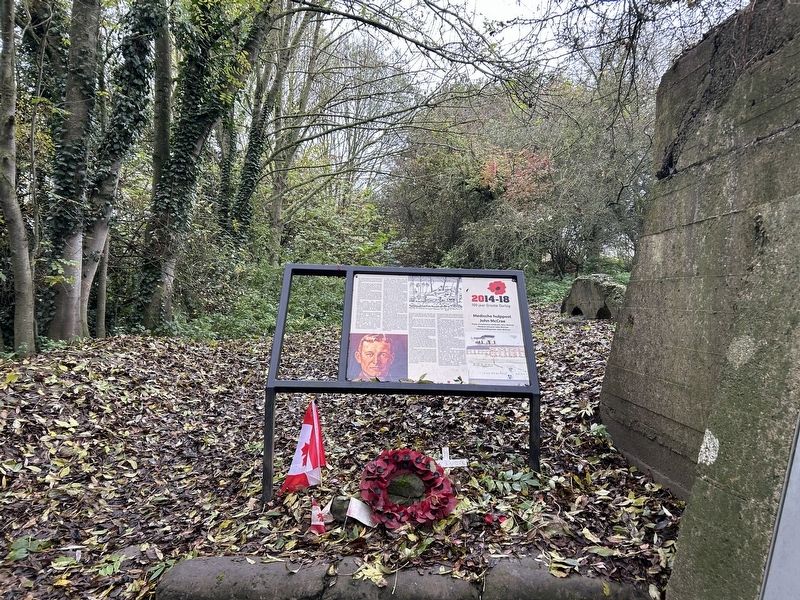
Medische hulppost John McCrae
⎯⎯⎯
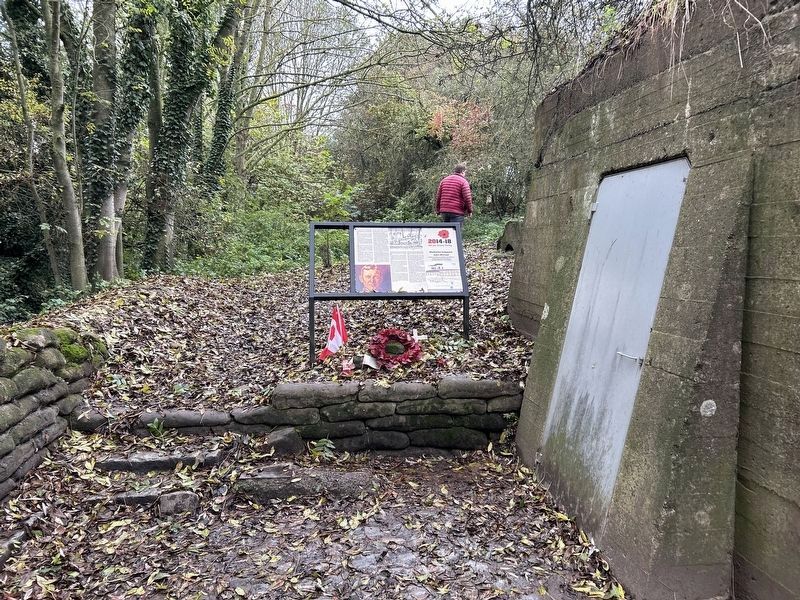
Medical Aid Post John McCrae
2024-18
| — | 100 jaar Groote Oorlog | — |

Photographed by Steve Stoessel, November 12, 2024
1. Medische hulppost John McCrae Marker
[Nederland]
De Canadese majoor, later luitenant-kolonel, John McCrae schreef op 2/3 mei 1915 in deze omgeving zijn beroemde gedicht "In Flanders Fields".
Zijn medische hulppost', zag er toen helemaal anders uit. McCrae beschikte in de hoge berm van de Kanaaldijk over een ruimte van 2.5 bij 2.5 m. Vooraan werd die afgedekt met zandzakken, bovenaan met hout en platen, op de bodem lag er stro.
Dokter John McCrae verzorgde er gedurende 17 dagen de gewonden van de 1ste Canadese Artilleriebrigade die op de Kanaaldijk stond opgesteld, alsook vele gewonden afkomstig van het slagveld nabij Sint-Juliaan, tijdens de zware gevechten na de gasaanval van 22 april 1915.
Vanaf September 1916 bouwden genietropen de betonnen dug-outs in de kanaabermen. In december 1916 en januari 1917 werden deze afgewerkt door de Royal Engineers. Door voortdurende beschietingen van de kanaalbruggen en de Kanaaldijk moesten voortdurend herstellingen worden uitgevoerd.
Als voorbereiding op het grote zomeroffensief van 1917 werden onderaan de Kanaaldijk vooruitgeschoven verbandposten of 'Advanced Dressing Station' uitgebouwd, zoals Duhallows, Talana
this page online
[français]
Le major canadien, devenu plus tard lieutenant-colonel, John McCrae écrivait le 2/3 mai 1915 dans cet environnement son célèbre poème « In Flanders Fields ».
Son poste d'assistance médicale avait alors un tout autre aspect. McCrae disposait dans le haut talus de la digue du canal d'un espace de 2,5 sur 2,5 m. A l'avant, celui-ci était recouvert de sacs de sable, surmontés de bois et de panneaux. De la paille tapissait le sol.
Pendant 17 jours, le docteur John McCrae y soigna les blessés de la 1ère brigade d'artillerie canadienne qui était disposée sur la digue du canal, c'est-à-dire de nombreux blessés provenant du champ de bataille proche de Sint-Julian au cours des durs combats qui suivirent l'attaque aux gaz du 22 avril 1915.
« Advanced Dressing Station Essex Farm »
A partir de septembre 1916, les troupes
Photographed by Steve Stoessel, November 12, 2024
2. Medical Aid Post John McCrae Marker
En préparation à la grande offensive d'été de 1917, des postes de premiers secours avancés furent implantés sous la Digue du canal, comme Duhallows, Talana Farm et Essex Farm. Ceux-ci comprenaient des locaux pour les soins et pour le séjour des infirmiers. A partir de là, les blessés étaient évacués à l'aide d'ambulances motorisées vers les « Main Dressing Stations » (postes de rassemblement principaux), les « Casualty Clearing Stations » (hôpitaux de campagne) et les « Base Hospitals » (hôpitaux) derrière le front
[English]
Somewhere near here on 2/3 May 1915, the Canadian major, later lieutenant colonel, John McCrae wrote his famous poem In Flanders Fields.
At the time, his aid post would have looked very different than it does now. McCrae had at his disposal a shelter dug into the canal bank no bigger than 2.5 by 2.5 metres. The front
Photographed by Steve Stoessel, November 12, 2024
3. Medical Aid Post John McCrae Marker
For 17 days Dr. John McCrae tended the wounded of the 1st Canadian Artillery Brigade, which was firing from positions near the canal bank, as well as the troops of many other units wounded in the heavy fighting around the village of Sint-Julian after the gas attack of 22 April 1915.
Essex Farm Advanced Dressing Station
From September 1916 onwards, the British built a series of concrete dug-outs into the canal bank. In December 1916 and January 1917, these dugouts were completed by the Royal Engineers. As a result of the continuous shelling of the canal bank and its bridges, repairs were necessary all the time.
In preparation for the major offensive in the summer of 1917, a number of advanced dressing stations were established in the canal bank, such as Duhallow, Talana Farm and Essex Farm. These ADS had space for the treatment of the wounded and for the accommodation of the medical staff. From here, the wounded were evacuated by motor ambulance to the main dressing stations, casualty clearing stations and base hospitals behind the
Photographed by Steve Stoessel, November 12, 2024
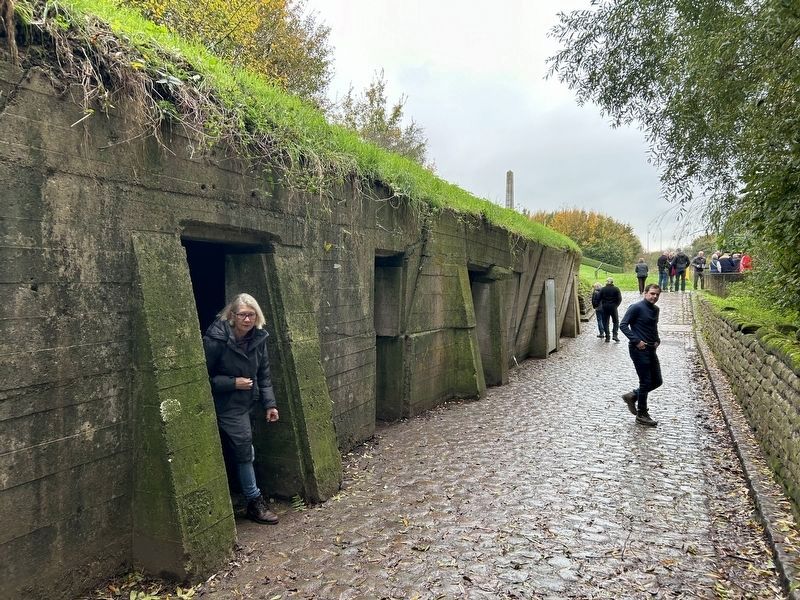
4. Medical Aid Post John McCrae
Looking back from the marker.
{,i>Deutsch]
Der kanadische Major, später Lieutenant-Colonel, John McCrae schrieb am 2./3. Mai 1915 in dieser Umgebung sein berühmtes Gedicht „In Flanders Fields".
Sein Sanitätsdienstposten sah damals völlig anders aus. McCrae verfügte in der hohen Böschung des Kanaldeichs über einen 2,5 mal 2,5 m großen Raum. Nach vorne war dieser mit Sandsäcken abgeschlossen, oben mit Holz und Platten verstärkt, auf dem Boden lag Stroh.
Doktor John McCrae versorgte hier 17 Tage lang die Verwundeten der 1. Kanadischen Artilleriebrigade, die auf dem Kanaldeich in Stellung war, sowie zahlreiche Verwundete vom Schlachtfeld in der Nähe von Sint-Juliaan, während der schweren Gefechte nach dem Gasangriff vom 22. April 1915.
„Advanced Dressing Station Essex Farm"
Ab September 1916 bauten Pioniertruppen die Betonunterstände in die Kanalböschungen. Im Dezember 1916 und Januar 1917 wurden sie von den Royal Engineers fertiggestellt. Aufgrund des fortwährenden Beschusses der Kanalbrücken und des Kanaldeichs mussten ständig Reparaturen durchgeführt werden.
Zur Vorbereitung der großen Sommeroffensive von 1917 wurden unten am Kanaldeich vorgeschobene Verbandsplätze, wie Duhallows, Talana Farm und Essex Farm ausgebaut. Sie umfassten Räume für die Versorgung und für den Aufenthalt der Pfleger. Von hier aus wurden die Verwundeten mit motorisierten Krankenwagen in die „Main Dressing Stations" (Hauptsammelplätze), „Casualty Clearing Stations" (Feldlazarette) und „Base Hospitals" (Lazarette) hinter der Front gebracht.
Topics and series. This historical marker is listed in these topic lists: Arts, Letters, Music • War, World I. In addition, it is included in the In Flanders Fields series list. A significant historical month for this entry is January 1917.
Location. 50° 52.308′ N, 2° 52.377′ E. Marker is in Ieper, Vlaanderen (Flanders), in West-Vlaanderen. It can be reached from the intersection of Diksmuidseweg (National Route 369) and Noorderring. Touch for map. Marker is at or near this postal address: Diksmuidseweg 148, Ieper, Vlaanderen 8900, Belgium. Touch for directions.

Regionally, it is in Europe, the European Union, Atlantic Europe, the Benelux Low Countries, the Schengen Area, Western Europe, and the Western World. Historically, it finds itself in what was once the Roman Empire and specifically also the Holy Roman Empire.
Other nearby markers. At least 8 other markers are within 3 kilometers of this marker, measured as the crow flies: Lieutenant-Colonel John McCrae (within shouting distance of this marker); In Flanders Fields (within shouting distance of this marker); McCrae Site, the Canal Bank 1914-1918 / Site McCrae de Canadijk 1914-1918 (within shouting distance of this marker); Kanaaldijk - Site John McCrae (within shouting distance of this marker); Essex Farm Cemetery (within shouting distance of this marker); 49th (West Riding) Division Memorial / Gedenkteken 49ste (West Riding) Divisie (within shouting distance of this marker); 49th West Riding Division (about 120 meters away, measured in a direct line); St. George’s Memorial Church (approx. 2.3 kilometers away). Touch for a list and map of all markers in Ieper.
Also see . . . John McCrae (Wikipedia). (Submitted on January 28, 2025, by Steve Stoessel of Niskayuna, New York.)
Credits. This page was last revised on December 23, 2025. It was originally submitted on January 27, 2025, by Steve Stoessel of Niskayuna, New York. This page has been viewed 134 times since then and 8 times this year. Photos: 1. submitted on January 27, 2025, by Steve Stoessel of Niskayuna, New York. 2, 3, 4. submitted on January 28, 2025, by Steve Stoessel of Niskayuna, New York.
