Ripa in Roma in Città metropolitana di Roma Capitale, Latium, Rome, Italy — Central Italy (Tyrrhenian Coast)
Chiesa di San Giorgio al Velabro
⎯⎯⎯
Church of Saint George at the Velabrum
Photographed by James Hulse, March 5, 2024
1. Chiesa di San Giorgio al Velabro / Church of Saint George at the Velabrum Marker

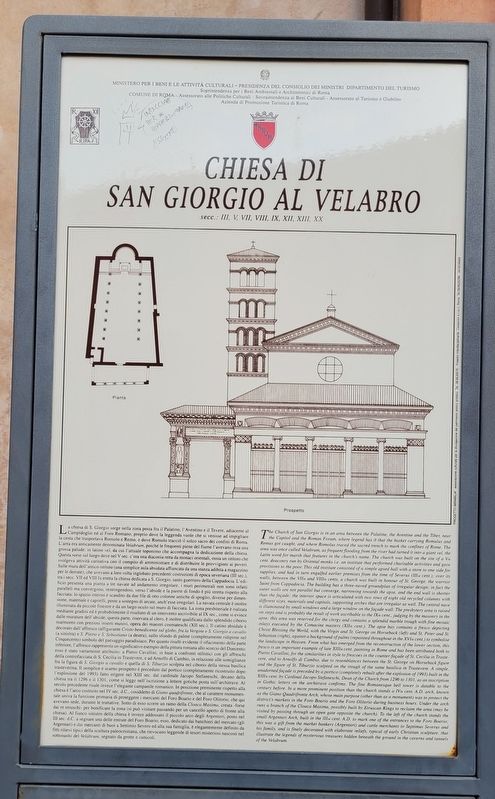
Giorgio sorge nella zona posta fra il Palatino, l'Aventino e il Tevere, adiacente al L Campidoglio ed al Foro Romano, proprio dove la leggenda vuole che si venisse ad impigliare la cesta che trasportava Romolo e Remo, e dove Romolo tracciò il solco sacro dei confini di Roma. L'area era anticamente denominata Velabrum, poiché le frequenti piene del fiume l'avevano resa una grossa palude: in latino vel, da cui l'attuale toponimo che accompagna la dedicazione della chiesa. Questa sorse sul luogo dove nel V sec. c'era una diaconia retta da monaci orientali, ossia un istituto che svolgeva attività caritativa con il compito di amministrare e di distribuire le provvigioni ai poveri. Sulle mura dell'antico istituto (una semplice aula absidata affiancata da una stanza adibita a magazzino per le derrate), che avevano a loro volta inglobato precedenti costruzioni di epoca severiana (III sec.), tra i secc. VII ed VIII fu eretta la chiesa dedicata a S. Giorgio, santo guerriero della Cappadocia. L'edificio presenta una pianta a tre navate ad andamento irregolare, i muri perimetrali non sono infatti paralleli ma convergono, restringendosi, verso l'abside e la parete di fondo è più stretta rispetto alla facciata; lo spazio interno è scandito da due file di otto colonne antiche di spoglio, diverse per dimensione, materiale e capitelli, poste a sostegno di arcate, anch'esse irregolari. La navata centrale è inoltre illuminata da piccole finestre e da un largo oculo sul muro di facciata. La zona presbiteriale è rialzata mediante gradini ed è probabilmente il risultato di un intervento ascrivibile al IX sec., come si evince dalle murature dell'abside; questa parte, riservata al clero, è inoltre qualificata dallo splendido ciborio marmoreo con preziosi inserti musivi,
this page online
Photographed by James Hulse, March 5, 2024
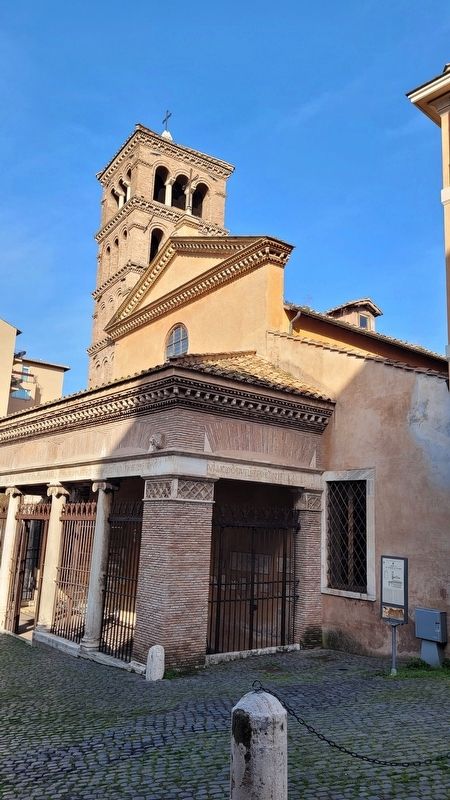
2. The view of the Church of Saint George at the Velabrum and Marker
Didascalie
(Foto #1) Pianta
(Foto #2) Prospetto
The Church of San Giorgio is in an area between the Palatine, the Aventine and the Tiber, near the Capitol and the Roman Forum, where legend has it that the basket carrying Romulus and Remus got caught, and where Romolus traced the sacred trench to mark the confines of Rome. The area was once called Velabrum, as frequent flooding from the river had turned it into a giant vel, the Latin word for marsh that features in the church's name. The church was built on the site of a Vth cent. deaconry run by Oriental monks i.e. an institute that performed charitable activities and gave provisions to the poor. This old institute consisted of a simple apsed hall with a store to one side for supplies, and had in turn engulfed earlier premises from the time of Severus (IIIrd cent.); over its walls,
Photographed by James Hulse, March 5, 2024
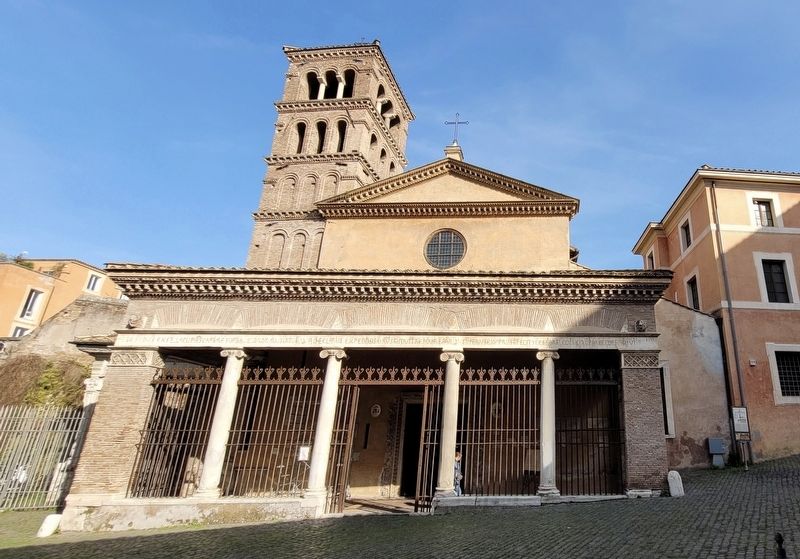
3. The front view of the Church of Saint George at the Velabrum and Marker
Photographed by James Hulse, March 5, 2024
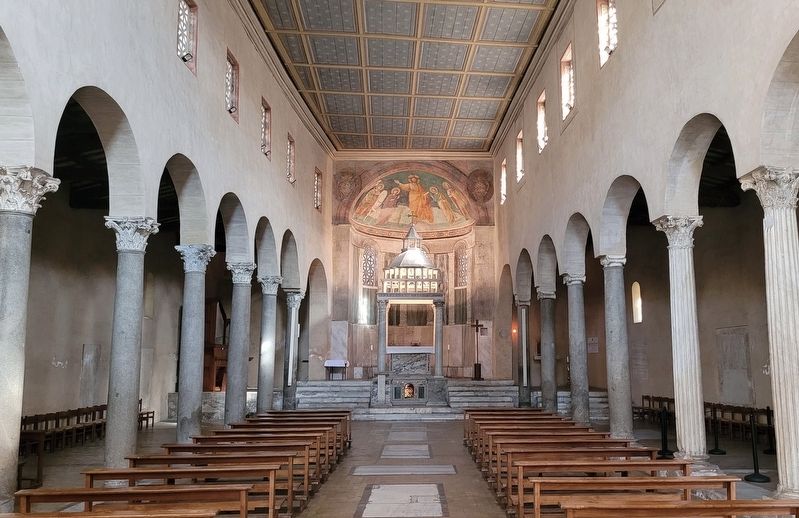
4. The inside view of the Church of Saint George at the Velabrum
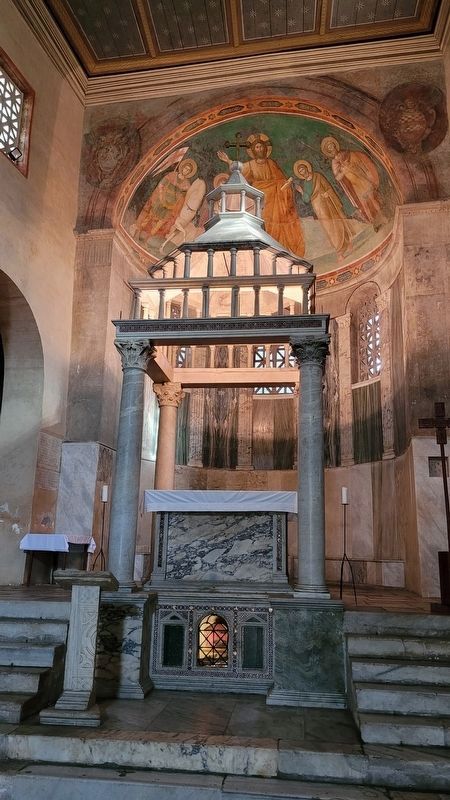
Photographed by James Hulse, March 5, 2024
5. Fresco depicting Christ Blessing the World
Captions
(Photo #1) Floor Plan
(Photo #2) Elevation
Erected by Ministry for Cultural Heritage and Activities Presidency of the Council of Ministers Department of Tourism Superintendency for Environmental and Architectural Heritage of Rome City of Rome Department of Cultural Policies - Superintendency for Cultural Heritage Department of Tourism and Jubilee Tourism Promotion Agency of Rome.
Topics. This historical marker is listed in this topic list: Religion & Religious Structures. A significant historical year for this entry is 1296.
Location. 41° 53.369′ N, 12° 28.998′ E. Marker is in Roma, Lazio (Latium, Rome), in Città metropolitana di Roma Capitale. It is in Ripa. It is on Via del Velabro just west of Via di S. Teodoro, on the right when traveling west. The marker is located at the east side of the church. Touch for map. Marker is at or near this postal address: Via del Velabro 19, Roma, Lazio 00186, Italy. Touch for directions.

Regionally, it is in Europe, the European Union, the Schengen Area, a coastal Mediterranean country, and the Western World. Historically, it finds itself in what was once the Roman Empire.
Other nearby markers. At least 8 other markers are within walking distance of this marker: Bernardino Bolasco (about 90 meters away, measured in a direct line); Terme di età Imperiale / Imperial Period Baths (about 120 meters away); Vacanze Romane / Roman Holiday (about 120 meters away); Chiesa di Sant'Anastasia / Church of St. Anastasia (about 150 meters away); Villaggio di Capanne / Hut Village (about 150 meters away); Tempio della Magna Mater / Temple of Magna Mater (about 150 meters away); Clivus Victoriae e Fontana / Clivus Victoriae and Fountain (about 150 meters away); Tempio di Victoria / Temple of Victoria (about 150 meters away). Touch for a list and map of all markers in Roma.
Credits. This page was last revised on January 31, 2025. It was originally submitted on January 30, 2025, by James Hulse of Medina, Texas. This page has been viewed 156 times since then and 24 times this year. Photos: 1, 2, 3, 4, 5. submitted on January 31, 2025, by James Hulse of Medina, Texas.
