Marker Logo
THE HISTORICAL
MARKER DATABASE
“Bite-Size Bits of Local, National, and Global History”
Rione XI Sant'Angelo in Roma in Città metropolitana di Roma Capitale, Latium, Rome, Italy — Central Italy (Tyrrhenian Coast)
 

Chiesa di Santa Caterina dei Funari
⎯⎯⎯
Church of Saint Catherine of the Ropemakers
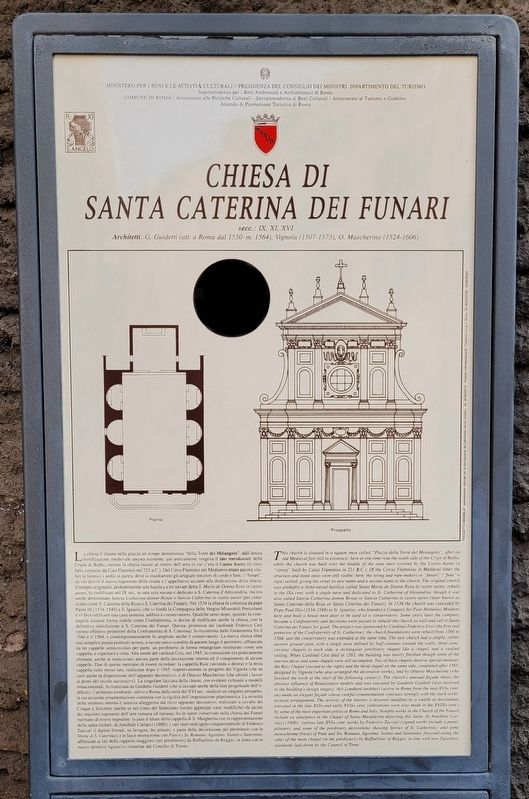
 
 
Chiesa di Santa Caterina dei Funari / Church of Saint Catherine of the Ropemakers Marker image. Click for full size.
Photographed by James Hulse, March 5, 2024
1. Chiesa di Santa Caterina dei Funari / Church of Saint Catherine of the Ropemakers Marker
Inscription.  Italian:
secc.: IX, XI, XVI
Architetti: G. Guidetti (att. a Roma dal 1550-m. 1564), Vignola (1507-1573), O. Mascherino (1524-1606)

La chiesa è situata nella piazza un tempo denominata "della Torre del Melangolo", dall'antica fortificazione medievale ancora esistente; qui anticamente sorgeva il lato meridionale della Cripta di Balbo, mentre la chiesa insiste al centro dell'area in cui c'era il Castro Aureo (il circo fatto costruire da Caio Flaminio nel 221 a.C.). Del Circo Flaminio nel Medioevo erano ancora visibili la forma e i sedili in pietra, dove si insediarono gli artigiani torcitori di corde e funi, i "funari", da cui derivò il nuovo toponimo della strada e l'appellativo accanto alla dedicazione della chiesa. Il tempio originario, probabilmente una basilica a tre navate detta S. Maria de Donna Rosa in castro aureo, fu riedificato nel IX sec. su una sola navata e dedicato a S. Caterina d'Alessandria, ma era anche denominato Sancta Catharina domne Rosae o Sancta Catherina in castro aureo (poi conosciuto come S. Caterina della Rosa o S. Caterina dei Funari). Nel
Paid Advertisement
Click or scan to see
this page online
1534 la chiesa fu concessa da papa Paolo III (1534-1549) a S. Ignazio, che vi fondò la Compagnia delle Vergini Miserabili Pericolanti e vi fece edificare una casa annessa, adibita a conservatorio. Qualche anno dopo, quando la compagnia assunse forma stabile come Confraternita, si decise di riedificare anche la chiesa, con la definitiva intitolazione a S. Caterina dei Funari. Questa, promossa dal cardinale Federico Cesi (primo effettivo protettore della Confraternita di S. Caterina), fu ricostruita dalle fondamenta fra il 1560 e il 1564, e contemporaneamente fu ampliato anche il conservatorio. La nuova chiesa ebbe una semplice pianta piuttosto severa, a navata unica scandita da paraste lungo il perimetro, affiancata da tre cappelle semicircolari per parte, un presbiterio di forma rettangolare strutturato come una cappella, e copertura a volta. Alla morte del cardinal Cesi, nel 1565, la costruzione era praticamente ultimata, anche se mancavano ancora parte della decorazione interna ed il compimento di alcune cappelle. Due di queste meritano di essere ricordate: la cappella Ruiz (seconda a destra) e la terza cappella sullo stesso lato, realizzate dopo il 1565, rispettivamente su progetto del Vignola (che ne curò anche la disposizione dell'apparato decorativo), e di Ottavio Mascherino (che ultimò i lavori ai primi del secolo successivo). La singolare facciata della chiesa, con evidenti
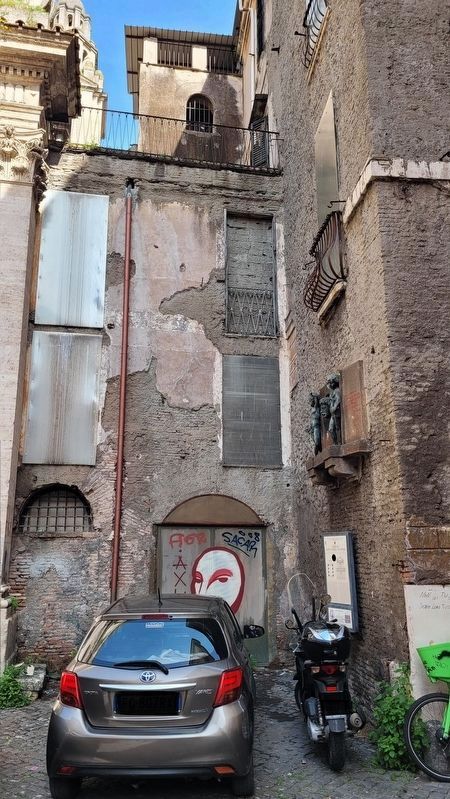
The marker is located on the east side of the church image. Click for full size.
Photographed by James Hulse
2. The marker is located on the east side of the church
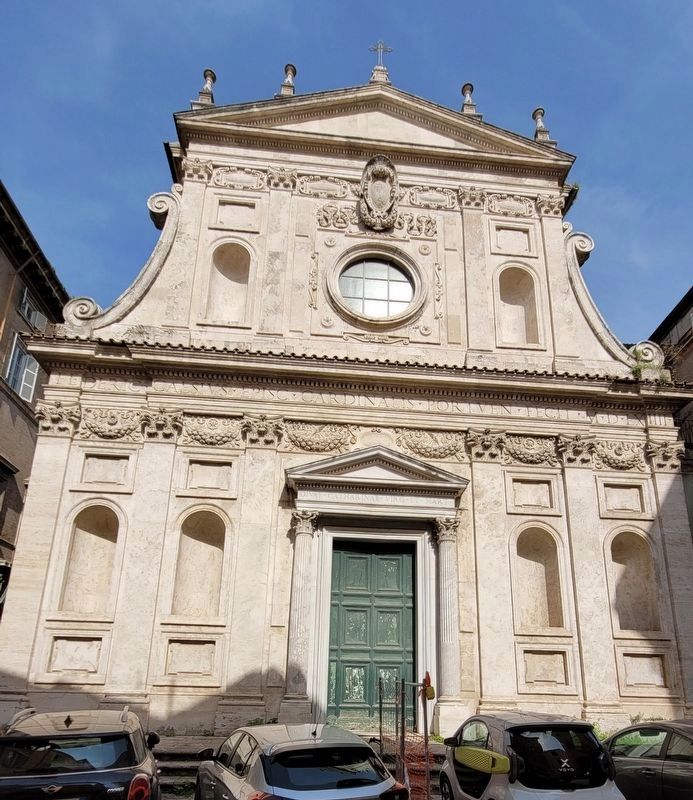
richiami a modelli rinascimentali, fu realizzata da Guidetto Guidetti (che si occupò anche della fase progettuale dell'edificio); l'architetto lombardo -attivo a Roma dalla metà del XVI sec.- realizzò un elegante prospetto, la cui accurata ornamentazione contrasta con la rigidità dell'impostazione planimetrica. La severità della struttura interna è tuttavia alleggerita dal ricco apparato decorativo, realizzato a cavallo del Cinque e Seicento (anche se nel corso del Settecento furono apportate varie modifiche) da alcuni dei massimi esponenti dell'arte romana ed italiana; fra le opere conservate nella chiesa dei Funari meritano di essere segnalate: la pala d'altare della cappella di S. Margherita con la rappresentazione della santa titolare, di Annibale Carracci (1600); i vari interventi tardo-cinquecenteschi di Federico Zuccari (i dipinti firmati, su lavagna, dei pilastri, e parte della decorazione del presbiterio con le Storie di S. Caterina); e le fasce monocrome con Putti e i Ss. Romano, Agostino, Sisinio e Saturnino, affrescate ai lati della cappella maggiore (nel presbiterio) da Raffaellino da Reggio, in linea con le nuove direttive figurative impartite dal Concilio di Trento.

Didascalie
(Foto #1) Pianta
(Foto #2) Prospetto


English:
Centuries: IX, XI, XVI
Architects:
The front view of the Church of Saint Catherine of the Ropemakers image. Click for full size.
Photographed by James Hulse, March 5, 2024
3. The front view of the Church of Saint Catherine of the Ropemakers
G. Guidetti (active in Rome from 1550 - died 1564), Vignola (1507-1573), O. Mascherino (1524-1606)

This church is situated in a square once called "Piazza della Torre del Melangolo", after an old Medieval fort still in existence; here at one time rose the south side of the Crypt of Balbo, while the church was built over the middle of the area once covered by the Castro Aureo (a "circus" built by Caius Flaminius in 221 B.C.). Of the Circus Flaminius in Medieval times the structure and stone seats were still visible; here, the string and rope-makers or "funari" ("fune"= rope) settled, giving the street its new name and a second name to the church. The original church was probably a three-naved basilica called Santa Maria de Donna Rosa in castro aureo, rebuilt in the IXth cent. with a single nave and dedicated to St. Catherine of Alexandria, though it was also called Sancta Catharina domne Rosae or Sancta Catherina in castro aureo (later known as Santa Caterina della Rosa or Santa Caterina dei Funari). In 1534 the church was conceded by Pope Paul IIIrd (1534-1549) to St. Ignatius, who founded a Company for Poor Homeless Maidens here and built a house next door to be used as a conservatory. Some years later the company became a Confraternity and decisions were passed to rebuild the church as well and call it Santa Caterina dei Funari for good. The project was sponsored
Paid Advertisement
by Cardinal Federico Cesi (the first real protector of the Confraternity of St. Catherine): the church foundations were rebuilt from 1560 to 1564, and the conservatory was extended at the same time. The new church had a simple, rather austere ground plan, with a single nave defined by half-columns around the walls, three semicircular chapels to each side, a rectangular presbytery shaped like a chapel, and a vaulted ceiling. When Cardinal Cesi died in 1565, the building was nearly finished though some of the interior décor and some chapels were still incomplete. Two of these chapels deserve special mention: the Ruiz Chapel (second to the right) and the third chapel on the same side, completed after 1565, designed by Vignola (who also arranged the decorative works), and by Ottavio Mascherino (who finished the work at the start of the following century). The church's unusual façade shows the obvious influence of Renaissance models and was executed by Guidetto Guidetti (also involved in the building's design stages); this Lombard architect (active in Rome from the mid-XVIth cent. on) made an elegant façade whose careful ornamentation contrasts strongly with the stark architectural arrangement. The severity of the interior is however modified by a wealth of decorations executed in the late XVIth and early XVIIth cent. (alterations were also made in the XVIIIth cent.) by some of the most important artists in Rome and Italy. Notable works in the Church of the Funari include an altarpiece in the Chapel of Santa Margherita depicting this Saint, by Annibale Carracci (1600); various late XVIth cent. works by Federico Zuccari (signed works include a panel, pilasters, and some of the presbytery decorations showing Stories of St. Catherine); and some monochrome friezes of Putti and Sts. Romano, Agostino, Sisinio and Saturnino, frescoed along the sides of the main chapel (in the presbytery) by Raffaellino of Reggio, in line with new figurative standards laid down by the Council of Trent.

Captions
(Photo #1) Floor Plan
(Photo #2) Elevation

 
Erected by Ministry for Cultural Heritage and Activities Presidency of the Council of Ministers Department of Tourism Municipality of Rome Superintendence for Environmental and Architectural Heritage of Rome Department of Cultural Policies - Superintendence for Cultural Heritage Department of Tourism and Jubilee Tourism Promotion Agency of Rome.
 
Topics. This historical marker is listed in this topic list: Religion & Religious Structures. A significant historical year for this entry is 1534.
 
Location. 41° 53.632′ N, 12° 28.722′ E. Marker is in Roma, Lazio (Latium, Rome), in Città metropolitana di Roma Capitale. It is in Rione XI Sant'Angelo. It is on Via dei Funari just east of Via dei Funari. The marker is located on the east side of the church entrance. Touch for map. Marker is at or near this postal address: Via dei Funari 15, Roma, Lazio 00186, Italy. Touch for directions.

Regionally, it is in Europe, the European Union, the Schengen Area, a coastal Mediterranean country, and the Western World. Historically, it finds itself in what was once the Byzantine Empire and specifically also the Roman Empire.

Other nearby markers. At least 8 other markers are within walking distance of this marker: Giggi Zanazzo (here, next to this marker); Michelangelo Caetani (a few steps from this marker); Settimio Calò (about 150 meters away, measured in a direct line); Il Portico di Ottavia / The Porticus of Octavia (about 150 meters away); Area archeologica del teatro di Marcello (about 150 meters away); Feroce Morte / Ferocious Death (about 180 meters away); In ricordo dei neonati / In Memory of the Infants (about 180 meters away); Tempio di Apollo Sesiano Tempio di Bellona / Temple of Apollo Sesiano Temple of Bellona (about 180 meters away). Touch for a list and map of all markers in Roma.
 
Also see . . .  Santa Caterina dei Funari. Wikipedia
Santa Caterina dei Funari is a church in Rome in Italy, in the rione of Sant'Angelo. The church is mainly known for its façade and its interior with frescoes and paintings.
(Submitted on February 1, 2025, by James Hulse of Medina, Texas.) 
 
 
Credits. This page was last revised on February 1, 2025. It was originally submitted on January 30, 2025, by James Hulse of Medina, Texas. This page has been viewed 189 times since then and 28 times this year. Photos:   1, 2, 3. submitted on February 1, 2025, by James Hulse of Medina, Texas.

m=265589

CeraNet Cloud Computing sponsors the Historical Marker Database.
This website earns income from purchases you make after using our links to Amazon.com. We appreciate your support.
Paid Advertisement
Jun. 8, 2026