Sant'Eustachio in Roma in Città metropolitana di Roma Capitale, Latium, Rome, Italy — Central Italy (Tyrrhenian Coast)
Chiesa di Sant'Andrea della Valle ⎯⎯⎯ Church of Saint Andrew of the Valley
Photographed by James Hulse, March 5, 2024
1. Chiesa di Sant'Andrea della Valle / Church of Saint Andrew of the Valley Marker
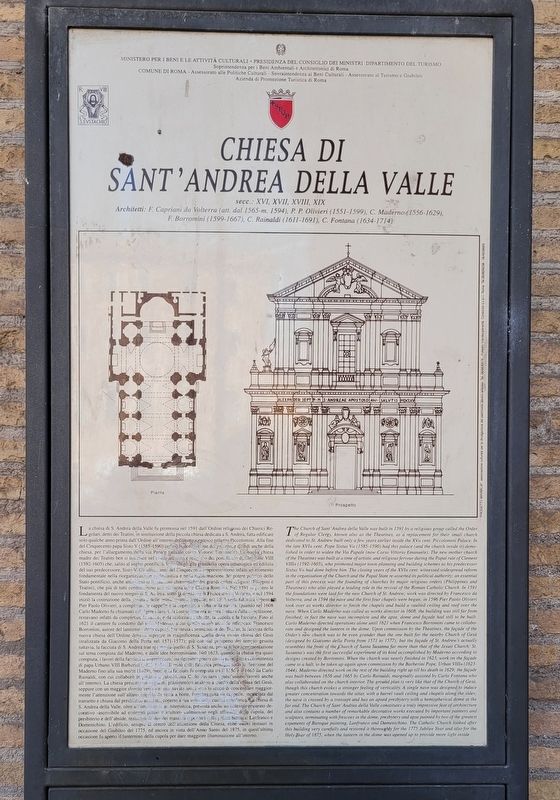
Inscription. Italian:
secc.: XVI, XVII, XVIII, XIX Architetti: F. Capriani da Volterra (att. dal 1565-m. 1594), P. P. Olivieri (1551-1599), C. Maderno (1556-1629), F. Borromini (1599-1667), C. Rainaldi (1611-1691), C. Fontana (1634-1714)
La chiesa di S. Andrea della Valle fu promossa nel 1591 dall'Ordine religioso dei Chierici Regolari, detto dei Teatini, in sostituzione della piccola chiesa dedicata a S. Andrea, fatta edificare solo qualche anno prima dall'Ordine all'interno del quattrocentesco palazzo Piccolomini. Alla fine del Cinquecento papa Sisto V (1585-1590) ordinò la demolizione del palazzo, e quindi anche della chiesa, per l'allargamento della via Papale (attuale corso Vittorio Emanuele). La nuova chiesa madre dei Teatini ben si inserisce nel clinta artistico e religioso del pontificato di Clemente VIII (1592-1605) che, salito al soglio pontificio, si ricollegò alla grandiesa opera urbanistica ed edilizia del suo predecessore, Sisto V. Gli ultimi anni del Cinquecento rappresentarono infatti un momento fondamentale nella riorganizzazione ecclesiastica e nella riaffermazione del potere politico dello Stato pontificio,
Click or scan to see this page online
anche attraverso le fondazioni chiesastiche
dei grandi ordini religiosi (Filippini e Teatini), che più di tutti contribuirono alla rinascita della Chiesa Romana. Nel 1591 si posero le fondamenta del nuovo tempio di S. Andrea, sotto la direzione di Francesco da Volterra, e nel 1594 iniziò la costruzione della navata e delle prime quattro cappelle; nel 1596 nella fabbrica subentrò Pier Paolo Olivieri, a completare le cappelle e la copertura a volta della navata. Quando nel 1608 Carlo Maderno fu chiamato a dirigere i lavori, la costruzione era ancora lontana dalla conclusione, restavano infatti da completare la navata e da realizzare l abside, la cupola e la facciata. Fino al 1621 il cantiere fu condotto dal solo Madernio, a cui quello stesso anno fu affiancato Francesco Borromini, autore del lanternino della cupola. Per stessa commissione del Teatini, la facciata della nuova chiesa dell'Ordine doveva superare in magnificenza quella della vicina chiesa del Gesù (realizzata da Giacomo della Porta nel 1571-1577); più che dal prospetto del tempio gesuita tuttavia, la facciata di S. Andrea trae spunto da quello di S. Susanna, prima relice
Photographed by James Hulse, March 5, 2024
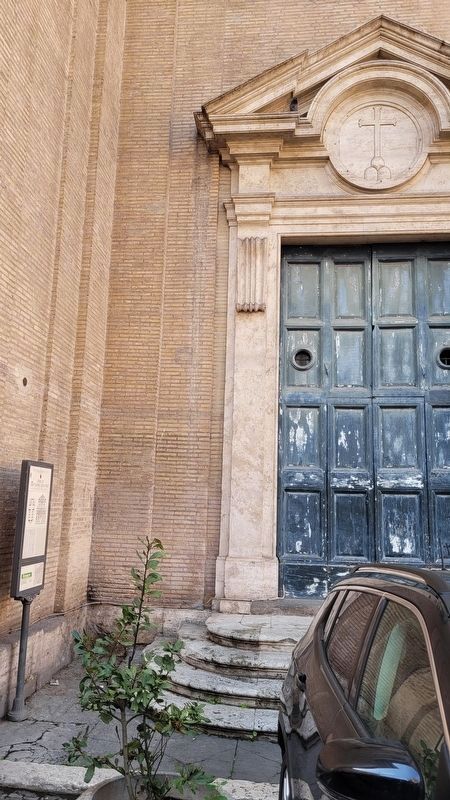
2. The marker is located by a side door of the church
sperimentazione sul tema compiuta dal Maderno, e dalle idee borrominiane. Nel 1623, quando la chiesa era quasi compiuta, i lavori della facciata si interruppero, ma ripresero presto con la prestigiosa committenza di papa Urbano VIII Barberini (1623-1644). Il resto della fabbrica prosegul sotto la direzione del Maderno fino alla sua morte (1629), mentre la facciata fu compruta tra il 1656 e il 1665 da Carlo Rainaldi, con cui collaborò in posizione subordinata Carlo Fontana (quest'ultimo lavoro anche all'interno). La chiesa presenta un impianto planimetrico analogo a quello della chiesa del Gesù, seppure con un maggior slancio verticale: una navata unica -con lo scopo di concentrare maggiormente l'attenzione sull'altare- coperta da volta a botte, fiancheggiata a cappelle, incrociata dal transetto e chiusa dal presbiterio absidato, coperto a sua volta dalla cupola emisferica. La chiesa di S. Andrea della Valle, oltre all'imponenza architettonica, presenta anche un notevole apparato decorativo -ascrivibile ad eminenti pittori e scultori- culminante negli affreschi della cupola, del presbiterio e dell'abside, realizzati da due dei massimi
Photographed by James Hulse, March 5, 2024
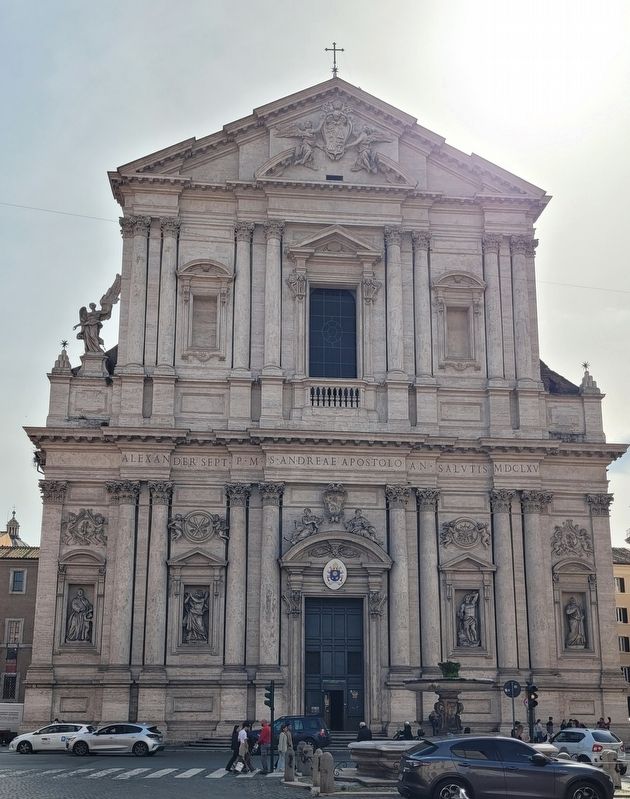
3. The front entrance to the Church of Saint Andrew of the Valley
esponenti della pittura barosca: Lanfranco e Domenichino. L'edificio, sempre al centro dell'attenzione della Chiesa, ebbe nuovi restauri in occasione del Giubileo del 1775, ed ancora in vista dell'Anno Santo del 1875, in quest'ultima occasione fu aperto il lanternino della cupola per dare maggiore illuminazione all'interno.
Didascalie (Foto #1) Pianta (Foto #2) Prospetto
English:
Centuries: XVI, XVII, XVIII, XIX Architects: F. Capriani da Volterra (active from 1565 – died 1594), P. P. Olivieri (1551–1599), C. Maderno (1556–1629), F. Borromini (1599–1667), C. Rainaldi (1611–1691), C. Fontana (1634–1714)
The Church of Sant' Andrea della Valle was built in 1591 by a religious group called the Order of Regular Clergy, known also as the Theatines, as a replacement for their small church dedicated to St. Andrew built only a few years earlier inside the XVth cent. Piccolomini Palace. In the late XVIth cent. Pope Sixtus Vth (1585-1590) had this palace (and the church inside it) demolished in order to widen the Via Papale (now Corso Vittorio Emanuele). The new mother church of the Theatines was built at a time of artistic and
Photographed by James Hulse, March 5, 2024
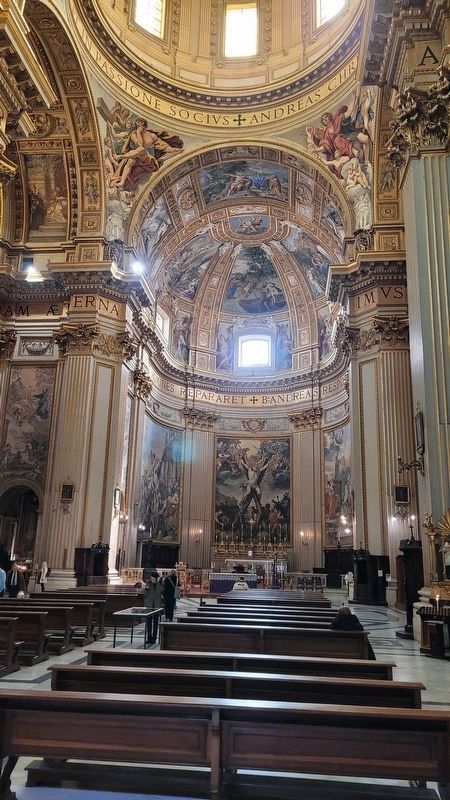
4. The interior of the Church
religious fervour during the Papal rule of Clement VIIIth (1592-1605), who promoted major town-planning and building schemes as his predecessor Sixtus Vth had done before him. The closing years of the XVIth cent. witnessed widespread reform in the organisation of the Church and the Papal State re-asserted its political authority; an essential part of this process was the founding of churches by major religious orders (Philippines and Theatines) who also played a leading role in the revival of the Roman Catholic Church. In 1591 the foundations were laid for the new Church of St. Andrew; work was directed by Francesco da Volterra, and in 1594 the nave and the first four chapels were begun; in 1596 Pier Paolo Olivieri took over as works director to finish the chapels and build a vaulted ceiling and roof over the nave. When Carlo Maderno was called as works director in 1608, the building was still far from finished; in fact the nave was incomplete and the apse, dome and façade had still to be built. Carlo Maderno directed operations alone until 1621 when Francesco Borromini came to collaborate and designed the lantern in the dome. Upon
Photographed by James Hulse, March 5, 2024
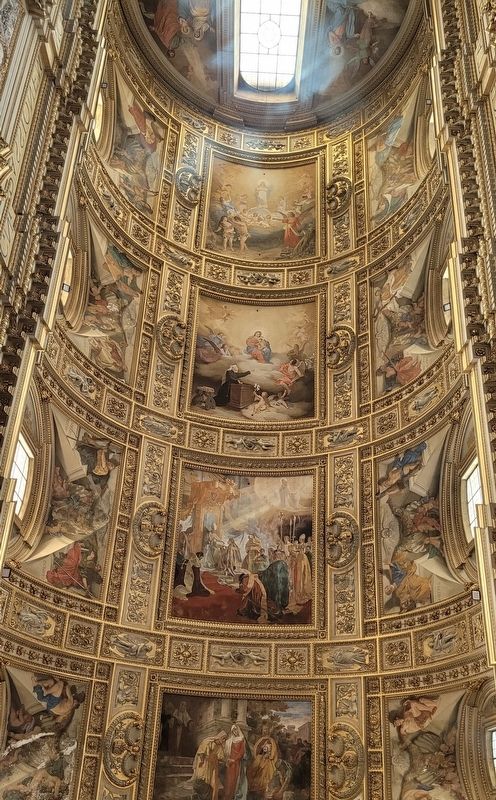
5. Vault over the nave
commission by the Theatines, the façade of the Order's new church was to be even grander than the one built for the nearby Church of Gesù (designed by Giacomo della Porta from 1571 to 1577); but the façade of St. Andrew's actually resembles the front of the Church of Santa Susanna far more than that of the Jesuit Church: St. Susanna's was the first successful experiment of its kind accomplished by Maderno according to designs created by Borromini. When the church was nearly finished in 1623, work on the façade came to a halt, to be taken up again upon commission by the Barberini Pope, Urban VIIIth (1623-1644). Maderno directed work on the rest of the building right up till his death in 1629; the façade was built between 1656 and 1665 by Carlo Rainaldi, marginally assisted by Carlo Fontana who also collaborated on the church interior. The ground plan is very like that of the Church of Gesù, though this church evokes a stronger feeling of verticality. A single nave was designed to induce greater concentration towards the altar, with a barrel vault ceiling and chapels along the sides; the nave is crossed by a transept and has an apsed
Photographed by James Hulse, March 5, 2024
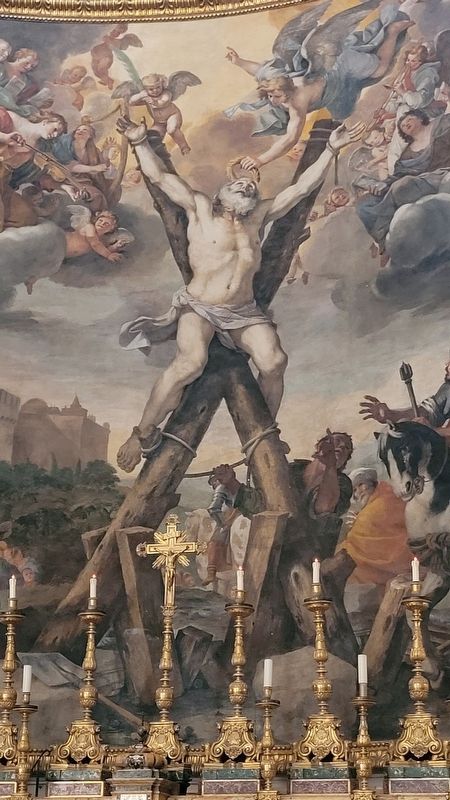
6. Artwork behind the alter
presbytery with a hemispherical dome at the far end. The Church of Sant' Andrea della Valle constitutes a truly impressive feat of architecture and also contains a number of remarkable decorative works executed by important painters and sculptors, terminating with frescoes in the dome, presbytery and apse painted by two of the greatest exponents of Baroque painting, Lanfranco and Domenichino. The Catholic Church looked after this building very carefully and restored it thoroughly for the 1775 Jubilee Year and also for the Holy Year of 1875, when the lantern in the dome was opened up to provide more light inside.
Captions (Photo #1) Floor Plan (Photo #2) Elevation
Erected by Ministero Per I Beni E Le Attività Culturali * Presidenza Del Consiglio Dei Ministri Dipartimento Del Turismo Soprintendenza Per I Beni Ambientali E Architettonici Di Roma Comune Di Roma - Assessorato Alle Politiche Culturali Sovraintendenza Ai Beni Culturali - Assessorato Al Turismo E Giubileo Azienda Di Promozione Turistica Di Roma.
Topics. This historical marker is listed in this topic list: Religion & Religious Structures. A significant historical year for this entry is 1591.
Location. 41° 53.765′ N, 12° 28.473′ E. Marker is in Roma, Lazio (Latium, Rome), in Città metropolitana di Roma Capitale. It is in Sant'Eustachio. It is at the intersection of Piazza Vidoni and Corso Vittorio Emanuele II, on the right when traveling south on Piazza Vidoni. The marker is located at the east entrance of the church. Touch for map. Marker is at or near this postal address: Piazza Vidoni 4, Roma, Lazio 00186, Italy. Touch for directions.
Regionally, it is in Europe, the European Union, the Schengen Area, a coastal Mediterranean country, and the Western World. Historically, it finds itself in what was once the Roman Empire.
Another marker is no longer nearby. Hotel Tiziano (was about 90 meters away but has been replaced with another marker now near it).
Also see . . . Sant'Andrea della Valle. Wikipedia (Submitted on February 1, 2025, by James Hulse of Medina, Texas.)
Credits. This page was last revised on February 2, 2025. It was originally submitted on January 31, 2025, by James Hulse of Medina, Texas. This page has been viewed 166 times since then and 14 times this year. Photos:1, 2, 3, 4, 5, 6. submitted on February 2, 2025, by James Hulse of Medina, Texas.