Sant'Eustachio in Roma in Città metropolitana di Roma Capitale, Latium, Rome, Italy — Central Italy (Tyrrhenian Coast)
Galleria Spada
⎯⎯⎯
Spada Gallery

Photographed by James Hulse, March 5, 2024
1. Galleria Spada / Spada Gallery Marker

Se De si desidera conoscere le consuetudini e i gusti della nobiltà della Roma rinascimentale, non si può tralasciare la visita alla dimora del cardinale Girolamo Capodiferro (1502-59) poi divenuta proprietà del cardinale Bernardino Spada, ai primi del Seicento (1632). All'interno del prezioso scrigno architettonico del palazzo sito nell'omonima piazza dietro la Piazza Farnese, si conserva, infatti, una delle più interessanti collezioni della città papale, specchio dello spirito erudito e dell'amore per l'arte dei diversi rappresentanti della famiglia Spada. Rimasta pressoché inalterata nei secoli e circoscritta alle quattro sale del piano nobile, coincidenti con l'ala sinistra verso il vicolo dell'Arco, conserva ancora oggi le caratteristiche di un'antica quadreria romana dei secc. XVII-XVIII, arricchita dai lasciti e dalle donazioni da parte di Bernardino, Virginio e Fabrizio Spada e della famiglia Veralli, tutti ritratti da illustri pittori, come Guido Reni (card. Bernardino, 1630-31), Domenichino (attr. Paolo Spada), G. D. Cerrini (attr. Orazio Spada, 1653), Sebastiano
this page online
Al cardinale Girolamo Capodiferro va riferita la decorazione pittorica e a stucco rinascimentale delle sale, oggi sede del Consiglio di Stato, con favole ispirate alle tematiche neoplatoniche dell'Amore e dell'Anima attraverso il Bello (Stanza di Amore e Psiche, di Callisto, di Perseo, di Achille, di Enea, dei Fasti romulei, di Alessandro Magno, Galleria degli Stucchi, sala delle Quattro Stagioni), attribuite a G. Mazzoni e scuola. Al cardinale Bernardino Spada (1549-1661), che acquista il palazzo nel 1632, prolungandolo sui due lati (lato sinistro, lungo vicolo dell'Arco, 1636-37; lato destro, lungo vicolo del Polverone, 1658-60), risale il nucleo originario della collezione, già conservata nella sala che da lui prende nome di "Galleria del cardinale" (oggi Sala III) (1636-37) con capolavori di G. Reni (Ritratto del cardinale Bernardino, S. Girolamo), della sua scuola (replica del Ratto di Elena dell'allievo Giacinto Campana, copia della Giuditta e Oloferne e della Lucrezia) e di Guercino (Ritratto del cardinale Bernardino,
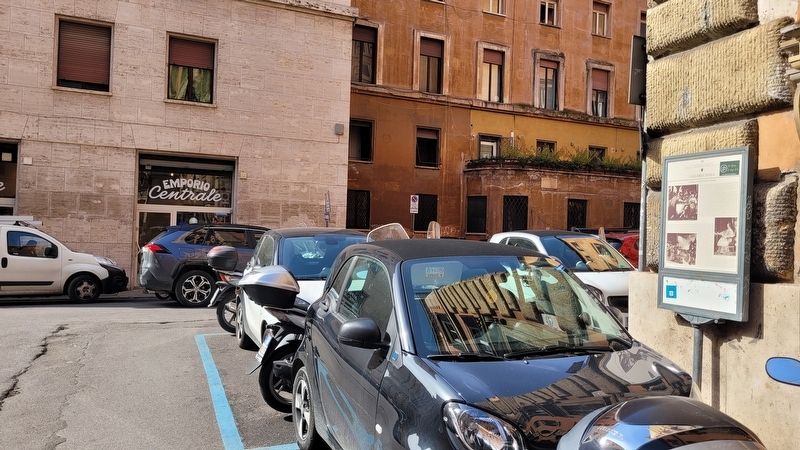
Photographed by James Hulse, March 5, 2024
2. The view of the marker along the street
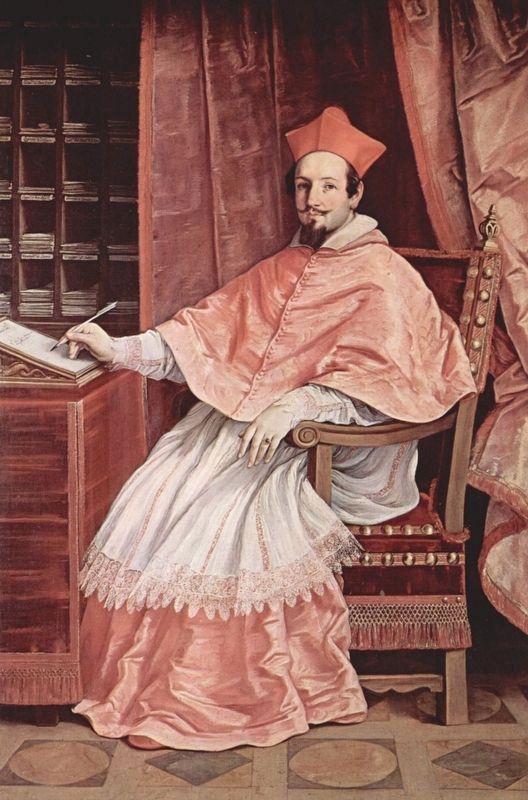
Public Domain - Galleria Spada - Wikipedia Commons, 1631
3. Portrait of Cardinal Bernardino Spada by G. Reni
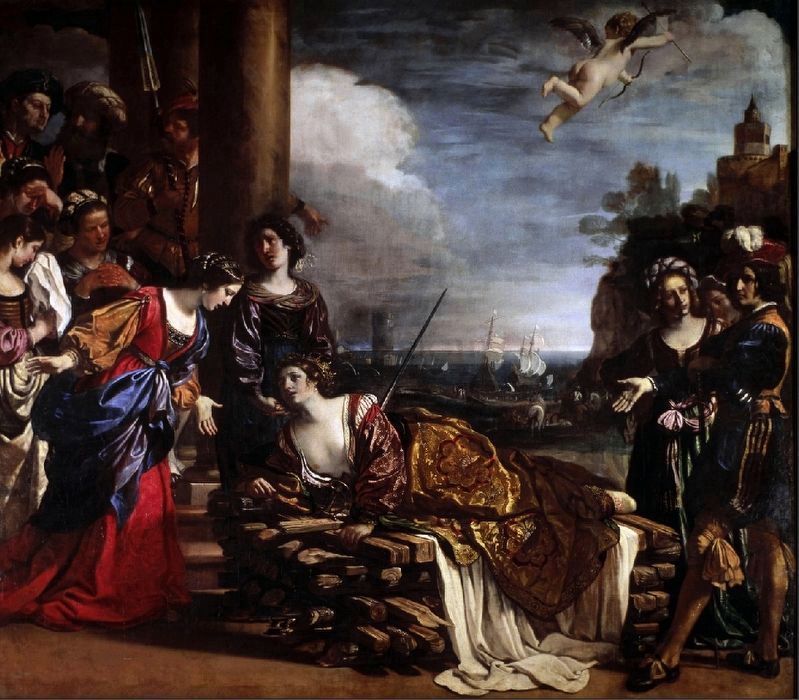
Public Domain - Galleria Spada - Giovanni Francesco Barbieri, circa 1631
4. The Death of Dido by G.F. Barbieri (1591-1666), known as Guercino
Didascalie
(Foto #1) F. Trevisani (1656-1746), Il festino di Marcantonio e Cleopatra, 1702, olio su tela
(Foto #2) G. F. Barbieri (1591-1666) detto il Guercino, La morte di Didone, 1629-30, olio su tela
(Foto #3) G. Reni (1575-1642), Ritratto del Cardinale Barnardino Spada, 1631, olio su tela
If one wishes to learn about the habits and tastes of the Roman nobility during the Renaissance, one cannot forgo a visit to the residence of Cardinal Girolamo Capodiferro (1502-59), which, already in the Seventeenth-century, in 1632, became the property of Cardinal Bernardino Spada. Indeed, this precious architectural jewel of a palace, placed in the homonymous square behind Piazza Farnese. houses one of the finest collections in the papal city, mirroring the erudition and passion for art of various members of the Spada family. The Gallery, which has remained mostly unaltered throughout the centuries, is confined to four rooms on the first floor, corresponding to the left wing facing the vicolo dell'Arco. It still presents the typical features of an old Roman picture gallery from the Seventeenth-and Eighteenth-centuries. The Gallery was enriched by bequests and donations from Bernardino, Virginio and Fabrizio Spada and the Veralli family, all of whom are portrayed in Hall I (also known as the Hall of the Popes), in paintings by famous artists, including Guido Reni (Cardinal Bernardino, 1630-31), Domenichino (attributed, Paolo Spada), G.D. Cerrini (attributed. Orazio Spada, 1653), Monsu Bernardo (Marchioness Veralli, 1663-65) and Sebastiano Ceccarini (Cardinal Fabrizio, 1754). Cardinal Girolamo Capodiferro was responsible for the Renaissance painted and stucco decoration of the rooms now housing the Council of State. The depicted fables, attributed to Giulio Mazzoni and his assistants, echo the Neoplatonic themes of the triumph of Love and Spirit through Beauty (Room of Love and Psyche, Room of Callisto, Room of Perseus, Room of Achilles, Room of Aeneas, Room of Romulus' grandeur, Room of Alexander the Great, the Stucco Gallery, and Room of the Four Seasons). Cardinal Bernardino Spada (1549-1661) acquired the palace in 1632, and extended it on two sides: to the left, along the vicolo dell'Arco (1636-37), and to the right, along the vicolo del Polverone (1658-60). It was he who assembled the original nucleus of works between 1636 and 1637, and displayed them in the room bearing his name, the so-called Gallery of the Cardinal (now Hall III). The room houses a number of masterpieces by G. Reni (Portrait of Cardinal Bernardino, St. Jerome) and by his school (including a copy of the Rape of Helen by Reni's pupil, Giacinto Campana, and a copy of Reni's Judith and Holophernes and Lucretia), as well as works by Guercino (Half-length portrait of Cardinal Bernardino, Death of Dido), a series of paintings of different genres, a number of ancient sculptures as well as modern sculptures from the Sixteenth and Seventeenth centuries, elaborate wooden furniture, and precious decorative objects, including two globes (one of the heavens, 1616, and one of the earth, 1622), by the Dutch artist W. Blaeu. Bernardino's great-nephew, Cardinal Fabrizio (1643-1717), commissioned four mythological paintings in the classical manner from Giuseppe Chiari (executed between 1695 and 1699), several Landscapes from G. Dughet, some Views from H. Van Lindt, Battles from Salvator Rosa and Borgognone, a series of Still Lives from O. Loth and Spadino, as well as the grand Feast of Mark Antony and Cleopatra from F. Trevisani (1702). Hall II, designed by G.L. Bernini between 1636 and 1637 and intended as a "Small Study," houses Perin del Vaga's (1542) precious painted frieze for the Sistine Chapel in the Vatican, and a tempera painting on canvas, placed high on the wall facing the window, as well as an interesting gallery of portraits from the Sixteenth-century, mostly by Emilian artists. Among them one finds The Notary and The Botanist by Bartolomeo Passerotti (Bologna, 1528-93), Prospero Fontana's King David and The Astronomer, together with The Violinist, attributed to Titian. The Astronomers (1645) by Nicolò Tornioli (painter of Siena), purchased by Virgilio Spada (1596-1662) in 1645, attests to Virginio's oratorian culture and to his support of the heliocentric theory of Galileo, whose portrait with a telescope also hangs nearby (1610). In 1698-99, Fabrizio Spada wrought changes to the Cardinal's Gallery, ordering the painter Michelangelo Ricciolini (1654-1715) to decorate the ceiling with allegories of the Four Continents, the Four Seasons, and the Four Elements. Hall IV, which was transformed from a terrace into a "Large Study," contains a number of paintings by Italian and foreign Caravaggisti (including Orazio and Artemisia Gentileschi, N. Tournier, and L. Baugin), as well as lively genre scenes by P. van Laer, Bamboccio, and M. Cerquozzi. Purchased by the State in 1926, together with the palace that became the seat of the Council of State, the Spada Collection opened to the public the following year (1927). As a consequence of a Second World War, the Collection suffered some dispersals and was closed. However, in 1951, thanks to the enlightened zeal of its then Director, Prof. Federico Zeri, several masterpieces were restored to the Collection, and a new display of the picture gallery was set in place. This arrangement can be admired to this day on the first floor of the building, corresponding to the left wing of the original noble storey.
Captions
(Photo #1) F. Trevisani (1656-1746), The Feast of Mark Antony and Cleopatra, 1702, oil on canvas
(Photo #2) G. F. Barbieri (1591-1666), known as Guercino, The Death of Dido, 1629-30, oil on canvas
(Photo #3) G. Reni (1575-1642), Portrait of Cardinal Bernardino Spada, 1631, oil on canvas
Erected by Ministry for Cultural Heritage and Activities Special Superintendency for the Roman Museum Complex Mirabilia Project - Communication Plan for National Cultural Heritage.
Topics. This historical marker is listed in this topic list: Arts, Letters, Music. A significant historical year for this entry is 1632.
Location. 41° 53.822′ N, 12° 28.483′ E. Marker is in Roma, Lazio (Latium, Rome), in Città metropolitana di Roma Capitale. It is in Sant'Eustachio. It is on Largo del Teatro Valle just north of Piazza di S. Andrea della Valle. The marker is located along the corner of the building. Touch for map. Marker is at or near this postal address: Largo del Teatro Valle 5, Roma, Lazio 00186, Italy. Touch for directions.

Regionally, it is in Europe, the European Union, the Schengen Area, a coastal Mediterranean country, and the Western World. Historically, it finds itself in what was once the Roman Empire.
Other nearby markers. At least 8 other markers are within walking distance of this marker: Adelaide Ristori and Aldo Palazzeschi (within shouting distance of this marker); Adelaide Ristori Capranica del Grillo and Aldo Palazzeschi (within shouting distance of this marker); Giuseppe Gioachino Belli (within shouting distance of this marker); Piazza Massimo Alle Colonne (about 90 meters away, measured in a direct line); Chiesa di Sant'Andrea della Valle / Church of Saint Andrew of the Valley (about 90 meters away); Hotel L'Orologio (about 120 meters away); Libreria Croce (about 120 meters away); Chiesa di Sant'Ivo Alla Sapienza / The Church of Sant'Ivo alla Sapienza (about 150 meters away). Touch for a list and map of all markers in Roma.
Another marker is no longer nearby. Hotel Tiziano (was about 120 meters away but has been replaced with another marker now near it).
Also see . . . Galleria Spada. Wikipedia
The Galleria Spada is a museum in Rome, which is housed in the Palazzo Spada on Piazza Capo di Ferro. The palazzo is also famous for its façade and for the forced perspective gallery by Francesco Borromini. The gallery exhibits paintings from the 16th and 17th centuries. A state museum, it is managed by the Polo Museale del Lazio.(Submitted on February 2, 2025, by James Hulse of Medina, Texas.)
Credits. This page was last revised on February 2, 2025. It was originally submitted on January 31, 2025, by James Hulse of Medina, Texas. This page has been viewed 120 times since then and 18 times this year. Photos: 1, 2, 3, 4. submitted on February 2, 2025, by James Hulse of Medina, Texas.
