DuBois in Clearfield County, Pennsylvania — The American Northeast (Mid-Atlantic)
A Trio of Founders for DuBois 1812-1871
Photographed by William Fischer, Jr., January 25, 2025
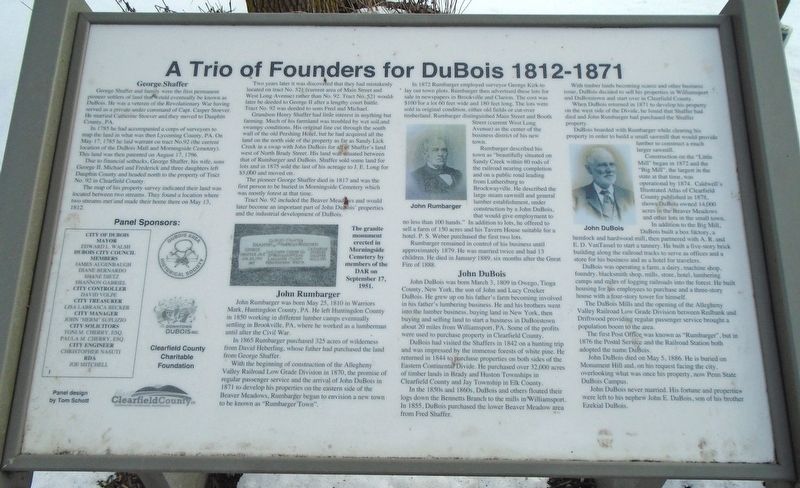
1. A Trio of Founders for DuBois 1812-1871 Marker
In 1785 he had accompanied a corps of surveyors to map the land in what was then Lycoming County, PA. On May 17, 1785 he laid warrant on tract No.92 (the current location of the DuBois Mall and Morningside Cemetery). This land was then patented on August 17, 1796.
Due to financial setbacks, George Shaffer, his wife, sons George II, Michael and Frederick and three daughters left Dauphin County and headed north to the property of Tract No. 92 in Clearfield County.
The map of his property survey indicated their land was located between two streams. They found a location where two streams met and made their home there on May 13, 1812.
Two years later it was discovered that they had mistakenly located on tract No. 521 (current area of Main Street and West Long Avenue) rather than No. 92. Tract No. 521
this page online
Grandson Henry Shaffer had little interest in anything but farming. Much of his farmland was troubled by wet soil and swampy conditions. His original line cut through the south wall of the old Pershing Hotel, but he had acquired all the land on the north side of the property as far as Sandy Lick Creek in a swap with John DuBois for all of Shaffer's land west of North Brady Street. His land was situated between that of Rumbarger and DuBois. Shaffer sold some land for lots and in 1875 sold the last of his acreage to J. E. Long for $5,000 and moved on.
The pioneer George Shaffer died in 1817 and was the first person to be buried in Morningside Cemetery which was mostly forest at that time.
Tract No. 92 included the Beaver Meadows and would later become an important part of John DuBois' properties and the industrial development of DuBois.
[Photo caption reads]
The granite monument erected in Morningside Cemetery by members of the DAR on September 17, 1951.
Photographed by William Fischer, Jr., January 25, 2025
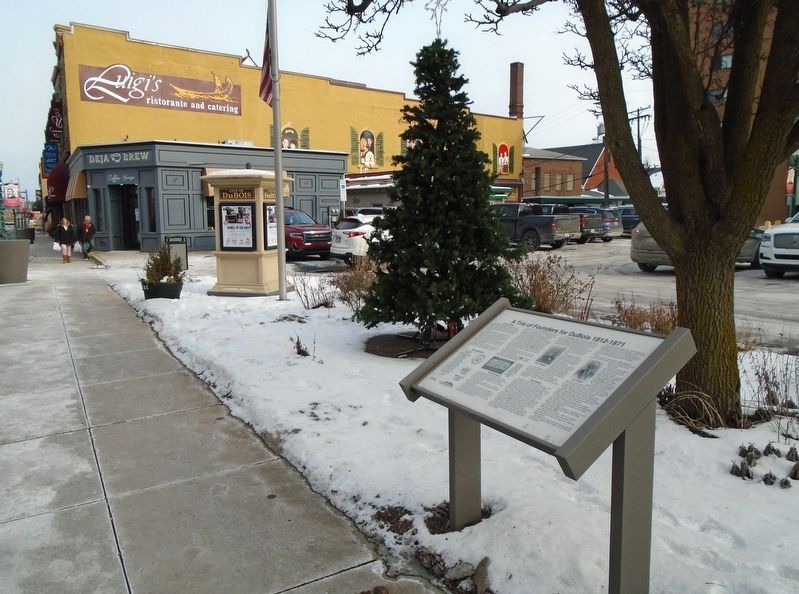
2. A Trio of Founders for DuBois 1812-1871 Marker
In 1865 Rumbarger purchased 325 acres of wilderness from David Heberling, whose father had purchased the land from George Shaffer.
With the beginning of construction of the Allegheny Valley Railroad Low Grade Division in 1870, the promise of regular passenger service and the arrival of John DuBois in 1871 to develop his properties on the eastern side of the Beaver Meadows, Rumbarger began to envision a new town to be known as "Rumbarger Town".
In 1872 Rumbarger employed surveyor George Kirk to lay out town plots. Rumbarger then advertised these lots for sale in newspapers in Brookville and Clarion. The cost was $100 for a lot 60 feet wide and 180 feet long. The lots were sold in original condition, either old fields or cut-over timberland. Rumbarger distinguished Main Street and Booth Street (current West Long Avenue) as the center of the business district of his new town.
Rumbarger described his town as "beautifully situated on Sandy Creek within 80 rods of the railroad nearing completion and on a public road leading from Luthersburg to Brockwayville. He described the large steam sawmill and general lumber establishment, under construction by a John DuBois, that would give employment to no less than 100 hands.” In addition to lots, he offered to sell a farm of 150 acres and his Tavern House suitable for a hotel. P. S. Weber purchased the first two lots.
[Photo caption reads] John Rumbarger
Rumbarger remained in control of his business until approximately 1879. He was married twice and had 13 children. He died in January 1889, six months after the Great Fire of 1888.
DuBois had visited the Shaffers in 1842 on a hunting trip and was impressed by the immense forests of white pine. He returned in 1844 to purchase properties on both sides of the Eastern Continental Divide. He purchased over 32,000 acres of timber lands in Brady and Huston Townships in Clearfield County and Jay Township in Elk County.
In the 1850s and 1860s, DuBois and others floated their logs down the Bennetts Branch to the mills in Williamsport. In 1855, DuBois purchased the lower Beaver Meadow area from Fred Shaffer.
With timber lands becoming scarce and other business issue, DuBois decided to sell his properties in Williamsport and DuBoistown and start over in Clearfield County.
When DuBois returned in 1871 to develop his property on the west side of the Divide, he found that Shaffer had died and John Rumbarger had purchased the Shaffer property.
DuBois boarded with Rumbarger while clearing his property in order to build a small sawmill that would provide lumber to construct a much larger sawmill.
[Photo caption reads] John DuBois
Construction on the "Little Mill” began in 1872 and the "Big Mill", the largest in the state at that time, was operational by 1874. Caldwell's Illustrated Atlas of Clearfield County published in 1878, shows DuBois owned 14,000 acres in the Beaver Meadows and other lots in the small town.
In addition to the Big Mill, DuBois built a box factory, a hemlock and hardwood mill, then partnered with A. R. and E. D. VanTassel to start a tannery. He built a five-story brick building along the railroad tracks to serve as offices and a store for his business and as a hotel for travelers.
DuBois was operating a farm, a dairy, machine shop, foundry, blacksmith shop, mills, store, hotel, lumbering camps and miles of logging railroads into the forest. He built housing for his employees to purchase and a three-story house with a four-story tower for himself.
The DuBois Mills and the opening of the Allegheny Valley Railroad Low Grade Division between Redbank and Driftwood providing regular passenger service brought a population boom to the area.
The first Post Office was known as "Rumbarger", but in 1876 the Postal Service and the Railroad Station both adopted the name DuBois.
John DuBois died on May 5, 1886. He is buried on Monument Hill and, on his request facing the city, overlooking what was once his property, now Penn State DuBois Campus.
John DuBois never married. His fortune and properties were left to his nephew John E. DuBois, son of his brother Ezekial DuBois.
Erected by City of DuBois, DuBois Area Historical Society, Downtown DuBois Inc., Clearfield County Charitable Foundation, and Visit Clearfield County.
Topics. This historical marker is listed in these topic lists: Horticulture & Forestry • Industry & Commerce • Railroads & Streetcars • Settlements & Settlers. A significant historical month for this entry is January 1889.
Location. 41° 7.121′ N, 78° 45.714′ W. Marker is in DuBois, Pennsylvania, in Clearfield County. It is on Brady Street north of Long Street, on the right when traveling north. Touch for map. Marker is at or near this postal address: 20 East Long Avenue, Du Bois PA 15801, United States of America. Touch for directions.

Regionally, this marker is in the Pennsylvania Wilds. It is also in the American Northeast, in the Mid-Atlantic, in Appalachia, and specifically in Northern Appalachia. Globally, it is in North America, the Western Hemisphere, the Western World, and the Anglosphere. Historically, it finds itself in what was once the Haudenosaunee (Iroquois) Confederacy and also one of the original Thirteen Colonies.
Other nearby markers. At least 8 other markers are within walking distance of this marker: The Fuller Opera House (within shouting distance of this marker); DuBois Area Historical Society Constitution (about 300 feet away, measured in a direct line); From Hotel, to Newspaper Office to Senior Housing: The Story of Gray Foundation Apartments (about 400 feet away); From Theater in 1902 to Senior Citizen Housing in 1982 (about 700 feet away); Veterans Memorial (approx. 0.2 miles away); War Memorial (approx. ¼ mile away); DuBois' Great Fire, June 18, 1888 (approx. ¼ mile away); Fourth Ward Hose & Rescue Co. (approx. 0.3 miles away). Touch for a list and map of all markers in DuBois.
Credits. This page was last revised on January 31, 2025. It was originally submitted on January 31, 2025, by William Fischer, Jr. of Reynoldsburg, Ohio. This page has been viewed 452 times since then and 141 times this year. Photos: 1, 2. submitted on January 31, 2025, by William Fischer, Jr. of Reynoldsburg, Ohio.
