Verdun in Meuse, Alsace, Lorraine, Champagne-Ardenne, France — Western Europe
Monument à la Victoire et aux Soldats de Verdun (XXe siècle)
Photographed by Steve Stoessel, November 18, 2024
1. Monument à la Victoire et aux Soldats de Verdun (XXe siècle) Marker

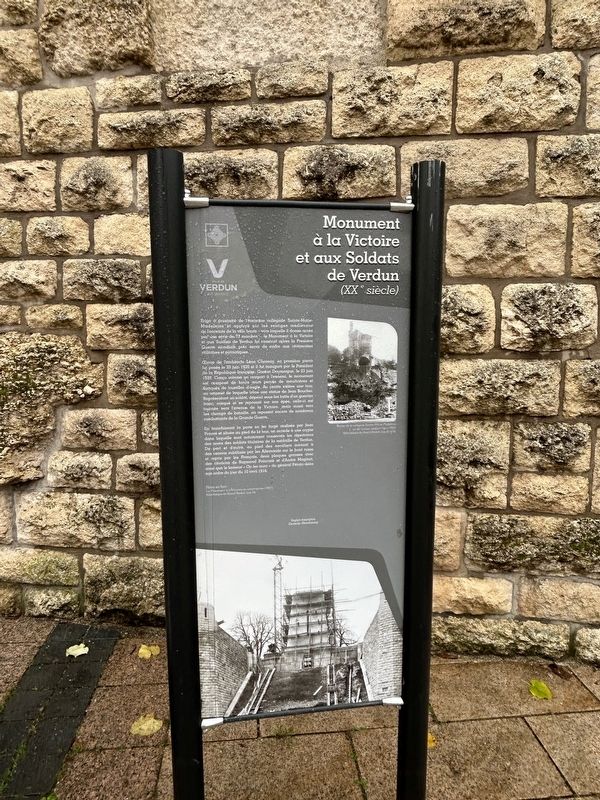
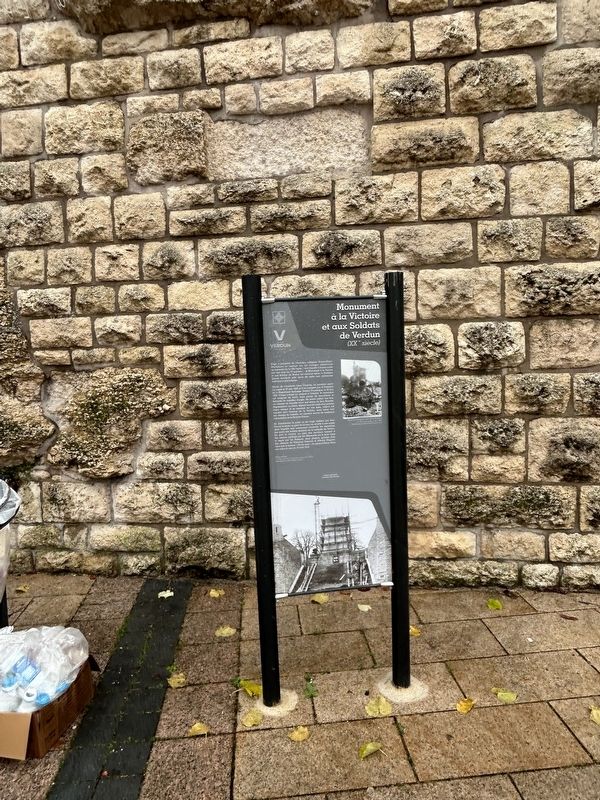
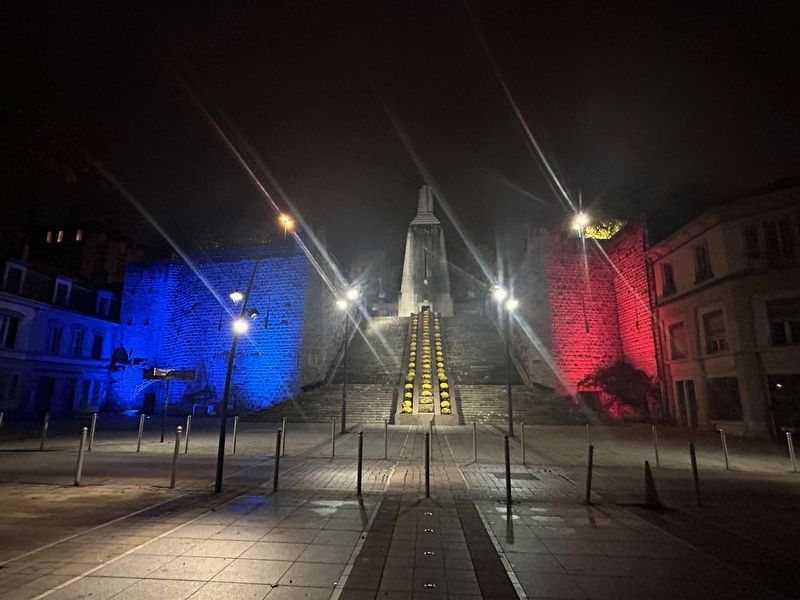
Érige à, proximité de l’ancienne collégiale Sainte Marie-Madeleine et appuyé sur les voltiges médiévales de l'enceinte de la vite haute - vers laquelle il donne accès par une sérié de 73 inarches -l’Monument à la Victoire et aux Soldats de Verdun fut construit après la Première Guerre mondiale pour servit de cadre aux cérémonies militaires et patriotiques.
Œuvre de l'architecte Leon Chesnay, en première pierre tut posée de 23 juin 1920 et il fut inauguré par la Président de la République française, Gaston Doumergue, la 23 juin 1929. Conçu comme un rempart a l’ennemi, le monument est composé de hauts murs percos de meurtrières et flanqués de tourelles d’angle. Au contre s’élève une touc ou sommet de laquelle trône une statue de Jean Bouchar. Représentant un soldat, dépeint sous les trais d'un guerrier franc, casqué et se reposant sur son épée, celle-ci ost tournée vers l’avenue de la Victoire, main vers los champs de bataille, où reposent encore de nombreuse combattante de la Grande Guerre.
En franchissant la porte en fer forgé réalisée par Joan Prouvé et située au pied de la tour, on accède à une crypte dans laquelle
this page online
Erected near the old collegiate church of Sainte Marie-Madeleine and supported by the medieval vaulting of the upper wall - to which it provides access by a series of 73 arches - the Monument to Victory and the Soldiers of Verdun was built after the First World War to serve as a setting for military and patriotic ceremonies.
The work of architect Leon Chesnay, the first stone was laid on June 23, 1920 and it was inaugurated by the President of the French Republic, Gaston Doumergue,, on June 23, 1929. Designed as a rampart against the enemy, the monument is composed of high walls pierced with loopholes and flanked by corner turrets. On the other side stands a touc or summit from which sits a statue by Jean Boucher. Representing
Photographed by Steve Stoessel, November 18, 2024
2. Monument à la Victoire et aux Soldats de Verdun (XXe siècle) Marker
By crossing the wrought iron gate made by Joan Prouvé and located at the foot of the tower, you reach a crypt in which are notably stored the lists of names of soldiers who received the Verdun medal. On either side, at the foot of the stairs leading to cannons stolen by the Germans on the front line and recaptured by the French, two large plaques with quotes from Raymond Poincaré and André Maginot as well as the famous "We will have them" from General Pétain in his order of the day of April 10, 1916.
Topics. This memorial is listed in these topic lists: Architecture • War, World I. A significant historical year for this entry is 1920.
Location. 49° 9.665′ N, 5° 23.063′ E. Memorial is in Verdun, Grand Est (Alsace, Lorraine, Champagne-Ardenne), in Meuse. It is on Rue Mazel south of Avenue dela Victoire, on the right when traveling south. Touch for map. Memorial is in this post office area: Verdun, Grand Est 55100, France. Touch for directions.

Regionally,
Photographed by Steve Stoessel, November 17, 2024
3. Monument à la Victoire et aux Soldats de Verdun (XXe siècle) Marker
Other nearby markers. At least 8 other markers are within walking distance of this marker: Hôtel de la Princerie (about 90 meters away, measured in a direct line); St. Nicolas Chapel / Chapelle Saint-Nicholas (about 120 meters away); Chapel Saint Nicolas/Chapelle Saint-Nicolas (about 120 meters away); Ancienne abbaye Saint-Paul (about 210 meters away); Le 166eme Régiment d'Infanterie (approx. 0.3 kilometers away); The Defense (approx. 0.3 kilometers away); Verdun War Memorial (approx. 0.3 kilometers away); Porte Saint-Paul (approx. 0.3 kilometers away). Touch for a list and map of all markers in Verdun.
Photographed by Steve Stoessel, November 17, 2024
4. Monument à la Victoire et aux Soldats de Verdun (XXe siècle) Marker
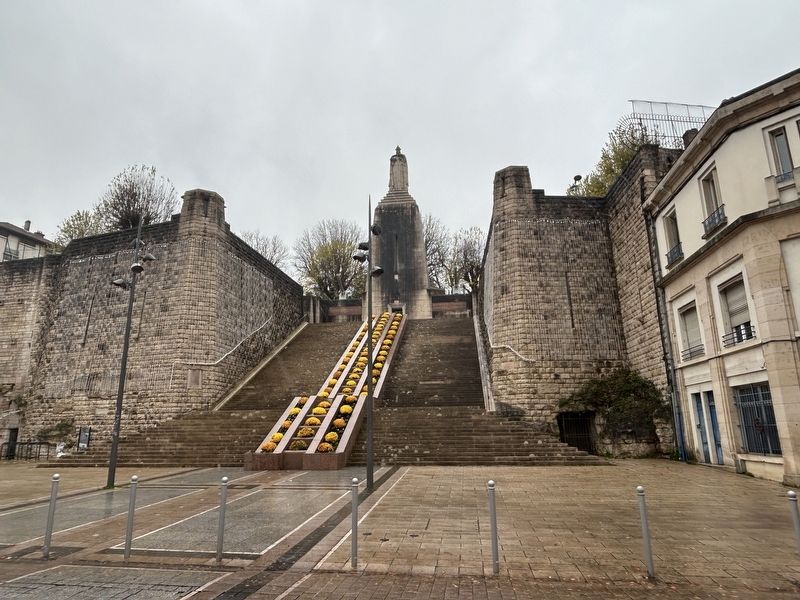
Photographed by Steve Stoessel, November 18, 2024
5. Monument à la Victoire et aux Soldats de Verdun (XXe siècle) Marker
Credits. This page was last revised on February 3, 2025. It was originally submitted on February 1, 2025, by Steve Stoessel of Niskayuna, New York. This page has been viewed 182 times since then and 33 times this year. Photos: 1, 2, 3, 4, 5. submitted on February 1, 2025, by Steve Stoessel of Niskayuna, New York.
