
Meaux in Seine-et-Marne, Île-de-France, France — Western Europe
Le Rail Pendant la Grande Guerre
Quand le Train Devient une Arme
Photographed by Steve Stoessel, November 16, 2024
1. Le Rail Pendant la Grande Guerre Marker

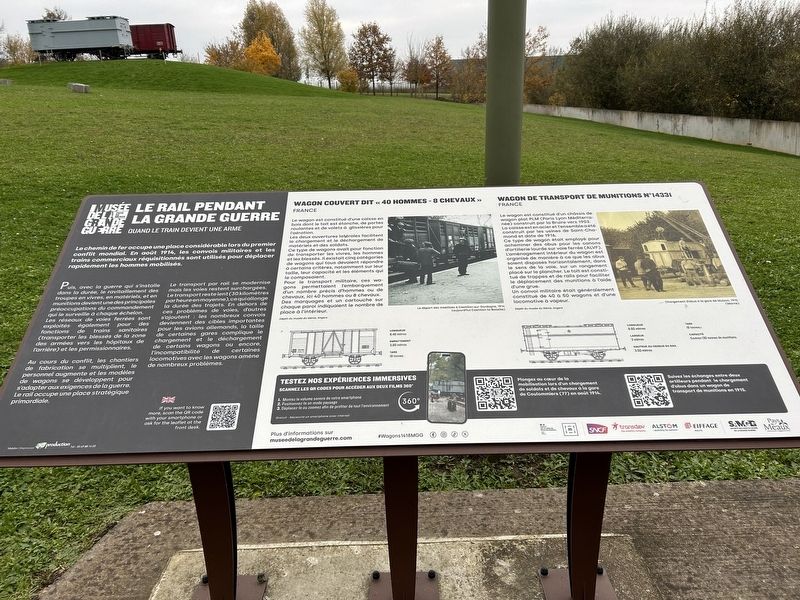
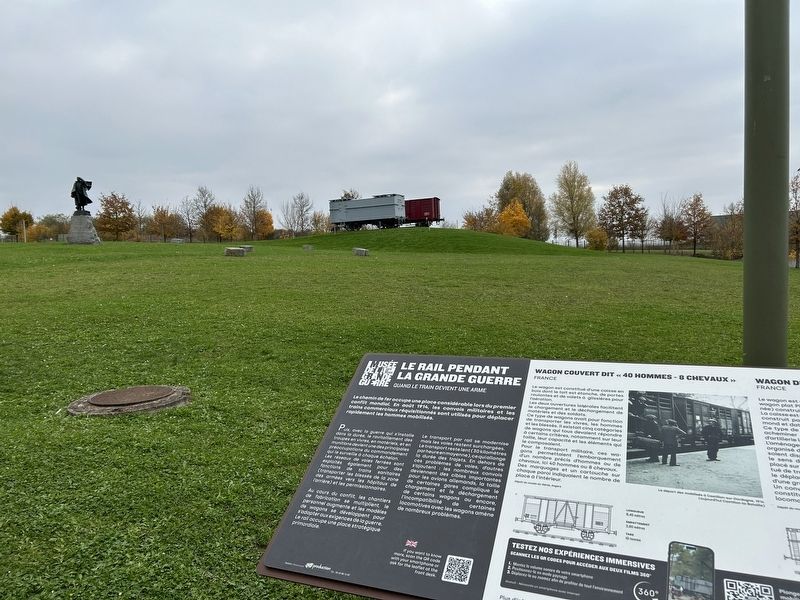
Le chemin de fer occupe une place considérable lors du premier conflit mondial. En août 1914, les convois militaires et les trains commerciaux réquisitionnés sont utilisés pour déplacer rapidement les hommes mobilisés.
Puis, avec la guerre qui s'installe dans la durée, le ravitaillement des troupes en vivres, en matériels, et en munitions devient une des principales préoccupations du commandement qui le surveille à chaque échelon. Les réseaux de voies ferrées sont exploités également pour des fonctions de trains sanitaires (transporter les blessés de la zone des armées vers les hôpitaux de l'arrière) et les permissionnaires.
Au cours du conflit, les chantiers de fabrication se multiplient, le personnel augmente et les modèles de wagons se développent pour s'adapter aux exigences de la guerre. Le rail occupe une place stratégique primordiale.
Le transport par rail se modernise mais les voies restent surchargées. Le transport reste lent (30 kilomètres par heure en moyenne), ce qui allonge la durée des trajets. En dehors de ces problèmes de voies, d'autres s'ajoutent : les nombreux convois deviennent des cibles
this page online
Wagon Couvert Dit « 40 Hommes - 8 Chevaux
France
Le wagon est constitué d'une caisse en bois dont le toit est étanche, do portes roulantes et do volets à glissières pour l'aération.
Les deux ouvertures latérales facilitent le chargement et le déchargement de matériels at dos soldats.
Ce type de wagons avait pour fonction de transporter les vivres, les hommes et les blessés. Il existait cinq catégories de wagons qui tous devaient répondre à certains critères, notamment sur lour taille, leur capacité et les éléments qui le composaient.
Pour le transport militaire, cas wagons permettaient l'embarquement d'un nombre précis d'hommes ou de chevaux, ici 40 hommes ou 8 chevaux.
Des marquages et un cartouche sur chaque paroi indiquaient le nombre de place à l'intérieur.
[Photo] Le déport dos mobilisée à Castillon-sur-Dordogne, 1914
Wagon De Transport De Munitions N° 14331
France
La wagon est constitué
Photographed by Steve Stoessel, November 16, 2024
2. Le Rail Pendant la Grande Guerre Marker
Ce type de wagon était employé pour acheminer des obus pour les canons d'artillerie lourde sur voie ferrée (ALVF). L'aménagement intérieur du wagon est organisé de manière à ce que les obus soient disposés horizontalement, dans le sens de la vole, sur un rangement placé sur le plancher. Le toit est constitué de trappes et de rails pour faciliter le déplacement des munitions à l'aide d'une grue.
Un convoi militaire était généralement constitué de 40 à 50 wagons et d'une locomotive à vapeur.
[Photo] Chargement d’obus à la gare de Mulzen, 1916
Plus d'informations sur museedelagrandeguerre.com
The railway played a significant role during the First World War. In August 1914, military convoys and requisitioned commercial trains were used to quickly move mobilized men.
Then, as the war dragged on, supplying troops with food, equipment, and ammunition became one of the main concerns of the command, which monitored it at every
Photographed by Steve Stoessel, November 16, 2024
3. Le Rail Pendant la Grande Guerre Marker
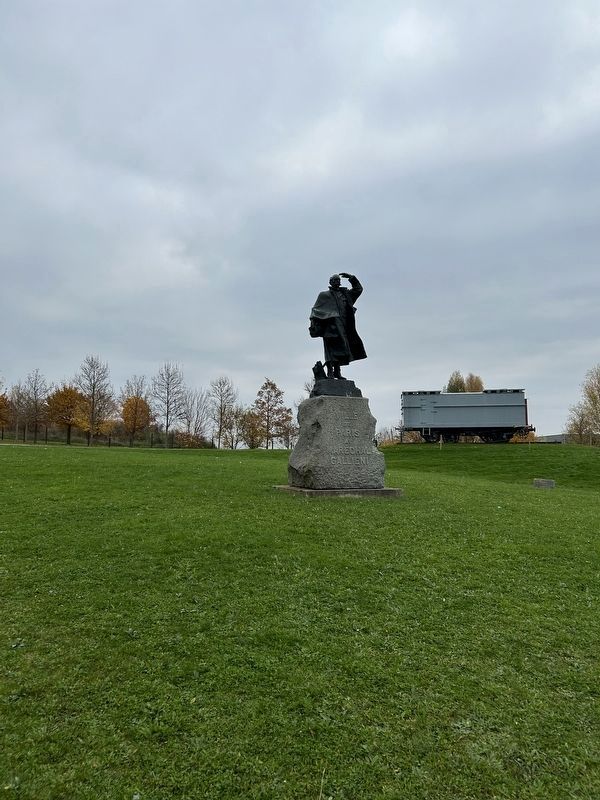
A munitions car is seen behind the statue of Marshall Gallieni
During the conflict, manufacturing sites multiplied, personnel increased, and wagon models developed to adapt to the demands of the war. Rail occupied a key strategic position.
Rail transport was modernized, but the tracks remained overloaded. Transport remains slow (30 kilometers per hour on average), which lengthens the journey time. In addition to these track problems, others are added: the many convoys become important targets for German planes, the size of some stations complicates the loading and unloading of certain wagons or the incompatibility of certain locomotives with the wagons leads to many problems.
Covered Wagon Called "40 Men - 8 Horses
France
The wagon consists of a wooden box with a waterproof roof, rolling doors and sliding shutters for ventilation.
The two side openings facilitate the loading and unloading of equipment and soldiers.
This type of wagon was used to transport food, men and the wounded. There were five categories of wagons that all had to meet certain criteria, particularly their size, their capacity and the elements that composed them.
For military transport, these wagons allowed the embarkation of a specific number of men or horses, here 40 men or 8 horses.
Markings and a cartouche on each wall indicated the number of places inside.
[Photo] The deportation back mobilized in Castillon-sur-Dordogne, 1914
Ammunition Transport Wagon No. 14331
France
The wagon is made of a PLM (Paria Lyon Méditerranée) flat wagon chassis built by Bruire around 1903. The body is made of steel and the whole was built by the Saint-Chamond factories and dates from 1916.
This type of wagon was used to transport shells for heavy artillery guns on the railway (ALVF). The interior layout of the wagon is organized so that the shells are arranged horizontally, in the direction of the flight, on a storage area placed on the floor. The roof is made up of hatches and rails to facilitate the movement of ammunition using a crane.
A military convoy generally consisted of 40 to 50 wagons and a steam locomotive.
[Photo] Loading shells at Mulzen station, 1916
More information on museedelagrandeguerre.com
[Technical specifications were not transcribed]
Topics. This historical marker is listed in these topic lists: Railroads & Streetcars • War, World I. A significant historical month for this entry is August 1914.
Location. 48° 58.247′ N, 2° 54.283′ E. Marker is in Meaux, Île-de-France, in Seine-et-Marne. It can be reached from the intersection of Rue Lazare Ponticelli and Route de Varreddes. Touch for map. Marker is in this post office area: Meaux, Île-de-France 77100, France. Touch for directions.

Regionally, it is in the North Atlantic Region, Europe, the European Union, Atlantic Europe, the Schengen Area, Western Europe, a coastal Mediterranean country, and the Western World. Historically, it finds itself in what was once a French colony and also the Roman Empire.
Other nearby markers. At least 8 other markers are within walking distance of this marker: Char Saint-Chamond modèle 1917 (within shouting distance of this marker); Construire (within shouting distance of this marker); Photographier La Tranchée (within shouting distance of this marker); a different marker also named Le Rail Pendant la Grande Guerre (within shouting distance of this marker); a different marker also named Construire (within shouting distance of this marker); a different marker also named Construire (about 90 meters away, measured in a direct line); a different marker also named Construire (about 90 meters away); a different marker also named Construire (about 90 meters away). Touch for a list and map of all markers in Meaux.
Related marker. Click here for another marker that is related to this marker.
Credits. This page was last revised on February 3, 2025. It was originally submitted on February 3, 2025, by Steve Stoessel of Niskayuna, New York. This page has been viewed 117 times since then and 10 times this year. Photos: 1, 2, 3. submitted on February 3, 2025, by Steve Stoessel of Niskayuna, New York.
