
Near Berry-au-Bac in Aisne, Upper France, France — Western Europe
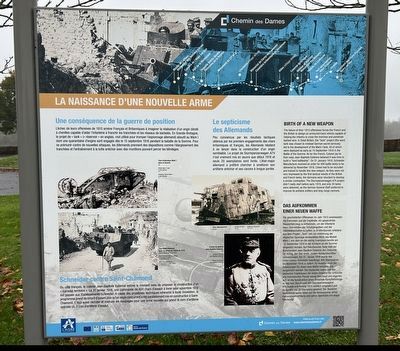
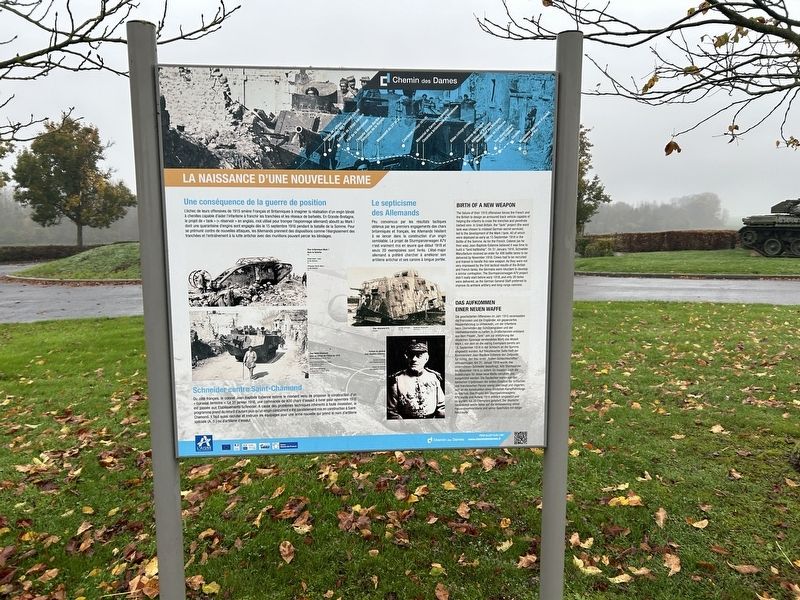
La Nissance d’une Nouvelle Arme
The Birth of a New Weapon
| — | Chemin des Dames | — |
Photographed by Steve Stoessel, November 18, 2024
1. La Nissan’s d’une Nouvelle Arme Marker

Une conséquence de la guerre de position
L'échec de leurs offensives de 1915 amène Français et Britanniques à imaginer la réalisation d'un engin blindé à chenilles capable d'aider l'infanterie à franchir les tranchées et les réseaux de barbelés. En Grande-Bretagne, le projet de « tank » (« réservoir » en anglais, mot utilisé pour tromper l'espionnage allemand) aboutit au Mark I dont une quarantaine d'engins sont engagés dès le 15 septembre 1916 pendant la bataille de la Somme. Pour se prémunir contre de nouvelles attaques, les Allemands prennent des dispositions comme l'élargissement des tranchées et l'entraînement à la lutte antichar avec des munitions pouvant percer les blindages.
Schneider contre Saint-Chamond
Du côté français, le colonel Jean-Baptiste Estienne estime le moment venu de proposer la construction d'un « cuirassé terrestre ». Le 31 janvier 1916, une commande de 400 chars d'assaut à livrer pour novembre 1916 est passée aux Etablissements Schneider. A cause des problèmes techniques inhérents à toute innovation, le programme prend du retard d'autant plus qu'un engin concurrent a été parallèlement
this page online
Le septicisme des Allemands
Peu convaincus par les résultats tactiques obtenus par les premiers engagements des chars britanniques et français, les Allemands hésitent à se lancer dans la construction d'un engin semblable. Le projet de Sturmpanzerwagen A7V n'est vraiment mis en œuvre que début 1918 et seuls 20 exemplaires sont livrés. L'état-major allemand a préféré chercher à améliorer son artillerie antichar et ses canons à longue portée.
[Photo Captions]
The
Photographed by Steve Stoessel, November 18, 2024
2. La Nissance d’une Nouvelle Arme Marker
Die gescheiterten Offensiven im Jahr 1915 veranlassten die Franzosen und die Engländer, ein gepanzertes Raupenfahrzeug zu entwickeln, um der Infanterie beim Überwinden der Schützengräben und der Stacheldrahtnetze zu helfen. In Großbritannien entstand aus dem Projekt „Tank" (ein zur Irreführung der deutschen Spionage verwendetes Wort) das Modell Mark I, von dem an die vierzig Exemplare bereits am 15. September 1916 in der Schlacht an der Somme eingesetzt wurden. Auf französischer Seite hielt der Kommandant Jean-Baptiste Estienne den Zeitpunkt für richtig, den Bau eines „Boden-Schlachtschiffes vorzuschlagen. Am 31. Januar 1916 wurde das Unternehmen Schneider beauftragt, 400 Sturmpanzer bis November 1916 zu liefern. Es mussten auch die Besatzungen für diese neue Waffe rekrutiert und ausgebildet werden. Die Deutschen waren von den taktischen Ergebnissen der ersten Einsätze der britischen und französischen Panzer wenig überzeugt und zögerten, sich an die Konstruktion eines ähnlichen Kampffahrzeugs zu machen. Das Projekt des Sturmpanzenwagen A7V wurde erst Anfang 1918 wirklich umgesetzt und es wurden nur 20 Exemplare geliefert. Der deutsche Generalstab setzte lieber auf die Verbesserung seiner Panzerabwehrartillerie und seiner Geschütze mit langer Reichweite.
Topics. This historical marker is listed in this topic list: War, World I. A significant historical date for this entry is January 31, 1916.
Location. 49° 24.79′ N, 3° 53.245′ E. Marker is near Berry-au-Bac, Hauts-de-France (Upper France), in Aisne. It can be reached from the intersection of Hauts-de-France Route 925 and Route 1044. Touch for map. Marker is in this post office area: Berry-au-Bac, Hauts-de-France 02190, France. Touch for directions.

Regionally, it is in the North Atlantic Region, Europe, the European Union, Atlantic Europe, the Schengen Area, Western Europe, a coastal Mediterranean country, and the Western World. Historically, it finds itself in what was once a French colony and also the Roman Empire.
Other nearby markers. At least 8 other markers are within walking distance of this marker: 1918: La Victoire du Char (here, next to this marker); Le Char Schneider CA-1 (here, next to this marker); The Offensive of April 16, 1917 / L’offensive du 16 Avril 1917 (a few steps from this marker); 16 Avril 1917: Le Premier Engagement des Chars (a few steps from this marker); Berry-au-Bac et la Mémoire de l’Arme Blindée (a few steps from this marker); Le Chemin des Dames (a few steps from this marker); Un Siècle de Blindés en France (within shouting distance of this marker); Aux Morts Des Chars d'Assaut (within shouting distance of this marker). Touch for a list and map of all markers in Berry-au-Bac.
Credits. This page was last revised on February 9, 2025. It was originally submitted on February 4, 2025, by Steve Stoessel of Niskayuna, New York. This page has been viewed 88 times since then and 8 times this year. Photos: 1, 2. submitted on February 4, 2025, by Steve Stoessel of Niskayuna, New York.
