Near Fleury-devant-Douaumont in Meuse, Alsace, Lorraine, Champagne-Ardenne, France — Western Europe
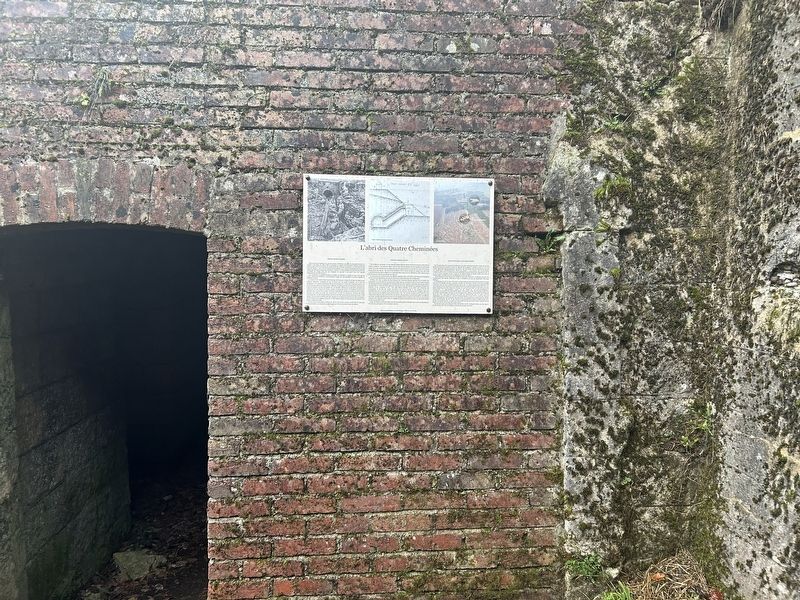
L'abri des Quatre Cheminées

Photographed by Steve Stoessel, November 17, 2024
1. L'abri des Quatre Cheminées Marker

L'abri-caverne de Froideterre (ou abri des Quatre Cheminées, en raison des dispositifs servant à le ventiler) a été réalisé de 1889 à 1891. Il appartient au système de fortifications organisé autour de Verdun avant 1914. Il est situé sur la commune de Fleury-devant-Douaumont, sur le versant nord du ravin des Vignes, à 1 km à l'est de l'ouvrage de Froideterre. Il est constitué principalement d'une salle voûtée avec des parois recouvertes de briques, creusée à 12 m de profondeur, longue d'environ 60 m et accessible, de chaque côté, par une vingtaine de marches. Il est prévu avec une capacité d'hébergement de 300 hommes.
Son occupation est attestée lorsque les combats se déroulent, à compter de juin 1916, dans le secteur Thiaumont-Froideterre. Il est bombardé à partir de cette époque et au moins jusqu’au 24 septembre suivant.
Le 23 juin 1916 à l'aube, le front entre l'ouvrage de Thiaumont et le fort de Souville fait l'objet d'une offensive allemande, complétée de part et d'autre par une action secondaire. Sur la crête de Froideterre, le 10e régiment d'infanterie (RI) bavarois progresse
this page online
De nos jours, le terre-plein au-dessus de celui-ci et le sol aux environs conservent les traces des bombardements. Les cheminées, endommagées en 1916, ont bénéficié d'une restauration.
The Froideterre cave shelter - or Four Chimneys shelter
Photographed by Steve Stoessel, November 17, 2024
2. L'abri des Quatre Cheminées Marker
Its occupation was confirmed when the fighting took place, from June 1916, in the Thiaumont-Froideterre sector, It was bombarded from this period and at least until the following 24th of September.
On June 23th 1916, at dawn, the front between the Thiaumont Redoubt and the Fort of Souville was subjected to a German offensive, accompanied on both sides by a secondary action. On the Froideterre Ridge, the 10th Bavarian Infantry Regiment (I.R.) advanced and one of its companies reached the aforementioned fort around 09:30 a.m. To the left of this regiment, a detachment of the 24th Bavarian I.R.,

Photographed by Steve Stoessel, November 17, 2024
3. L'abri des Quatre Cheminées Marker
The chimneys, damaged in 1916, have been restored.
Der Schutzbunker „Abri caverne de Froideterre" (auch: „Vier-Luftschächte-Bunker"), wegen der vier der Belüftung dienenden Schächte) wurde von 1889 bis 1891

Photographed by Steve Stoessel, November 17, 2024
4. L'abri des Quatre Cheminées Marker
Seine Belegung ist zum Beginn der Kämpfe im Abschnitt Thiaumont - Froideterre ab Juni 1916 nachgewiesen. Von diesem Zeitpunkt an liegt er mindestens bis zum 24. September 1916 unter Beschuss.
Im Morgengrauen des 23. Juni 1916 ist der Frontabschnitt zwischen dem Zwischenwerk Thiaumont und dem Fort Souville Ziel eines deutschen Angriffs, der auf beiden Flanken durch Nebenangriffe unterstützt wird. Auf dem Froideterre-Rücken kommt das 10. bayerische Infanterie-Regiment (.R.) voran und eine seiner Kompanien erreicht gegen 09.30 Uhr das gleichnamige Zwischenwerk. Links von diesem Regiment vernichten Kräfte des 24. Bayer. I.R. nach und nach Teile von zwei Kompanien des französischen 114. Jäger-Bataillons (Jg.Btl.), die das Vorfeld des „Vier-Luftschächte-Bunkers" verteidigen, und erreichen das Gelände über diesem. Die Angreifer werfen zwei Handgranaten in eine der beiden Zugangstreppen, bringen ein Maschinengewehr in Stellung und blockieren die Besatzung durch sein Feuer. Unter dieser befinden sich außer den Überlebenden des 114. Jg.Btl., auch die Angehörigen von vier Stäben (41. und 258. Infanterie-Brigade, 65./und 297. I.R.) sowie das Personal eines Verbandplatzes und Verwundete. Als gegen Ende des Vormittags der Angriff gegen den Bunker durch zwei Kompanien des 297. I.R. und zwar durch eine derselben mit Erfolg zurückgeschlagen wird, bringen vier Kompanien des 114. Jg.Btl. auch den Angriff der über den Bunker hinaus vorgedrungenen Bayern zum Stehen und werfen diese weiter zurück.
Heutzutage zeugen der Erdauswurf über dem Bunker und der umliegende Boden von den Spuren des Beschusses. Die 1916 beschädigten Luftschächte wurden restauriert.
Topics. This historical marker is listed in these topic lists: Forts and Castles • War, World I. A significant historical month for this entry is June 1916.
Location. 49° 11.956′ N, 5° 24.719′ E. Marker is near Fleury-devant-Douaumont, Grand Est (Alsace, Lorraine, Champagne-Ardenne), in Meuse. It can be reached from Grand Est Route 913b one kilometer south of Route 913, on the right when traveling north. Touch for map. Marker is in this post office area: Fleury-devant-Douaumont, Grand Est 55100, France. Touch for directions.

Regionally, it is in the North Atlantic Region, Europe, the European Union, Atlantic Europe, the Schengen Area, Western Europe, a coastal Mediterranean country, and the Western World. Historically, it finds itself in what was once a French colony, the Roman Empire, and specifically the Holy Roman Empire.
Other nearby markers. At least 8 other markers are within walking distance of this marker: Pierre Cazalis de Fondouce (within shouting distance of this marker); a different marker also named L'abri des Quatre Cheminées (about 90 meters away, measured in a direct line); Fleury-devant-Douaumont Enjeu de la Bataille de Verdun (approx. 1.2 kilometers away); Fleury / Hohenlinden (approx. 1.2 kilometers away); Retranchement d'infanterie (approx. 1.2 kilometers away); Fleury-devant-Douaumont (approx. 1.3 kilometers away); La nécropole nationale de Fleury-devant-Douaumont (approx. 1.3 kilometers away); Soldats Antillais Morts Devant Verdun et à Fleury-devant-Douaumont (approx. 1.3 kilometers away). Touch for a list and map of all markers in Fleury-devant-Douaumont.
Credits. This page was last revised on February 6, 2025. It was originally submitted on February 4, 2025, by Steve Stoessel of Niskayuna, New York. This page has been viewed 111 times since then and 16 times this year. Photos: 1, 2, 3, 4. submitted on February 4, 2025, by Steve Stoessel of Niskayuna, New York.
