
Helper in Carbon County, Utah — The American Mountains (Southwest)
Western Springs Canyon - Rains - Mutual

Photographed by Braden Orr, January 25, 2025
1. Western Springs Canyon - Rains - Mutual Marker
Western Springs Canyon
Mutual and Rains were not the only mines in the extreme western end of Spring Canyon. There was the Little Standard mine (1925-1945) operated by the Standard Coal Company and three small family operated mines, the Day, the Vulcan, and the Western. The canyon forked at the Mutual store, Little Standard was on the south fork while the Day, Vulcan and Western mines were on the north fork. Most of the miners employed by these small mines lived in the developed company towns of either Mutual or Rains. That was not the case for the employees of the Little Standard mine, they lived in a tent city that included a fourteen room bunkhouse. This tent town thrived for thirteen years until the Mutual mine shut down in 1938 and the town of Mutual was mostly abandoned. At that point the residents of Little Standard folded up their tents and moved into the vacant houses in Mutual. Even after the Little Standard mine closed in 1945 this group of families along with the remaining residents of Rains kept the Mutual Store alive until its eventual demise in 1954. The western end of Spring Canyon is also home to the legend
this page online
Rains 1915-1958
In 1915 prominent mining engineer Leon Felix Rains convinced P.J. Quealy, a coal operator from Wyoming, to invest in the coal rich lands west of Standardville. Soon the Carbon Coal Company was organized and the land was purchased from the government. Mг. Rains served as president. Rains had been a grand opera singer until he became interested in the coal industry. He first gained experience by selling coal in California.
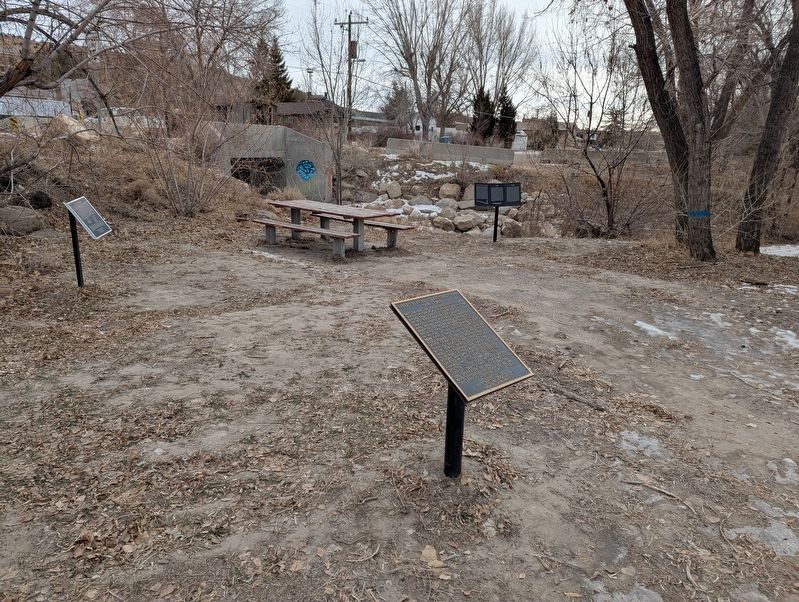
Photographed by Braden Orr, January 25, 2025
2. Western Springs Canyon - Rains - Mutual Marker
Mutual 1919-1954
The extreme western end was the last area to be developed in Spring Canyon. In December of 1919 the Mutual Coal Company was organized and advertised the sale of stock thereby becoming the only mine in the canyon that was not privately owned. The name Mutual was chosen because it was organized as a cooperative with stockholders. Fred J. Leonard was the first president. The unusual ownership scheme promised shareholders they would receive their coal at a discount. The diversity of the shareholders grew along with the mine. As soon as weather permitted, in the spring of 1920, a tipple was built along with a surface tramway 600 feet long from the upper coal seam to the tipple. The mine had 3 seams of coal, one 8 feet thick at the highest elevation, one 14 feet thick between the other two and one 6.5 feet thick closest to the tipple. The Mutual Mines consisted of Morton #1 opened by Thomas Lamp, the Morton #2 opened by Walter Drake and the Mutual #3 opened by Albert Shaw. In 1921 the Mutual store was built by Joe Pauagano and later sold to Walter and Helen Johnson. The store remained open until 1954 outliving the Mutual Mines by 16 years. Unlike the company towns in Spring Canyon and elsewhere, Mutual was different because it did not have its own school, instead sending their children to the school in Rains, and it had a privately owned store, very unusual for that time. Mutual was the last stop on the Spring Canyon Stage Line. Local residents Joe & Bob Cormani, Peter Labori and Harry Eda operated the line and charged $1.50 for a round trip fare to Helper. The fare was high for the time but for many residents it was their only option. In the winter the snow was so deep that even residents who owned cars would use the stage line. The Mutual mines were closed in 1938 and the workings were taken over by the Carbon Coal Company in adjacent Rains. Miners from the nearby mines of Rains and Little Standard moved into some of the homes abandoned by the Mutual miners but as the coal boom died away after WWII so did the town of Mutual.
Erected 2016 by E Clampus Vitus Matt Warner Chapter #1900.
Topics and series. This historical marker is listed in this topic list: Settlements & Settlers. In addition, it is included in the E Clampus Vitus series list.
Location. 39° 41.283′ N, 110° 51.333′ W. Marker is in Helper, Utah, in Carbon County. It is on Helper Riverwalk, on the right when traveling north. Touch for map. Marker is in this post office area: Helper UT 84526, United States of America. Touch for directions.

Regionally, this marker is in Canyon Country. It is also in the American Mountain West, on the Colorado Plateau, and at the Four Corners. Globally, it is in North America, the Western Hemisphere, the Western World, and the Anglosphere. Historically, it finds itself in what was once New Spain and also Mexico’s Alta California.

Other nearby markers. At least 8 other markers are within walking distance of this marker: Liberty Fuel - Latuda, Utah (here, next to this marker); Peerless / New Peerless (here, next to this marker); Sweets Coal Company - Consumers - National (a few steps from this marker); Coal City (a few steps from this marker); WPA - PWA (within shouting distance of this marker); Helper Civic Auditorium (about 400 feet away, measured in a direct line); The History of Big John (about 400 feet away); Heiner (1911-1937) (about 600 feet away). Touch for a list and map of all markers in Helper.
Credits. This page was last revised on February 5, 2025. It was originally submitted on February 4, 2025, by Braden Orr of Helper, Utah. This page has been viewed 211 times since then and 24 times this year. Photos: 1, 2. submitted on February 4, 2025, by Braden Orr of Helper, Utah. • J. Makali Bruton was the editor who published this page.
