
Fleury-devant-Douaumont in Meuse, Alsace, Lorraine, Champagne-Ardenne, France — Western Europe
L'abri des Quatre Cheminées
Photographed by Steve Stoessel, November 17, 2024
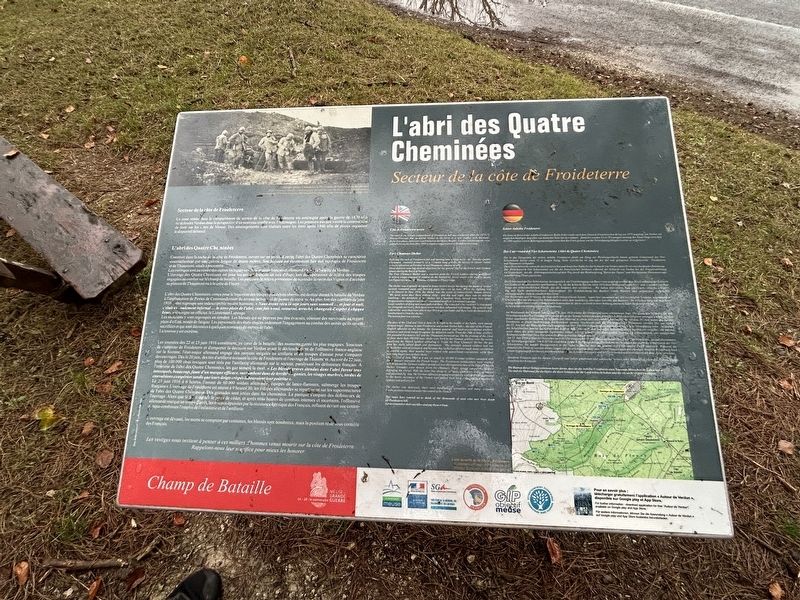
1. L'abri des Quatre Cheminées Marker

La zone située dans le comparurent de terrain de la côte de Froideterre est aménagée appli la guerre de 1870 [obscured] de défendre Verdon dans la perspective d'un nouveau conflit avec l'Allentagne: Les premier travaux voient la construction de fors sur les estes de Meuse, Des aménagements sont réalisés entre les forts après 1900 afin de mieux organiserle dispositif défensif.
L'abri des Quatre Cheminées
Construit dans la roche de la cire de Froideterre, ouvert sur un profond ravin, J'abri des Quatre Cheminées de caractérise essentiellement par une galerie longue de douze mètres, Son histoire est étroitement liée aux ouvrages de Froideterre et de Thiaumont, silves a proximité.
Les outrages sont au centre des enjeux tactiques des majors français et allemand [obscured] la bataille de Verdun. L'ouvrage des Quatre Cheminées est pour les solea français un lieu d’étage lors de opérations de relève des troupes engages all combat sur le champ de bataille: Les parcours de relève permettent de rejoindre le ravin des Vignes et d'accéder au plateau de Thiaumont ou à la crète de Fleury.
L’abri des Quatre Cheminées, conçu pour le logement des troupes placées en réserve, col destine durant la bataille de Verdun à l'implantation de Postes de Commandement du niveau tactique et de postes de secours. Au plus fort des combats de juin 1916 abri regroupe une indescriptible misère humaine « Nous avons vécu là sept jours sans sommeil... et jour et nuit, l'était un coulement infernal ... le terre-plein de l'abri, cent fois troué, retourné, arraché, changeait d'aspect à chaque leurs » témoigne on officier le Lieutenant Lapouge.
Les mourants y sont regroupés en nombré. Les blessés qui ne peuvent pas être évacués, côtoient des survivants au regard plein d'étroit, mines de fatigue. Les personnels des états-majors ordonnent l'engagement au combat des unités qu'ils savent sacrifices et qui sont décimées à quelques centaines de mètres de l'abri. La tension y est extrême.
Les journées des 22 et 23 juin 1916 constituent, au cœur de la bataille, des moments, parmi les plus tragiques. Soucieux de s'emparer de Froideterre et d'emporter la décision sur Verdun avant le déclenchaient de l'offensive franco-anglaise sur la Somme, l'état-major allemand engage des moyens inégalés en artillerie et en troupes d'assaut pour s’emparer des ouvrages. Dès le 20 juin, des tirs d'artillerie écrasent la cote de Froideterre et l'ouvrage de Thiaumont. Au soir du 22 juin. plus de 100.000 obus toxiques sont tirés par l'artillerie allemande sur le secteur, paralysant les défenseurs français. A D’intérieur de labri des Quatre Cheminées, les gaz sèment la mort « Les blessés graves étendus dans l'abri furent tous intoxiqués, beaucoup faute d'un masque efficace, succombent dans de terribles agonies, les visages marbrés, tordus de convulsions exaspérées tandis que leurs doigts crispes labouraient leur poitrine.»
Le 23 juin 1916 à 6 heures, l'assaut de 60.000 soldats allemand équipés de lance-flammes, submerge les troupes françaises: L'ouvrage de Froideterre est atteint à 9 heures 30, les tripes allemandes se réparassent sur les superstructures de l’abri des Quatre Cheminées. Des grenades sont jetées dans les cheminées. La panique s'empare des défenseurs de l’ouvrage. Alors que le front capter le [obscured] de céder, et après trois heures de combats intenses et incertains, l'offensive allemande marque un temps l’arrêt, les troupes épuisées par lu résistance héroïque des Français, refluent devant une contre-attaque combinat l'emploi de l'infanterie et de l'artillerie.
L’ouvrage est dévasté, les morts se comptent par centaines, les blessés sont nombreux, mais la position reste sous contrôle des Français.
Les vestiges nous invitent à penser à eus millier d'hommes venus mourir sur la côte de Froideterre.
Rappelons-nous leur sacrifice pour mieux les honorer.
The area in the terrain compartment or Froideterrere hill was reinforced after the 1870-71 Franco-Prussian War to defend Verdun in the event of a new conflict with Germany. In the first phase, forts were constructed on the Meuse Heights. Further reinforcements were added between the forts after 1900 to improve organization of the defensive system.
Four Chimneys Shelter
Built into the rock or Froideterre hill and opening onto a deep ravine, the Abri des Quatre Cheminées consisted primarily of 12-metre long gallery. Its history is closely linked to the fortifications of Froideterre and Thiaumont, situated nearby. These defenses were key tactical objectives for the general staff of the French and German armies during the Battle of Verdun.
The Four Chimneys Shelter was a stopover point for French soldiers during operations to relieve troops engaged in combat on the battlefield. Relief routes were used to access Les Vignes ravine and the Thiaumant plateau or Fleury ridge.
The shelter was originally designed to house reserve troops but during the Battle of Verdun tactical command posts and first-aid posts were set up here. When the fighting was at its fiercest in June 1916 the shelter was the scene of indescribable human misery.
’We spent seven days there without sleep… and day and night, there was an infernal rumbling… the terreplein of the shelter, hit a hundred times, turned over, torn apart, its appearance changed every hour.” recounted an officer, Lieutenant Lapouge.
Large numbers of dying men were gathered there. The wounded who could not be evacuated lay alongside survivors, their faces terror-stricken, exhausted with fatigue. The general staff ordered the units they were able to sacrifice to go into battle and these were decimated a few hundred metres from the shelter.
The tension here was extreme.
The days of the 22nd and 23rd of June 1916, right in the middle of the battle, were among its most tragic. Anxious to take Froideterre and secure Verdun before the start of the Franco-English offensive on the Somme, the German general staff used unprecedented artillery resources and storm troops to capture the defensive works. From the 20th of June artillery fire pounded Froideterre hill and the Thiaumont fortifications. On the evening of the 22nd of June, more than 100,000 toxic shells were fired by the German artillery onto the sector. paralyzing the French soldiers defending it. Inside the Four Chimneys Shelter, the gas from the shells sowed death and destruction. “The seriously injured soldiers laid out in the shelter were all poisoned, and because they lacked an effective mask, many succumbed in terrible agony, their mottled faces twisted with exacerbated convulsions while their twitching fingers tore at their chests."
On the 23rd of June 1916 at 6 am, an attack by 60,000 German soldiers equipped with flamethrowers overcame the French troops. The Froideterre fortifications were reached at 9.30 am and the German soldiers spread out over the superstructure of the Four Chimneys Shelter. Grenades were thrown down the chimneys. Panic spread among the soldiers defending the shelter. With the front line about to collapse, after three hours of intense and uncertain fighting, the German offensive stopped temporarily, and the troops exhausted by the heroic resistance of the French were forced back by a counter-attack combining infantry and artillery fire.
The shelter was destroyed, there were hundreds of casualties and many wounded, but the position remained under the control of the French.
The ruins here remind us to think of the thousands of men who met their death on Froideterre hill.
Let us remember their sacrifice and pay them tribute.
[German text was not transcribed]
Topics.
this page online
Location. 49° 11.98′ N, 5° 24.648′ E. Marker is in Fleury-devant-Douaumont, Grand Est (Alsace, Lorraine, Champagne-Ardenne), in Meuse. It is on D913B (Grand Est Route 913B) 2 kilometers south of Route 913, on the left when traveling north. Touch for map. Marker is in this post office area: Fleury-devant-Douaumont, Grand Est 55100, France. Touch for directions.

Regionally, it is in the North Atlantic Region, Europe, the European Union, Atlantic Europe, the Schengen Area, Western Europe, a coastal Mediterranean country, and the Western World. Historically, it finds itself in what was once a French colony, the Roman Empire, and specifically the Holy Roman Empire.
Other nearby markers. At least 8 other markers are within walking distance of this marker: A different marker also named L'abri des Quatre Cheminées (about 90 meters away, measured in a direct line); Pierre Cazalis de Fondouce (about 120 meters away); Retranchement d'infanterie (approx. 1.2 kilometers away); Fleury-devant-Douaumont Enjeu de la Bataille de Verdun
Photographed by Steve Stoessel, November 17, 2024
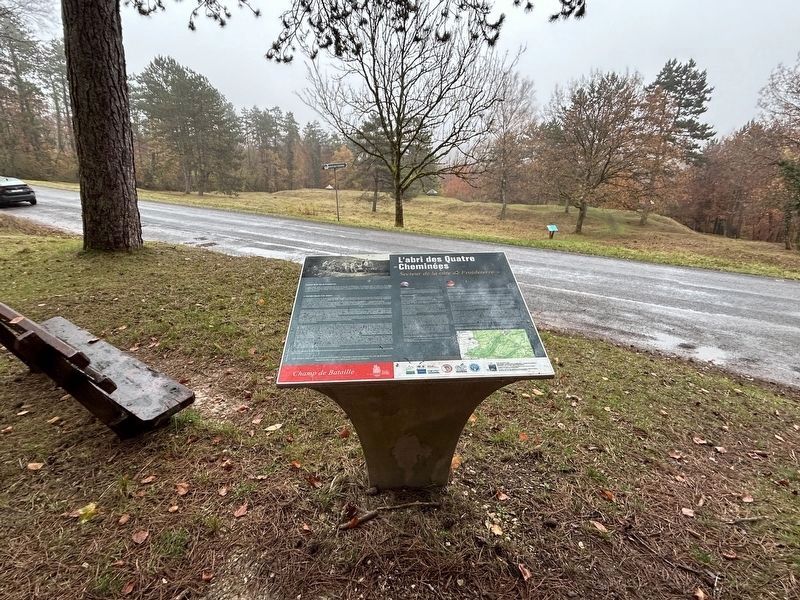
2. L'abri des Quatre Cheminées Marker
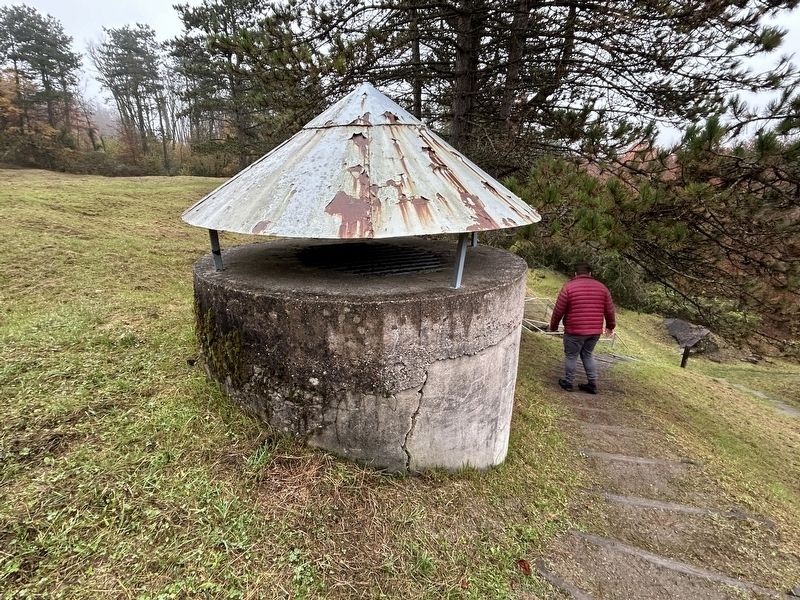
This looking over the marker towards the four chimneys across the road. Two chimneys are visible in the background - they are the small pyramids.
Photographed by Steve Stoessel, November 17, 2024
3. One of the Four Chimneys
Credits. This page was last revised on February 18, 2025. It was originally submitted on February 4, 2025, by Steve Stoessel of Niskayuna, New York. This page has been viewed 120 times since then and 28 times this year. Photos: 1. submitted on February 4, 2025, by Steve Stoessel of Niskayuna, New York. 2, 3. submitted on February 18, 2025, by Steve Stoessel of Niskayuna, New York.
