Near Damloup in Meuse, Alsace, Lorraine, Champagne-Ardenne, France — Western Europe
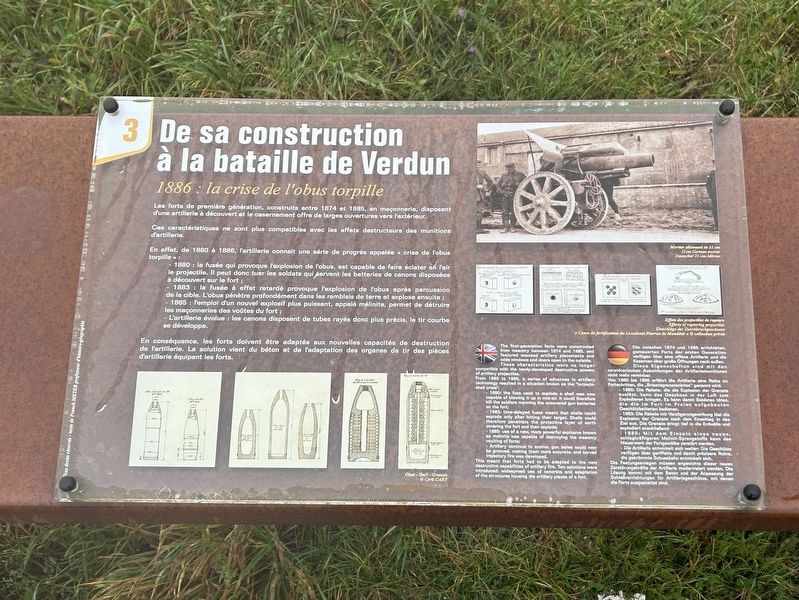
De sa construction à la bataille de Verdun
1886 : la crise de l'obus torpille
Photographed by Steve Stoessel, November 18, 2024
1. De sa construction à la bataille de Verdun Marker

Les forts de première génération, construits entre 1874 et 1885, en maçonnerie, disposent d'une artillerie à découvert et le casernement offre de larges ouvertures vers l'extérieur.
Ces caractéristiques ne sont plus compatibles avec les effets destructeurs des munitions d'artillerie.
En effet, de 1880 à 1886, l'artillerie connait une série de progrès appelée « crise de l'obus torpille » :
- 1880: la fusée qui provoque l'explosion de l'obus, est capable de faire éclater en l'air le projectile. Il peut donc tuer les soldats qui servent les batteries de canons disposées à découvert sur le fort
- 1883 : la fusée à effet retardé provoque l'explosion de l'obus après percussion de la cible. L'obus pénètre profondément dans les remblais de terre et explose ensuite
- 1885 : l'emploi d'un nouvel explosif plus puissant, appelé mélinite, permet de détruire les maçonneries des voûtes du fort
- L'artillerie évolue: les canons disposent de tubes rayés donc plus précis, le tir courbe se développe.
En conséquence, les forts doivent être adaptés aux nouvelles capacités de destruction de l'artillerie. La solution vient du béton
this page online
From 1880 to 1886, a series of advances In artillery technology resulted in a situation known as the "torpedo-shell crisis":
- 1880: the fuse used to explode a shell was now capable of blowing it up in mid-air. It could therefore kill the soldiers manning the uncovered gun batteries on the fort;
- 1883: time-delayed fuses meant that shells could explode only after hitting their target. Shells could therefore penetrate the protective layer of earth covering the fort and then explode;
- 1885: use of a new, more powerful explosive known as melinite was capable of destroying the masonry vaulting of forts;
- Artillery continue to evolve: gun bores could now be grooved, making them more accurate, and curved trajectory fire was developed.
This meant that forts had to be
Photographed by Steve Stoessel, November 18, 2024
2. De sa construction à la bataille de Verdun Marker
Von 1880 bis 1886 erfährt die Artillerie eine Reihe an Fortschritten, die „Brisanzgranatenkrise" genannt wird.
- 1880: Die Rakete, die die Explosion der Granate auslöst, kann das Geschoss in der Luft zum Explodieren bringen. Es kann damit Soldaten töten, die die Im Fort Im Freien aufgebauten Geschützbatterien bedienen.
- 1883: Die Rakete mit Verzögerungswirkung löst die Explosion der Granate nach dem Einschlag in das Ziel aus. Die Granate dringt tief In die Erdwälle und explodiert anschließend.
• 1885: Mit dem Einsatz eines neuen, schlagkräftigeren Melinit-Sprengstoffs kann das Mauerwerk der Fortgewölbe zerstört werden.
- Die Artillerie entwickelt sich weiter: Die
Photographed by Steve Stoessel, November 18, 2024
3. De sa construction à la bataille de Verdun Marker
Die Festungsanlagen müssen angesichts dieser neuen Zerstörungskräfte der Artillerie modernisiert werden. Die Lösung kommt mit dem Beton und der Anpassung der Schleßvorrichtungen für Artilleriegeschütze, mit denen die Forts ausgestattet sind.
[Photo Captions]
Mortier allemand de 21 cm
21cm German mortar
Deutscher 21-cm-Morder
Effets des projectlles de rupture
Effects of rupturing projectiles
Einschläge der Durchbruchgeschosse
(Marker Number 3.)
Topics. This historical marker is listed in these topic lists: Forts and Castles • War, World I. A significant historical year for this entry is 1886.
Location. 49° 12.018′ N, 5° 28.199′ E. Marker is near Damloup, Grand Est (Alsace, Lorraine, Champagne-Ardenne), in Meuse. It can be reached from Grand Est Route 913a near Route 913. Mark is on top of Fort Vaux. Touch for map. Marker is in this post office area: Damloup, Grand Est 55400, France. Touch for directions.

Regionally, it is in the North Atlantic Region, Europe, the European Union, Atlantic Europe, the Schengen Area, Western Europe, a coastal Mediterranean country, and the Western World. Historically, it finds itself in what was once a French colony, the Roman Empire, and specifically the Holy Roman Empire.
Other nearby markers. At least 8 other markers are within walking distance of this marker: Dans la bataille de Verdun (here, next to this marker); a different marker also named De sa construction à la bataille de Verdun (here, next to this marker); a different marker also named Dans la bataille de Verdun (here, next to this marker); a different marker also named Dans la bataille de Verdun (a few steps from this marker); a different marker also named De sa construction à la bataille de Verdun (a few steps from this marker); Les Défenseurs du Fort de Vaux (a few steps from this marker); Dans la Bataille de Verdun (a few steps from this marker); a different marker also named Dans la bataille de Verdun (a few steps from this marker). Touch for a list and map of all markers in Damloup.
Credits. This page was last revised on February 19, 2025. It was originally submitted on February 6, 2025, by Steve Stoessel of Niskayuna, New York. This page has been viewed 103 times since then and 14 times this year. Photos: 1, 2, 3. submitted on February 6, 2025, by Steve Stoessel of Niskayuna, New York.
