Near Damloup in Meuse, Alsace, Lorraine, Champagne-Ardenne, France — Western Europe
Dans la bataille de Verdun
24 octobre - 2 novembre 1916: La reconquête française
Photographed by Steve Stoessel, November 18, 2024
1. Dans la bataille de Verdun Marker

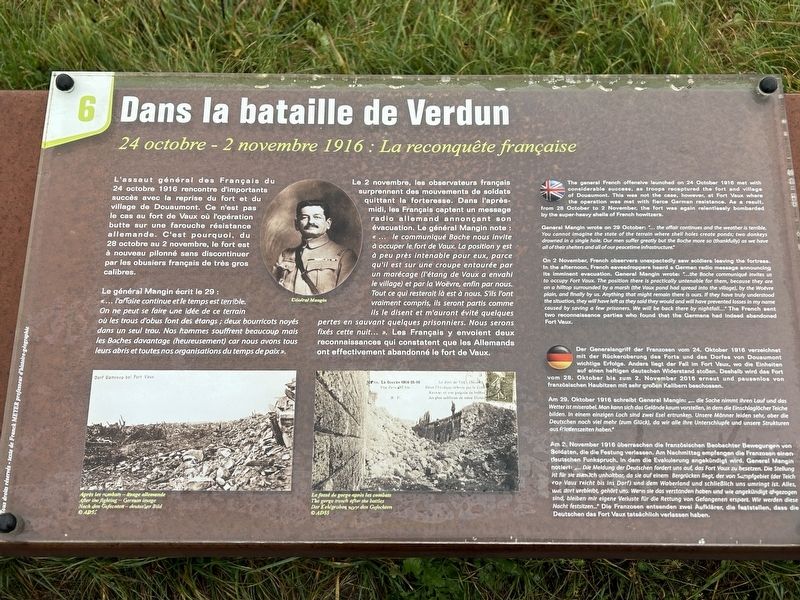
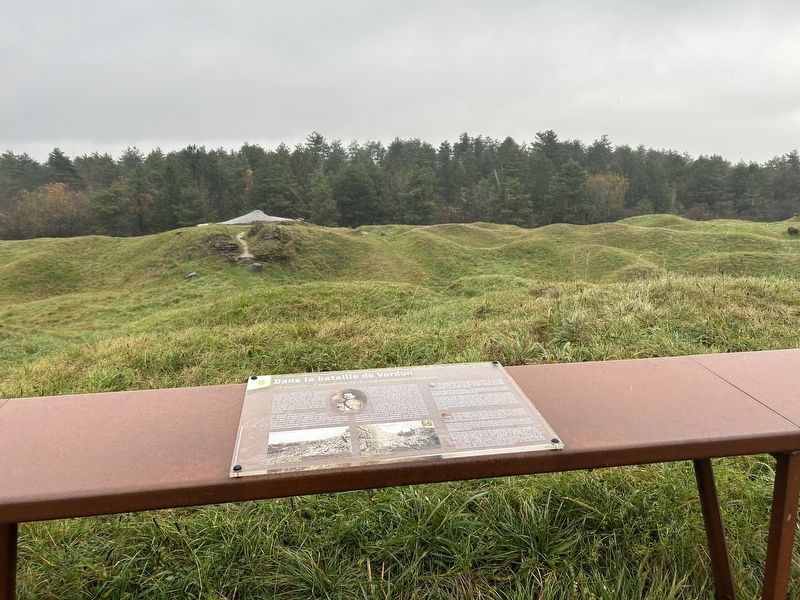
L'assaut général des Français du 24 octobre 1916 rencontre d'importants succès avec la reprise du fort et du village de Douaumont. Ce n'est pas le cas au fort de Vaux où l'opération butte sur une farouche résistance allemande. C'est pourquoi, du 28 octobre au 2 novembre, le fort est à nouveau pilonné sans discontinuer par les obusiers français de très gros calibres.
Le général Mangin écrit le 29 :
«... l'affaire continue et le temps est terrible.
On ne peut se faire une idée de ce terrain où les trous d'obus font des étangs; deux bourricots noyés dans un seul trou. Nos hommes souffrent beaucoup mais les Boches davantage (heureusement) car nous avons tous leurs abris et toutes nos organisations du temps de paix ».
Le 2 novembre, les observateurs français surprennent des mouvements de soldats quittant la forteresse. Dans l'après-midi, les Français captent un message radio allemand annonçant son évacuation. Le général Mangin note :
« … le communiqué Boche nous invite à occuper le fort de Vaux. La position y est à peu près intenable pour eux, parce qu'il est sur une croupe entourée par un marécage (l'étang de Vauxa envahi le village) et par la Woëvre, enfin par nous. Tout ce qui resterait là est à nous. S'ils l'ont vraiment compris, ils seront partis comme ils le disent et m'auront évité quelques pertes en sauvant quelques prisonniers. Nous serons fixés cette nuit... ».
Click or scan to see
this page online
Les Français y envoient deux reconnaissances qui constatent que les Allemands ont effectivement abandonné le fort de Vaux.
General Mangin wrote on 29 October: “... the affair continues and the weather is terrible. You cannot imagine the state of the terrain where shell holes create ponds; two donkeys drowned in a single hole. Our men suffer greatly but the Boche more so (thankfully) as we have all of their shelters and all of our peacetime infrastructure."
On 2 November, French observers unexpectedly
Photographed by Steve Stoessel, November 18, 2024
2. Dans la bataille de Verdun Marker
Photographed by Steve Stoessel, November 18, 2024
3. Dans la bataille de Verdun Marker
Am 2, November 1916 überraschen die französischen Beobachter Bewegungen von Soldaten, die die Festung verlassen. Am Nachmittag empfangen die Franzosen einen deutschen Funkspruch, in dem die Evakuierung angekündigt wird. General Mangin notiert: „... Die Meldung der Deutschen fordert uns auf, das Fort Vaux zu besetzen. Die Stellung ist für sie ziemlich unhaltbar, da sie auf einem Bergrücken liegt, der von Sumpfgebiet (der Teich von Vaux reicht bis ins Dorf) und dem Waberland und schließlich uns umringt ist. Alles, was dort verbleibt, gehört uns. Wenn sie das verstanden haben und wie angekündigt abgezogen sind, bleiben mir eigene Verluste für die Rettung von Gefangenen erspart. Wir werden diese Nacht festsitzen..." Die Franzosen entsenden zwei Aufklärer, die feststellen, dass die Deutschen das Fort Vaux tatsächlich verlassen haben.
[Photo Captions]
General Mangin
Topics. This historical marker is listed in this topic list: Forts and Castles. A significant historical date for this entry is October 24, 1916.
Location. 49° 12.015′ N, 5° 28.207′ E. Marker is near Damloup, Grand Est (Alsace, Lorraine, Champagne-Ardenne), in Meuse. It can be reached from Grand Est Route 913a near Route 913. Touch for map. Marker is at or near this postal address: D913a, Damloup, Grand Est 55400, France. Touch for directions.

Regionally, it is in the North Atlantic Region, Europe, the European Union, Atlantic Europe, the Schengen Area, Western Europe, a coastal Mediterranean country, and the Western World. Historically, it finds itself in what was once a French colony, the Roman Empire, and specifically the Holy Roman Empire.
Other nearby markers. At least 8 other markers are within walking distance of this marker: A different marker also named Dans la bataille de Verdun (here, next to this marker); De sa construction à la bataille de Verdun (here, next to this marker); a different marker also named Dans la bataille de Verdun (a few steps from this marker); a different marker also named De sa construction à la bataille de Verdun (a few steps from this marker); a different marker also named De sa construction à la bataille de Verdun (a few steps from this marker); a different marker also named Dans la bataille de Verdun (a few steps from this marker); Les Défenseurs du Fort de Vaux (a few steps from this marker); Pigeon de Verdun (a few steps from this marker). Touch for a list and map of all markers in Damloup.
Credits. This page was last revised on February 19, 2025. It was originally submitted on February 6, 2025, by Steve Stoessel of Niskayuna, New York. This page has been viewed 133 times since then and 24 times this year. Photos: 1, 2, 3. submitted on February 6, 2025, by Steve Stoessel of Niskayuna, New York.
