Prati in Roma in Città metropolitana di Roma Capitale, Latium, Rome, Italy — Central Italy (Tyrrhenian Coast)
Monumento a Camillo Benso Conte di Cavour
⎯⎯⎯
Monument to Camillo Benso Count of Cavour
Photographed by James Hulse, March 3, 2024
1. Monumento a Camillo Benso Conte di Cavour / Monument to Camillo Benso Count of Cavour Marker

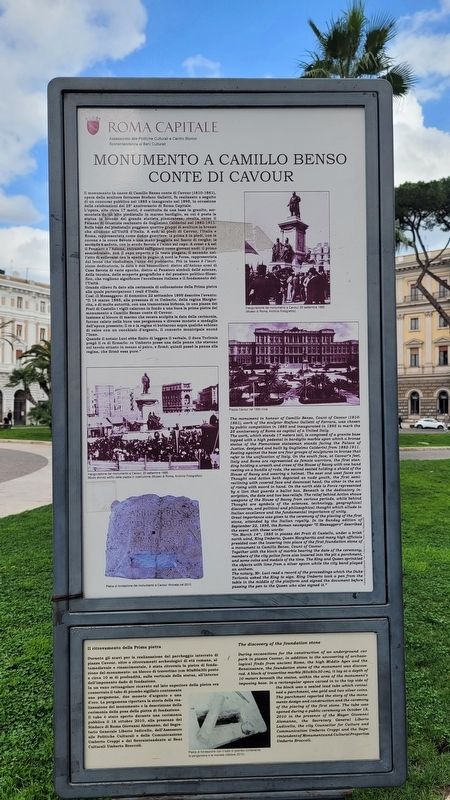
Il monumento in onore di Camillo Benso conte di Cavour (1810-1861), opera dello scultore ferrarese Stefano Galletti, fu realizzato a seguito di un concorso pubblico nel 1885 e inaugurato nel 1895, in occasione delle celebrazioni del 25° anniversario di Roma Capitale.
L'opera, alta circa 17 metri, è costituita da una base in granito, sormontata da un alto piedistallo in marmo bardiglio, su cui è posta la statua in bronzo del grande statista piemontese, rivolta verso il Palazzo di Giustizia realizzato da Guglielmo Calderini nel 1882-1911. Sulla base del piedistallo poggiano quattro gruppi di sculture in bronzo che alludono all'Unità d'Italia. A sud, ai piedi di Cavour, l'Italia e Roma, rappresentate come donne guerriere: la prima è in piedi, con la corona e la croce Savoia e una mano poggiata sul fascio di verghe; la seconda è seduta, con lo scudo Savoia e l'elmo sul capo. A ovest e a est il Pensiero e l'Azione, entrambi raffigurati come giovani nudi: il primo semisdraiato, con il capo coperto e la testa piegata; il secondo nell'atto di sollevarsi con la spada in pugno. A nord la Forza, rappresentata dal leone che custodisce l'urna del plebiscito. Più in basso è l'iscrizione dedicatoria, la data e due bassorilievi: dietro all'Azione armi di Casa Savoia di varie epoche, dietro al Pensiero simboli delle scienze, della tecnica, delle scoperte geografiche e del pensiero politico-filosofico, che vogliono significare l'eccellenza italiana e il fondamento dell'Unità.
Grande rilievo fu dato alla cerimonia di collocazione della Prima pietra alla quale parteciparono i reali d'Italia.
Così «Il Messaggero» di domenica 22 settembre 1895 descrive l'evento: "Il 14 marzo 1885, alla presenza di re Umberto, della regina Margherita, e di molte autorità, con una tramontana birbona, in una piazza dei Prati di Castello i vigili calarono in fondo a una buca la prima pietra del monumento a Camillo Benso conte di Cavour.
Insieme al blocco di marmo che recava scolpita la data della cerimonia, furono calate nella buca una pergamena e diverse monete e medaglie dell'epoca presente; il re e la regina vi buttarono sopra qualche schizzo di calce con un cucchiaio d'argento, il concerto municipale suonò l'inno.
Quando il notaio Luci ebbe finito di leggere il verbale, il duca Torlonia pregò il re di firmarlo: re Umberto prese una delle penne che stavano sul tavolo situato in mezzo al palco, e firmò; quindi passò la penna alla regina, che firmò essa pure."
Il ritrovamento della Prima pietra
Durante
this page online
In un vano rettangolare ricavato sul lato superiore della pietra era conservato il tubo di piombo sigillato contenente una pergamena, due monete d'argento e una d'oro. La pergamena riportava la storia della realizzazione del monumento e la descrizione della cerimonia della posa della pietra di fondazione. Il tubo è stato aperto durante una cerimonia pubblica il 18 ottobre 2010, alla presenza del Sindaco di Roma Giovanni Alemanno, del Segretario Generale Liborio Iudicello, dell'Assessore alle Politiche Culturali e della Comunicazione Umberto Croppi e del Sovraintendente ai Beni Culturali Umberto Broccoli.
Didascalie
(Foto #1) Inaugurazione del monumento a Cavour, 20 settembre 1895. (Museo di Roma, Archivio Fotografico)
(Foto #2) Piazza Cavour nel 1930 circa
(Foto #3) Inaugurazione del monumento a Cavour, 20 settembre 1895. Sullo sfondo edifici della piazza in costruzione (Museo di Roma, Archivio Fotografico)
(Foto #4) Pietra di fondazione del monumento a Cavour ritrovata nel 2010
(Foto #5) Pietra di fondazione con il tubo in piombo contenente la pergamena e le monete (ottobre 2010)
The
Photographed by James Hulse, March 3, 2024
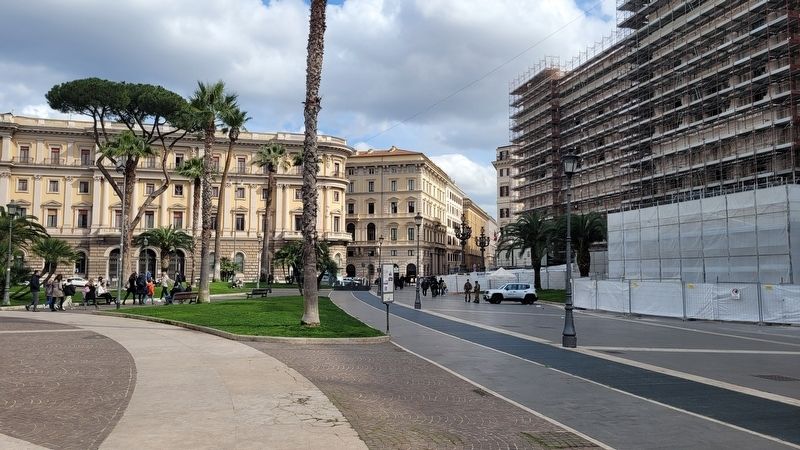
2. The view of the Marker in front of the Supreme Court building
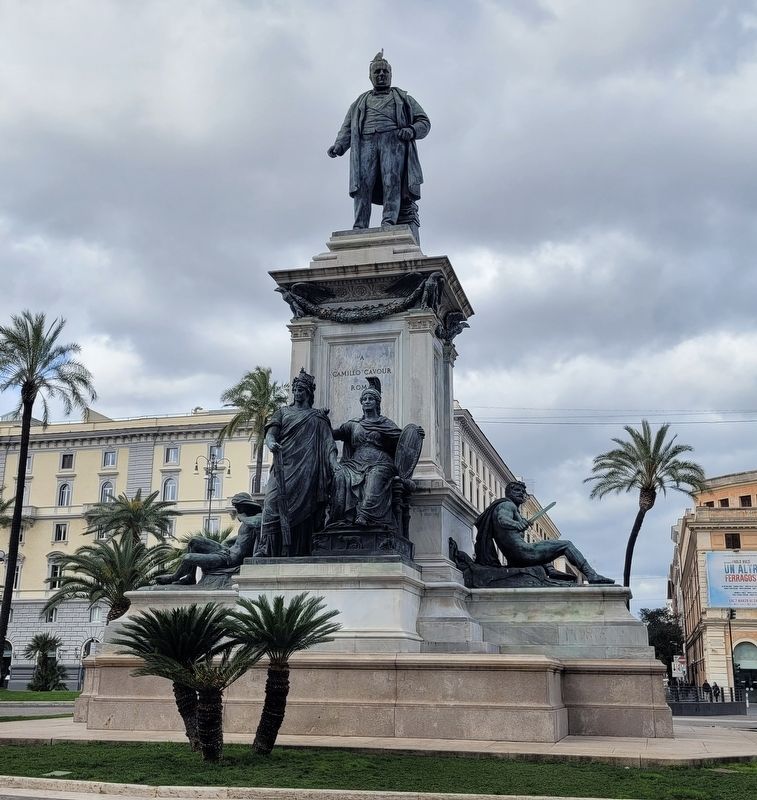
The work, which stands 17 meters tall, is composed of a granite base topped with a high pedestal in bardiglio marble upon which a bronze statue of the Piemontese statesman stands facing the Palace of Justice, designed and built by Guglielmo Calderini from 1882-1911.
Resting against the base are four groups of sculptures in bronze that refer to the unification of Italy. On the south face, at Cavour's feet, Italy and Rome are represented as female warriors, the first standing holding a wreath and cross of the House of Savoy with one hand resting on a bundle of rods, the second seated holding a shield of the House of Savoy and wearing a helmet. The east and west faces are Thought and Action both depicted as nude youth, the first semireclining with covered face and downcast head, the other in the act of rising with sword in hand. On the north side is Force represented by a lion that guards
Photographed by James Hulse, March 3, 2024
3. The Monument to Camillo Benso Count of Cavour
Great importance was given to the ceremony of the placing of the first stone, attended by the Italian royalty. In its Sunday edition of September 22, 1895, the Roman newspaper "Il Messaggero" described the event with these words:
"On March 14th, 1885 in piazza dei Prati di Castello, under a brisk north wind, King Umberto, Queen Margherita and many high officials presided over the lowering into place of the first foundation stone of a monument to Camillo Benso, Count of Cavour.
Together with the block of marble bearing the date of the ceremony, members of the city police force also lowered into the pit a parchment, and some coins and medals of the time. The King and Queen sprinkled the objects with lime from a silver spoon while the city band an anthem.
The notary, Mr. Luci read a record of the proceedings which the Duke Torlonia asked the King to sign. King Umberto took a pen from the table in the middle of the platform and signed the document before passing the pen to the Queen who also signed it."
The discovery of the foundation stone
During
Public Domain - Artist Antonio Ciseri - Wikipedia Commons, 1861
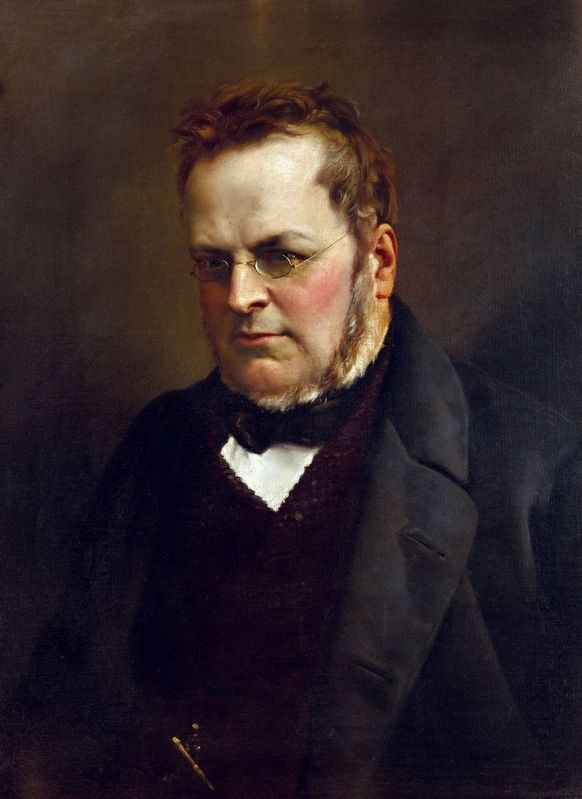
4. Camillo Benso Count of Cavour - 1st Prime Minister of Italy
Inscription on the back of the canvas: Ant. Ciseri painted it in Florence from a photograph, towards the end of 1861
Captions
Photo #1: Inauguration of the Monument to Cavour, September 20, 1895. (Museum of Rome, Photographic Archive)
Photo #2: Piazza Cavour around 1930
Photo #3: Inauguration of the Monument to Cavour, September 20, 1895. In the background, buildings of the square under construction. (Museum of Rome, Photographic Archive)
Photo #4: Foundation stone of the Monument to Cavour found in 2010
Photo #5: Foundation stone with the lead tube containing the parchment and coins (October 2010)
Erected by Roma Capitale, Department of Cultural Policies and Historic Center, Superintendence for Cultural Heritage.
Topics. This historical marker is listed in these topic lists: Architecture • Arts, Letters, Music. A significant historical date for this entry is March 14, 1885.
Location. 41° 54.311′ N, 12° 28.2′ E. Marker is in Roma, Lazio (Latium, Rome), in Città metropolitana di Roma Capitale. It is in Prati. It is at the intersection of Piazza Cavour and Via Cicerone on Piazza Cavour. The marker is located in the Piazza Cavour in front of the Supreme Court building. Touch for map. Marker is at or near this postal address: Piazza Cavour SNC, Roma, Lazio 00193, Italy. Touch for directions.

Regionally, it is in Europe, the European Union, the Schengen Area, a coastal Mediterranean country, and the Western World. Historically, it finds itself in what was once the Roman Empire.
Other nearby markers. At least 8 other markers are within walking distance of this marker: Ponte Umberto I / Umberto I Bridge (about 240 meters away, measured in a direct line); Chiesa di Santa Maria in Porta Paradisi / Church of Saint Mary in the Gate of Paradise (approx. 0.6 kilometers away); Vincenzo Monti and Costanza Monti Perticari (approx. 0.6 kilometers away); Palazzo Incontro (approx. 0.6 kilometers away); Ponte Vittorio Emanuele II / Victor Emmanuel II Bridge (approx. 0.6 kilometers away); Eleonora de Fonseca Pimentel (approx. 0.7 kilometers away); Chiesa di San Luigi dei Francesi / Church of St. Louis of the French (approx. 0.7 kilometers away); San Luigi dei Francesi / Saint Louis of the French (approx. 0.7 kilometers away). Touch for a list and map of all markers in Roma.
Also see . . . Camillo Benso, Count of Cavour. Wikipedia
Camillo Paolo Filippo Giulio Benso, Count of Cavour, Isolabella and Leri (Italian: [kaˈmillo ˈbɛnso]; 10 August 1810 – 6 June 1861), generally known as the Count of Cavour (/kəˈvʊər/ kə-VOOR; Italian: Conte di Cavour [ˈkonte di kaˈvur]) or simply Cavour, was an Italian politician, statesman, businessman, economist, and noble, and a leading figure in the movement towards Italian unification. He was one of the leaders of the Historical Right and Prime Minister of the Kingdom of Sardinia from 1852, a position he maintained (except for a six-month resignation) until his death, throughout the Second Italian War of Independence and Giuseppe Garibaldi's campaigns to unite Italy. After the declaration of a united Kingdom of Italy, Cavour took office as the first Prime Minister of Italy; he died after only three months in office and did not live to see the Roman Question solved through the complete unification of the country after the Capture of Rome in 1870.(Submitted on February 9, 2025, by James Hulse of Medina, Texas.)
Credits. This page was last revised on February 9, 2025. It was originally submitted on February 6, 2025, by James Hulse of Medina, Texas. This page has been viewed 372 times since then and 125 times this year. Photos: 1, 2, 3, 4. submitted on February 9, 2025, by James Hulse of Medina, Texas.
