Near Cerny-en-Laonnois in Aisne, Upper France, France — Western Europe
Les Britanniques sur le Chemin des Dames
Photographed by Steve Stoessel, November 18, 2024
1. Les Britanniques Sur Le Chemin des Dames Marker

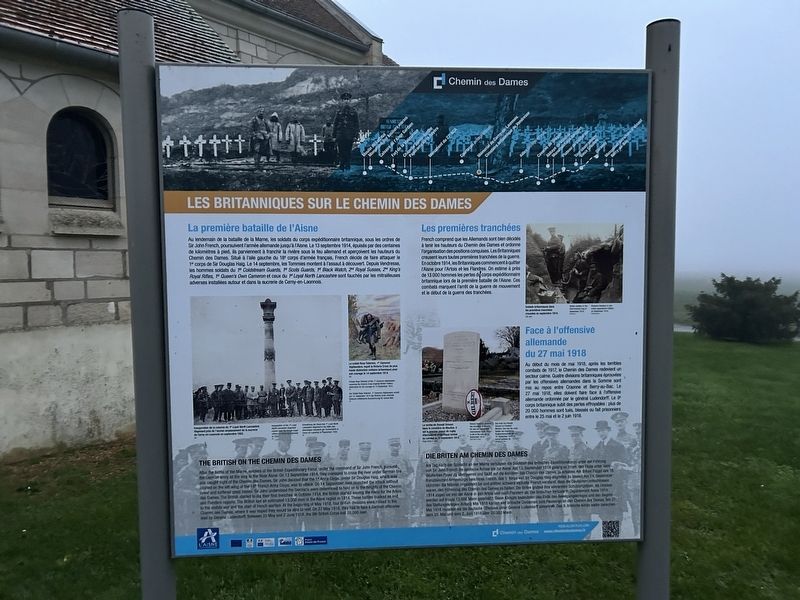
Au lendemain de la bataille de la Marne, les soldats du corps expéditionnaire britannique, sous les ordres de Sir John French, poursuivent l'armée allemande jusqu'à l'Aisne. Le 13 septembre 1914, épuisés par des centaines de kilomètres à pied, ils parviennent à franchir la rivière sous le feu allemand et aperçoivent les hauteurs du Chemin des Dames. Situé à l'aile gauche du 18e corps d'armée français, French décide de faire attaquer le 1e corps de Sir Douglas Haig. Le 14 septembre, les Tommies montent à l'assaut à découvert. Depuis Vendresse, les hommes soldats du 1st Coldstream Guards, 1st Scots Guards, 1st Black Watch, 2nd Royal Sussex, 2nd King's Royal Rifles, 2nd Queen's Own Cameron et ceux du 1st Loyal North Lancashire sont fauchés par les mitrailleuses adverses installées autour et dans la sucrerie de Cerny-en-Laonnois.
Les premières tranchées
French comprend que les Allemands sont bien décidés à tenir les hauteurs du Chemin des Dames et ordonne l'organisation des positions conquises. Les Britanniques creusent leurs toutes premières tranchées de la guerre. En octobre 1914,
this page online
Face à l'offensive allemande du 27 mai 1918
Au début du mois de mai 1918, après les terribles combats de 1917, le Chemin des Dames redevient un secteur calme. Quatre divisions britanniques éprouvées par les offensives allemandes dans la Somme sont mis au repos entre Craonne et Berry-au-Bac. Le 27 mai 1918, elles doivent faire face à l'offensive allemande ordonnée par le général Ludendorff. Le 9° corps britannique subit des pertes effroyables : plus de 20 000 hommes sont tués, blessés ou fait prisonniers entre le 25 mai et le 2 juin 1918.
After the Battle of the Marne, soldiers of the British Expeditionary Force, under the command of Sir John French, pursued the German army all the way to the River Aisne. On 13 September 1914, they managed to cross the river under German fire and caught sight of the Chemin
Photographed by Steve Stoessel, November 18, 2024
2. Les Britanniques Sur Le Chemin des Dames Marker
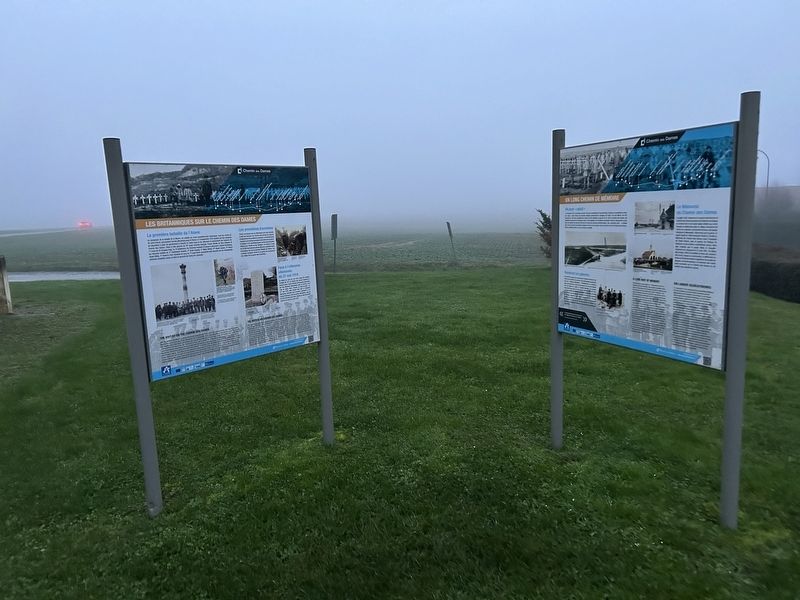
Am Tag nach der Schlacht an der Marne verfolgten die Soldaten des britischen Expeditionskorps unter der Führung von Sir John French die deutsche Armee bis zur Aisne. Am 13. September 1914 gelang es ihnen, den Fluss unter dem deutschen Feuer zu überqueren und Sicht auf die Anhöhen des Chemin des Dames zu erhalten, Am linken Flügel des 18. französischen Armeekorps beschloss French, das 1. Korps von Sir Douglas Haig angreifen zu lassen. Am 14 September stürmten die Männer ungedeckt los und erlitten schwere Verluste, French verstand, dass die Deutschen entschlossen wären, den Höhenzug des Chemin des Dames zu halten. Die Briten gruben ihre allerersten Schützengräben. Ab Oktober 1914 zogen sie von der Aisne in den Artois und nach Flandern ab. Die britischen Verluste In Departement Aisne 1914 werden auf knapp 13.000 Mann geschätzt. Diese Kämpfe bedeuteten das Ende des Bewegungskrieges und den Beginn des Stellungskrieges. Anfang Mai 1918 kamen vier britische Divisionen zum Pausieren an den Chemin des Dames, Am 27. Mai 1918 mussten sie die deutsche Offensive unter General Ludendorff abwehren, Das 9, britische Korps verlor zwischen dem 25. Mat und dem 2. Juni 1918 über 20.000 Mann.
[Photo Captions]
Topics and series. This historical marker is listed in this topic list: War, World I. In addition, it is included in the Victoria Cross and George Cross Recipients series list. A significant historical month for this entry is May 1918.
Location. 49° 26.586′ N, 3° 40.031′ E. Marker is near Cerny-en-Laonnois, Hauts-de-France (Upper France), in Aisne. It is at the intersection of Hauts-de-France Route 18cd and Gr. Grande Rue ( Route 967), on the right when traveling east on Hauts-de-France Route 18cd. Touch for map. Marker is in this post office area: Cerny-en-Laonnois, Hauts-de-France 02860, France. Touch for directions.

Regionally, it is in the North Atlantic Region, Europe, the European Union, Atlantic Europe, the Schengen Area, Western Europe, a coastal Mediterranean country, and the Western World. Historically, it finds itself in what was once a French colony and also the Roman Empire.
Other nearby markers. At least 8 other markers are within 5 kilometers of this marker, measured as the crow flies: Un Long Chemin de Mémoire (here, next to this marker); La Mort de Masse (a few steps from this marker); Cerny-en-Laonnois (a few steps from this marker); La nécropole nationale de Cerny-en-Laonnois (within shouting distance of this marker); 41ème Bataillon de Chasseurs à Pied (approx. 4.7 kilometers away); Aux morts de la 164e Division (approx. 4.7 kilometers away); A la Gloire du 4 Régiment de Zouaves (approx. 4.7 kilometers away); « Ils N'ont Pas Choisi Leur Sepulture » (approx. 4.8 kilometers away). Touch for a list and map of all markers in Cerny-en-Laonnois.
Credits. This page was last revised on February 15, 2025. It was originally submitted on February 7, 2025, by Steve Stoessel of Niskayuna, New York. This page has been viewed 126 times since then and 17 times this year. Photos: 1, 2. submitted on February 7, 2025, by Steve Stoessel of Niskayuna, New York.
