Trevi in Roma in Città metropolitana di Roma Capitale, Latium, Rome, Italy — Central Italy (Tyrrhenian Coast)
Hotel White

Photographed by James Hulse, February 28, 2024
1. Hotel White Marker

Il discreto ed elegante hotel White, già rispondente all'insegna di albergo Tunnel in relazione al vicino Traforo Umberto I, ha sede nel cuore dello storico rione Trevi, inserito nella suggestiva rete di strade che convergono verso la piazza della più celebre fontana capitolina. L'albergo si affaccia sull'ombrosa e pittoresca via in Arcione, che, insieme a via del Lavatore e via delle Muratte, rappresentava il percorso che costeggiava l'estremità settentrionale del colle Quirinale. Il tracciato della via si svolge in prossimità del grandioso complesso architettonico che dal 1947 è sede della Presidenza della Repubblica Italiana, il cui nucleo originario risale al XV secolo. La zona ebbe la decisiva configurazione urbanistica durante il pontificato di Pio IV dei Medici, che nel 1561 promosse l'apertura della via Pia (corrispondente alle attuali vie del Quirinale e XX Settembre), e poi con Sisto V, che alla fine dello stesso secolo si occupò della storica via Felice (corrispondente a via delle Quattro Fontane). In seguito alle iniziative nate dall'illuminata politica papale, nella zona iniziò un rapido processo di sviluppo edilizio, culminante nel monumentale palazzo sulla vetta del colle. La strada deve il toponimo alla presenza dell'arcuazione dell'Acqua Vergine, che attraversava per intero l'area; con lo stesso nome nel Medioevo si identificava la circostante ed estesa contrada, che arrivava fino alle pendici del Quirinale. Questa zona era percorsa dalla via della Chiavica del Bufalo, che dalla Fontana di Trevi giungeva a piazza di Spagna, il cui nome si legava all'acquedotto, la cosiddetta Chiavica Del Bufalo, che su grandi arcate portava l'acqua Vergine in città. L'area era occupata dal grande giardino della villa dei Del Bufalo, animato da un casino dalle facciate splendidamente affrescate
this page online
Didascalie
(Foto #1) Prospetto originale, Roma, Archivio Storico Capitolino
The discrete and elegant Hotel White
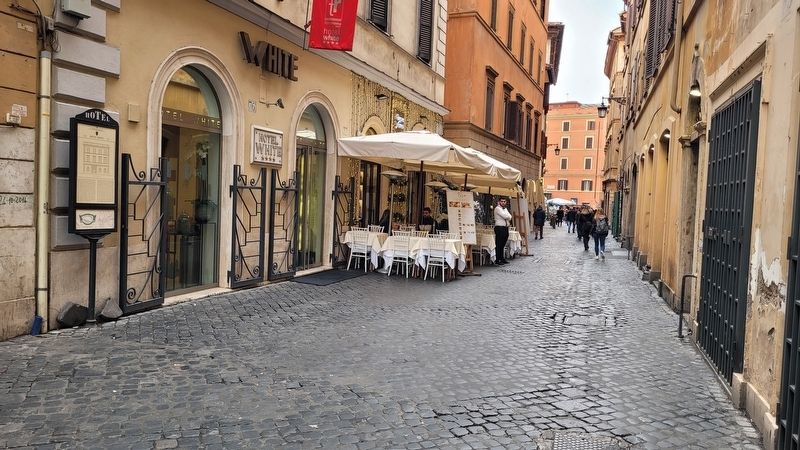
Photographed by James Hulse, February 28, 2024
2. The view of the Hotel White and Marker along the street

Photographed by James Hulse, February 28, 2024
3. Hotel White
Captions
(Photo #1) Original document, Rome, Capitolini Historical Archive
Erected by Ministry for Cultural Heritage and Activities City of Rome - Department of Cultural Policies - Superintendency for Cultural Heritage Policies for International Promotion of Tourism and Fashion Mirabilia Project - Communication Plan for National Cultural Heritage.
Topics. This historical marker is listed in this topic list: Industry & Commerce. A significant historical year for this entry is 1947.
Location. 41° 54.118′ N, 12° 29.14′ E. Marker is in Roma, Lazio (Latium, Rome), in Città metropolitana di Roma Capitale. It is in Trevi. It is on Via in Arcione just west of Via del Traforo, on the left when traveling west. The marker is located at the front of the hotel. Touch for map. Marker is at or near this postal address: Via in Arcione 76, Roma, Lazio 00187, Italy. Touch for directions.

Regionally, it is in Europe, the European Union, the Schengen Area, a coastal Mediterranean country, and the Western World. Historically, it finds itself in what was once the Roman Empire.
Other nearby markers. At least 8 other markers are within walking distance of this marker: Alessandro Verri (within shouting distance of this marker); Giuseppe Celani (about 150 meters away, measured in a direct line); Sandro Pertini (about 180 meters away); Rione II Trevi / District II Trevi (about 240 meters away); Chiesa di Sant'Andrea delle Fratte / Church of Sant'Andrea delle Fratte (approx. 0.2 kilometers away); Trevi-Pantheon Route (approx. 0.2 kilometers away); Chiesa di Santa Maria in Trivio / Church of Santa Maria in Trivio (approx. 0.3 kilometers away); Gian Lorenzo Bernini (approx. 0.3 kilometers away). Touch for a list and map of all markers in Roma.
Credits. This page was last revised on February 9, 2025. It was originally submitted on February 8, 2025, by James Hulse of Medina, Texas. This page has been viewed 97 times since then and 15 times this year. Photos: 1, 2, 3. submitted on February 9, 2025, by James Hulse of Medina, Texas.
