Geluveld near Zonnebeke in West-Vlaanderen, Flanders, Belgium — Northwestern Europe
Black Watch Corner
Photographed by Steve Stoessel, November 14, 2024
1. Black Watch Corner Marker

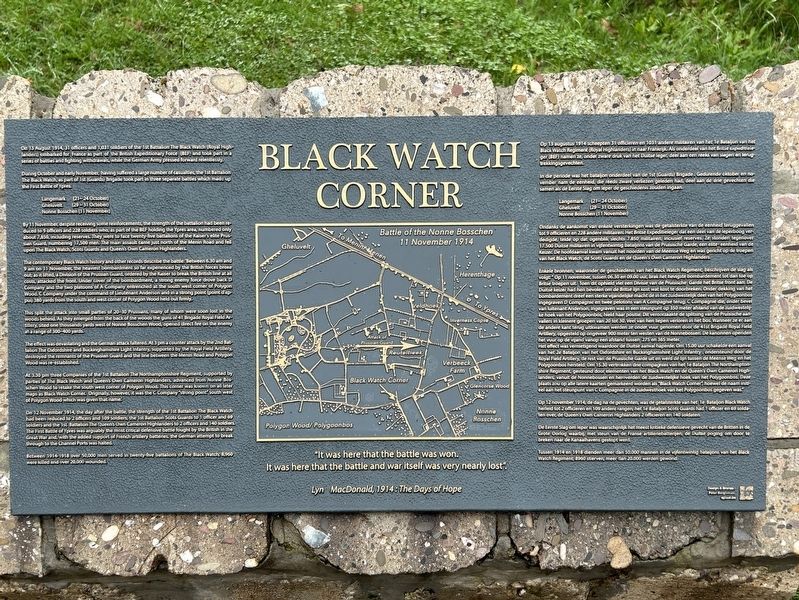
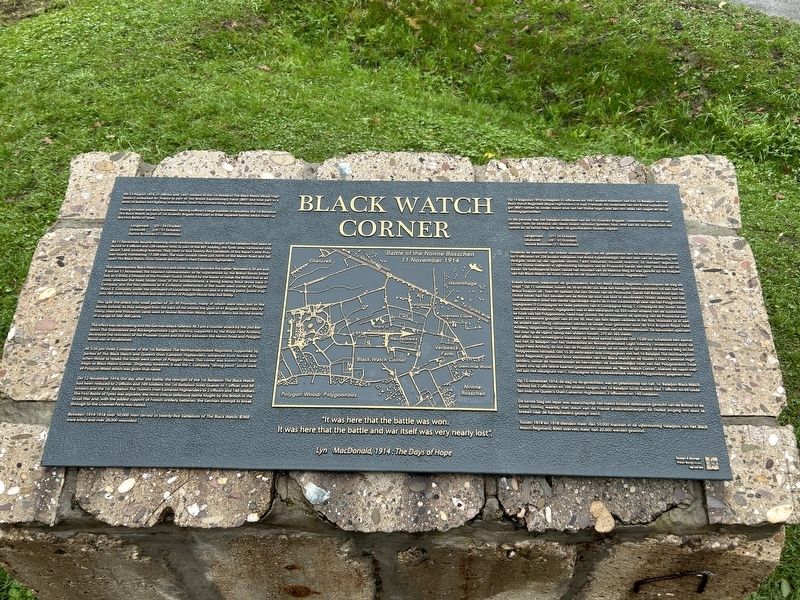
On 13 August 1914, 31 officers and 1,031 soldiers of the 1st Battalion - The Black Watch (Royal Highlanders) - embarked for France as part of the British Expeditionary Force (BEF) and took part in a series of battles and fighting withdrawals while the German Army pressed forward relentlessly.
During October and early November, having suffered a large number of casualties, the 1st Battalion, The Black Watch, as part of 1st (Guards) Brigade took part in three separate battles which made up the First Battle of Ypres:
Langemark (21-24 October)
Gheluvelt (29-31 October)
Nonne Bosschen (11 November)
By 11 November, despite receiving some reinforcements, the strength of the battalion had been reduced to 9 officers and 228 soldiers who, as part of the BEF holding the Ypres area, numbered only about 7,850, including reserves. They were to face twenty-five battalions of the Kaiser's elite Prussian Guard, numbering 17,500 men. The main assault came just north of the Menin Road and fell upon The Black Watch, Scots Guards and Queen's Own Cameron Highlanders.
The contemporary Black Watch history and other records describe
this page online
This split the attack into small parties of 20-30 Prussians, many of whom were soon lost in the woods behind. As they emerged from the back of the woods the guns of 41 Brigade Royal Field Artillery, sited one thousand yards west of Nonne Bosschen Wood, opened direct fire on the enemy at a range of 300-400 yards.
The effect was devastating and the German attack faltered. At 3 pm a counter attack by the 2nd Battalion The Oxfordshire and Buckinghamshire Light Infantry, supported by the Royal Field Artillery, destroyed the remnants of the Prussian Guard and the
Photographed by Steve Stoessel, November 14, 2024
2. Black Watch Corner Marker
At 3.30 pm three Companies of the 1st Battalion The Northamptonshire Regiment, supported by parties of The Black Watch and Queen's Own Cameron Highlanders, advanced from Nonne Bosschen Wood to retake the south west corner of Polygon Wood. This corner was known on all later maps as Black Watch Corner. Originally, however, it was the C Company "strong point" south west of Polygon Wood which was given that name.
On 12 November 1914, the day after the battle, the strength of the 1st Battalion The Black Watch had been reduced to 2 officers and 109 soldiers; the 1st Battalion Scots Guards to 1 officer and 69 soldiers and the 1st Battalion The Queen's Own Cameron Highlanders to 2 officers and 140 soldiers. The First Battle of Ypres was arguably the most critical defensive battle fought by the British in the Great War and, with the added support of French artillery batteries, the German attempt to break through to the Channel Ports was halted.
Between 1914-1918 over 50,000 men served in twenty-five battalions of The Black Watch: 8,960 were killed and over 20,000 wounded.
Photographed by Steve Stoessel, November 14, 2024
3. Black Watch Corner Marker
In die periode was het bataljon onderdeel van de 1st (Guards) Brigade, Gedurende oktober en november nam de eenheid, die reeds zware verliezen geleden had, deel aan de drie gevechten die samen als de Eerste Slag om leper de geschiedenis zouden ingaan.
Langemark (21-24 Oktober)
Gheluvelt (29 - 31 Oktober)
Nonne Bosschen (11 November)
Ondanks de aankomst van enkele versterkingen was de getalsterkte van de eenheid teruggevallen tot 9 officieren en 228 andere militairen. Het Britse Expeditieleger dat een deel van de Ieperboog verdedigde, telde op dat ogenblik slechts 7.850 militairen, inclusief reserves. Ze stonden tegenover 17.500 Duitse militairen in vijfentwintig bataljons van de Pruisische Garde, een elite- eenheid van de Keizer. De hoofdaanval kwam vanuit het noorden van de Meense Weg en was gericht op de troepen van
Photographed by Steve Stoessel, November 14, 2024
4. Black Watch Corner Marker
Enkele bronnen, waaronder de geschiedenis van het Black Watch Regiment, beschrijven de slag ais volgt: Op 11 november, tussen 06.30 en 09.00 uur, brak het hevigste bombardement tot dan toe op Britse troepen uit. Toen dit ophield viel een Divisie van de Pruisische Garde het Britse front aan. De Duitse keizer had hen bevolen om de Britse lijn kost wat kost te doorbreken. Onder dekking van het bombardement dreef een sterke vijandelijke macht de in het zuidwestelijk deel van het Polygoonbos ingegraven D Compagnie en twee pelotons van A Compagnie terug. C Compagnie die, onder bevel van luitenant Anderson, ingegraven was in een steunpunt op 350 meter afstand van de zuidwestelijke hoek van het Polygoonbos, hield haar positie. Dit veroorzaakte de splitsing van de Pruisische aanvallers in kleinere groepen van 20 tot 30. Veel van hen liepen verloren in het bos. Wanneer ze er aan de andere kant terug uitkwamen werden ze onder vuur genomen door de 41st Brigade Royal Field Artillery, opgesteld op ongeveer 900 meter ten westen van de Nonnebossen. De kanonnen openden het vuur op de vijand vanop een afstand tussen 275 en 365 meter.
Het effect was vernietigend waardoor de Duitse aanval haperde. Om 15.00 uur schakelde een aanval van het 2e Bataljon van het Oxfordshire en Buckinghamshire Light Infantry, ondersteund door de Royal Field Artillery, de rest van de Pruisische Garde uit en werd de lijn tussen de Meense Weg en het Polygoonbos hersteld. Om 15.30 vertrokken drie compagnies van het 1e Bataljon The Northamptonshire Regiment, gesteund door elementen van het Black Watch en de Queen's Own Cameron Highlanders, vanuit de Nonnebossen en heroverden de zuidwestelijke hoek van het Polygoonbos. Deze plaats zou op alle latere kaarten gemarkeerd worden als "Black Watch Corner', hoewel de naam initieel aan het steunpunt van C Compagnie in de zuidwesthoek van het Polygoonbos gegeven was
Op 12 november 1914, de dag na de gevechten, was de getalsterkte van het te Bataljon Black Watch herleid tot 2 officieren en 109 andere rangen; het 1e Bataljon Scots Guards had 1 officier en 69 soldaten over, de Queen's Own Cameron Highlanders 2 officieren en 140 soldaten. De Eerste Slag om leper was waarschijnlijk het meest kritieke defensieve gevecht van de Britten in de Grote Oorlog waarbij], met steun van de Franse artilleriebatterijen, de Duitse poging om door te breken naar de Kanaalhavens gestopt werd.
Tussen 1914 en 1918 dienden meer dan 50.000 mannen in de vijfentwintig bataljons van het Black Watch Regiment: 8960 stierven, meer dan 20.000 werden gewond.
Topics. This historical marker is listed in this topic list: War, World I. A significant historical date for this entry is August 13, 1914.
Location. 50° 50.903′ N, 2° 58.922′ E. Marker is near Zonnebeke, Vlaanderen (Flanders), in West-Vlaanderen. It is in Geluveld. It is at the intersection of Oude Kortrijkstraat and Lotegatstraat, on the right when traveling west on Oude Kortrijkstraat. Touch for map. Marker is at or near this postal address: Oude Kortrijkstraat 93, Zonnebeke, Vlaanderen 8980, Belgium. Touch for directions.

Regionally, it is in Europe, the European Union, Atlantic Europe, the Benelux Low Countries, the Schengen Area, Western Europe, and the Western World. Historically, it finds itself in what was once the Roman Empire and specifically also the Holy Roman Empire.
Other nearby markers. At least 8 other markers are within walking distance of this marker: A different marker also named Black Watch Corner (here, next to this marker); a different marker also named Black Watch Corner (a few steps from this marker); Polygons Ruiterpad (approx. 0.7 kilometers away); Scott Post (approx. 0.7 kilometers away); Polygon Wood (approx. 0.8 kilometers away); New Zealand Bunkers (approx. 0.9 kilometers away); Glencorse Wood- Nonnebossen (approx. 0.9 kilometers away); Buttes New British Cemetery (approx. one kilometer away). Touch for a list and map of all markers in Zonnebeke.
Credits. This page was last revised on February 9, 2025. It was originally submitted on February 8, 2025, by Steve Stoessel of Niskayuna, New York. This page has been viewed 158 times since then and 23 times this year. Photos: 1, 2, 3, 4. submitted on February 8, 2025, by Steve Stoessel of Niskayuna, New York.
