Rione IV Campo Marzio in Roma in Città metropolitana di Roma Capitale, Latium, Rome, Italy — Central Italy (Tyrrhenian Coast)
Chiesa di Santa Maria del Popolo
⎯⎯⎯
Church of Saint Mary of the People
Photographed by James Hulse, February 26, 2024
1. Chiesa di Santa Maria del Popolo / Church of Saint Mary of the People Marker

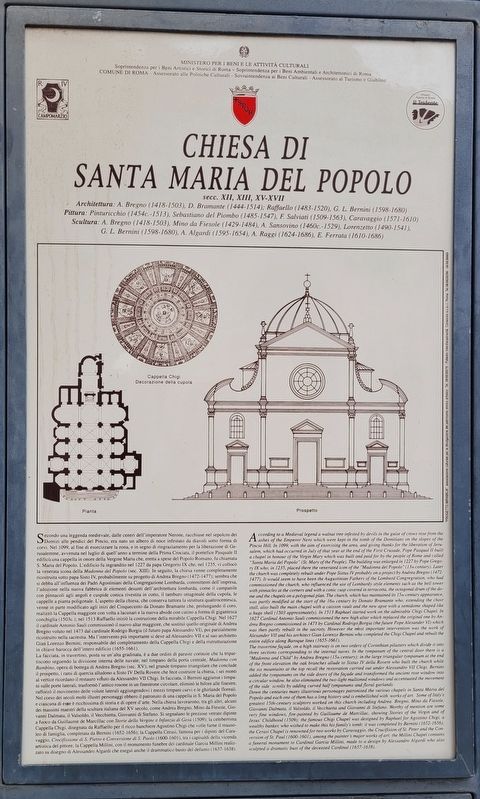
Architettura: A. Bregno (1418-1503), D. Bramante (1444-1514); Raffaello (1483-1520), G. L. Bernini (1598-1680) Pittura: Pinturicchio (1454c.-1513), Sebastiano del Piombo (1485-1547), F. Salviati (1509-1563), Caravaggio (1571-1610) Scultura: A. Bregno (1418-1503), Mino da Fiesole (1429-1484), A. Sansovino (1460c.-1529), Lorenzetto (1490-1541), G. L. Bernini (1598-1680), A. Algardi (1595-1654), A. Raggi (1624-1686), E. Ferrata (1610-1686)
Secondo una leggenda medievale, dalle ceneri dell'imperatore Nerone, racchiuse nel sepolcro dei Seco Domizi alle pendici del Pincio, era nato un albero di noce infestato da diavoli sotto forma di corvi. Nel 1099, al fine di esorcizzare la zona, e in segno di ringraziamento per la liberazione di Gerusalemme, avvenuta nel luglio di quell'anno a termine della Prima Crociata, il pontefice Pasquale II edificò, una cappella in onore della Vergine Maria che, eretta a spese del Popolo Romano, fu chiamata S. Maria del Popolo. L'edificio fu ingrandito nel 1227 da papa Gregorio IX che, nel 1235, vi collocò la venerata icona della Madonna del Popolo (sec. XIII). In seguito, la chiesa venne completamente ricostruita sotto papa Sisto IV, probabilmente su progetto di Andrea Bregno (1472-1477); sembra che si debba all'influenza dei Padri Agostiniani della Congregazione Lombarda, committenti dell'impresa, l'adozione nella nuova fabbrica di elementi desunti dell'architettura lombarda, come il campanile con pinnacoli agli angoli e cuspide conica rivestita in cotto, il tamburo ottagonale della cupola, le cappelle a pianta poligonale. L'aspetto della chiesa, che conserva tuttora la struttura quattrocentesca, venne in parte modificato agli inizi del Cinquecento da Donato Bramante che, prolungando il coro, realizzò la Cappella maggiore con volta a lacunari e la nuova abside con catino a forma di gigantesca conchiglia (1503c.); nel 1513 Raffaello iniziò la costruzione della mirabile Cappella Chigi. Nel 1627 il cardinale Antonio Sauli commissionò il nuovo altar maggiore, che sostitui quello originale di Andrea Bregno voluto nel 1473 dal cardinale
this page online
La facciata, in travertino, posta su un'alta gradinata, è a due ordini di paraste corinzie che la tripartiscono seguendo la divisione interna delle navate; nel timpano della porta centrale, Madonna con Bambino, opera di bottega di Andrea Bregno (sec. XV); nel grande timpano triangolare che conclude il prospetto, i rami di quercia alludono a Sisto IV Della Rovere che fece costruire la chiesa, i sei monti al vertice ricordano il restauro voluto da Alessandro VII Chigi. In facciata, il Bernini aggiunse i timpani sulle porte laterali, trasformò l'antico rosone in un finestrone circolare, eliminò le bifore alle finestre, rafforzò il movimento delle volute laterali aggiungendovi i mezzi timpani curvi e le ghirlande floreali. Nel corso dei secoli molti illustri personaggi ebbero il patronato di una cappella in S. Maria del Popolo e ciascuna di esse è ricchissima di storia e di opere d'arte. Nella chiesa lavorarono, tra gli altri, alcuni dei massimi maestri della scultura italiana del XV secolo, come Andrea Bregno, Mino da Fiesole, Giovanni Dalmata, il Valsoldo, il Vecchietta, Giovanni di Stefano. Si segnalano le preziose

Photographed by James Hulse, February 26, 2024
2. Chiesa di Santa Maria del Popolo / Church of Saint Mary of the People Marker
Didascalie
(Foto #1) Cappella Chigi Decorazione della cupola
(Foto #2) Pianta
(Foto #3) Prospetto
Architecture: A. Bregno (1418-1503), D. Bramante (1444-1514), Raphael (1483-1520), G. L. Bernini (1598-1680) Painting: Pinturicchio (1454c.-1513), Sebastiano del Piombo (1485-1547), F. Salviati (1509-1563), Caravaggio (1571-1610) Sculpture: A. Bregno (1418-1503), Mino da Fiesole (1429-1484), A. Sansovino (1460c.-1529), Lorenzetto (1490-1541), G. L. Bernini (1598-1680), A. Algardi (1595-1654), A. Raggi (1624-1686), E. Ferrata (1610-1686)
According to a Medieval legend a walnut tree infested by devils in the guise of crows rose from the ashes of the Emperor Nero which were kept in the tomb of the Domitians on the slopes of the Pincio Hill. In 1099, with the aim
Photographed by James Hulse, February 26, 2024
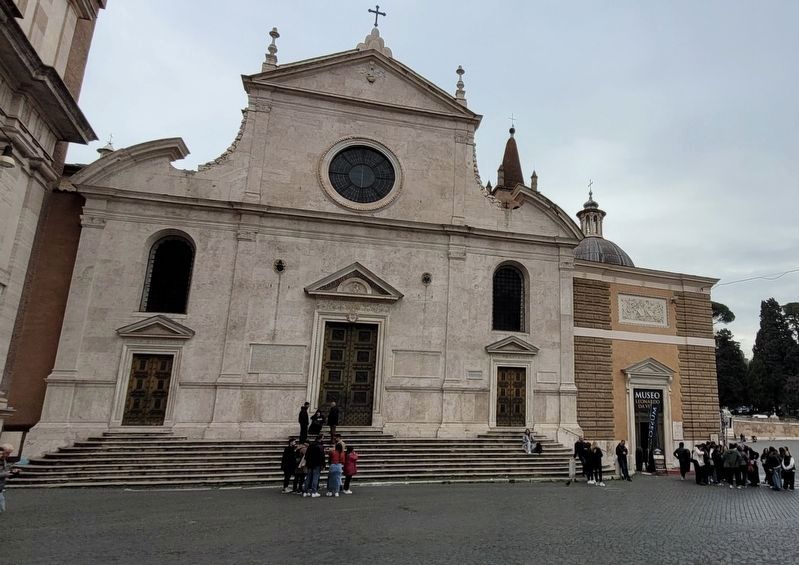
3. Church of Saint Mary of the People
The marker is located on the far right side of the church behind the group of people.

Photographed by James Hulse, February 26, 2024
4. The nearby Piazza del Popolo
The travertine façade, on a high stairway is on two orders of Corinthian pilasters which divide it into three sections corresponding to the internal naves. In the tympanum of the central door there is a "Madonna and Child" by Andrea Bregno (15th century); in the large triangular tympanum at the end of the front elevation the oak branches allude to Sixtus IV della Rovere who built the church while the six mountains at the top recall the restoration carried out under Alessandro VII Chigi. Bernini added the tympanums on the side doors of the façade and transformed the ancient rose window into a circular window, he also eliminated the two-light mullioned windows and accentuated the movement of the side scrolls by adding curved half tympanums and floral garlands.
Down the centuries many illustrious personages patronised the various chapels in Santa Maria del Popolo and each one of them has a long history and is embellished with works of art. Some of Italy's greatest 15th-century sculptors worked on this church including Andrea Bregno, Mino da Fiesole, Giovanni Dalmata, il Valsoldo, il Vecchietta and Giovanni di Stefano. Worthy of mention are some very fine windows, fire-painted by Guillaume de Marcillac, showing Stories of the Virgin and of Jesus' Childhood (1509); the famous Chigi Chapel was designed by Raphael for Agostino Chigi, a wealthy banker, who wished to make this his family's tomb; it was completed by Bernini (1652-1656); the Cerasi Chapel is renowned for two works by Caravaggio, the Crucifixion of St. Peter and the Conversion of St. Paul (1600-1601), among the painter's major works of art; the Millini Chapel contains a funeral monument to Cardinal Garcia Millini, made to a design by Alessandro Algardi who also sculpted a dramatic bust of the deceased Cardinal (1637-1638).
Captions
(Photo #1) Chigi Chapel Dome Decoration
(Photo #2) Floor Plan
(Photo #3) Elevation
Erected by Ministry for Cultural Heritage and Activities Superintendency for Artistic and Historical Heritage of Rome Superintendency for Environmental and Architectural Heritage of Rome City of Rome - Department for Cultural Policies - Superintendency for Cultural Heritage - Department for Tourism and Jubilee.
Topics. This historical marker is listed in this topic list: Religion & Religious Structures. A significant historical year for this entry is 1099 CE.
Location. 41° 54.675′ N, 12° 28.577′ E. Marker is in Roma, Lazio (Latium, Rome), in Città metropolitana di Roma Capitale. It is in Rione IV Campo Marzio. It is on Piazza del Popolo just west of Viale Gabriele D'Annunzio. The marker is located on the southwest corner of the church. Touch for map. Marker is at or near this postal address: Piazza del Popolo 12, Roma, Lazio 00187, Italy. Touch for directions.

Regionally, it is in Europe, the European Union, the Schengen Area, a coastal Mediterranean country, and the Western World. Historically, it finds itself in what was once the Roman Empire.
Other nearby markers. At least 8 other markers are within walking distance of this marker: Chiesa di Santa Maria di Montesanto / Church of Saint Mary of Montesanto (about 150 meters away, measured in a direct line); Chiesa di Santa Maria dei Miracoli / Church of Saint Mary of Miracles (about 150 meters away); Hotel de Russie (about 180 meters away); Prince Girolamo Napoleone (about 180 meters away); Hotel Palazzo Nainer (about 180 meters away); Eleonora de Fonseca Pimentel (approx. 0.2 kilometers away); Official connection between Via Del Babuino and Madison Avenue (approx. 0.3 kilometers away); Juliusz Słowacki (approx. 0.3 kilometers away). Touch for a list and map of all markers in Roma.
Credits. This page was last revised on February 9, 2025. It was originally submitted on February 8, 2025, by James Hulse of Medina, Texas. This page has been viewed 222 times since then and 22 times this year. Photos: 1, 2, 3, 4. submitted on February 9, 2025, by James Hulse of Medina, Texas.
