Zillebeke near Ypres in West-Vlaanderen, Flanders, Belgium — Northwestern Europe
1st Australian Tunneling Company
Photographed by Steve Stoessel, November 14, 2024
1. 1st Australian Tunneling Company Marker

Australian Mining Corps
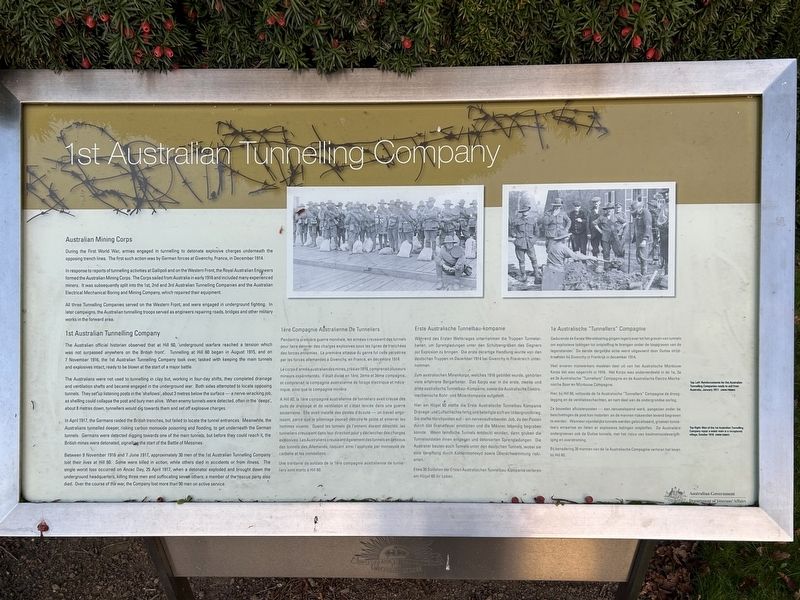
During the First World War, armies engaged in tunnelling to detonate explosive charges underneath the opposing trench lines. The first such action was by German forces at Givenchy, France, in December 1914.
In response to reports of tunnelling activities at Gallipoli and on the Western Front, the Royal Australian Engineers formed the Australian Mining Corps. The Corps sailed from Australia in early 1916 and included many experienced miners. It was subsequently split into the 1st, 2nd and 3rd Australian Tunnelling Companies and the Australian Electrical Mechanical Boring and Mining Company, which repaired their equipment.
All three Tunnelling Companies served on the Western Front, and were engaged in underground fighting. In later campaigns, the Australian tunnelling troops served as engineers repairing roads, bridges and other military works in the forward area.
1st Australian Tunnelling Company
The Australian official historian observed that at Hill 60, 'underground warfare reached a tension which was not surpassed anywhere on the British front. Tunnelling at Hill 60 began in August
this page online
The Australians were not used to tunnelling in clay but, working in four-day shifts, they completed drainage and ventilation shafts and became engaged in the underground war. Both sides attempted to locate opposing tunnels. They set up listening posts in the 'shallows', about 3 metres below the surface — a nerve-wracking job, as shelling could collapse the post and bury men alive. When enemy tunnels were detected, often in the 'deeps', about 8 metres down, tunnellers would dig towards them and set off explosive charges.
In April 1917, the Germans raided the British trenches, but failed to locate the tunnel entrances. Meanwhile, the Australians tunnelled deeper, risking carbon monoxide poisoning and flooding, to get underneath the German tunnels. Germans were detected digging towards one of the main tunnels, but before they could reach it, the British mines were detonated, signalling the start of the Battle of Messines.
Between 9 November 1916
Photographed by Steve Stoessel, November 14, 2024
2. 1st Australian Tunneling Company Marker
[français]
1ère Compagnie Australienne De Tunneliers
Pendant la première guerre mondiale, les armées creusaient des tunnels pour faire détoner des charges explosives sous les lignes de tranchées des forces ennemies. La première attaque du genre fut celle perpétrée par les forces allemandes à Givenchy, en France, en décembre 1914.
Le corps d'armée australien des mines, créé en 1916, comprenait plusieurs mineurs expérimentés. Il était divisé en 1ère, 2ème et 3ème compagnie, et comprenait la compagnie australienne de forage électrique et mécanique, ainsi que la compagnie minière.
A Hill 60, la 1ère compagnie australienne de tunneliers avait creusé des puits de drainage et de ventilation et s'était lancée dans une guerre souterraine. Elle avait installé des postes d'écoute — un travail angoissant, parce que le pilonnage pouvait détruire le poste et enterrer les hommes vivants. Quand les tunnels de l'ennemi étaient détectés, les tunneliers creusaient dans leur direction pour y déclencher des charges explosives. Les Australiens creusaient également des tunnels en dessous des tunnels des Allemands, risquant ainsi l'asphyxie par monoxyde de carbone et les inondations.
Une trentaine de soldats de la 1ère compagnie australienne de tunneliers sont morts à Hill 60.
[Deutsch]
Während des Ersten Weltkrieges unternahmen die Truppen Tunnelarbeiten, um Sprengladungen unter den Schützengräben des Gegners zur Explosion zu bringen. Die erste derartige Handlung wurde von den deutschen Truppen im Dezember 1914 bei Givenchy in Frankreich unternommen. Zum australischen Minenkorps, welches 1916 gebildet wurde, gehörten viele erfahrene Bergarbeiter. Das Korps war in die erste, zweite und dritte australische, Tunnelbau-Kompanie, sowie die Australische Elektromechanische Bohr- und Minenkompanie aufgeteilt. Hier am Hügel 60 stellte die Erste Australische Tunnelbau Kompanie Dränage- und Luftschächte fertig und beteiligte sich am Untergrundkrieg. Sie stellte Horchposten auf - ein nervenaufreibender Job, da der Posten durch das Granatfeuer einstürzen und die Männer lebendig begraben konnte. Wenn feindliche Tunnels entdeckt wurden, dann gruben die Tunnelsoldaten ihnen entgegen und detonierten Sprengladungen. Die Australier bauten auch Tunnels unter den deutschen Tunnels, wobei sie eine Vergiftung durch Kohlenmonoxyd sowie Überschwemmung riskierten. Etwa 30 Soldaten der Ersten Australischen Tunnelbau-Kompanie verloren am Hügel 60 ihr Leben.
[Nederland]
Gedurende de Eerste Wereldoorlog gingen legers over tot het graven van tunnels om explosieve ladingen tot ontploffing te brengen onder de loopgraven van de tegenstander.' De eerste dergelijke actie werd uitgevoerd door Duitse strijdkrachten bij Givenchy in Frankrijk in december 1914. Veel ervaren mijnwerkers maakten deel uit van het Australische Mijnbouw Korps dat was opgericht in 1916. Het Korps was onderverdeeld in de te, 2e en 3e Australische "Tunnellers" Compagnie en de Australische Electro Mechanische Boor en Mijnbouw Compagnie.
Hier, bij Hill 60, voltooide de 1e Australische "Tunnellers" Compagnie de drooglegging en de ventilatieschachten, en nam deel aan de ondergrondse oorlog.
Ze bouwden afluisterposten - een zenuwslopend werk, aangezien onder de beschietingen de post kon instorten en de mannen riskeerden levend begraven te worden. Wanneer vijandelijke tunnels werden gelocaliseerd, groeven tunnelaars ernaartoe en lieten er explosieve ladingen ontploffen. De Australiërs ondergroeven ook de Duitse tunnels, met het risico van koolmonoxidevergiftiging en overstroming.
>br> Bij benadering 30 mannen van de 1e Australische Compagnie verloren het leven bij Hill 60.
Top Left: Reinforcements for the Australian Tunnelling Companies ready to sail from Australia, January 1917.
Top Right: Men of the 1st Australian Tunnelling Company repair a water main in a recaptured village, October 1918.
Erected by Australian Goverament, Department of Veterans Affairs.
Topics. This historical marker is listed in this topic list: War, World I. A significant historical month for this entry is January 1317.
Location. 50° 49.456′ N, 2° 55.696′ E. Marker is near Ypres, Vlaanderen (Flanders), in West-Vlaanderen. It is in Zillebeke. It is on Zwarteleenstraat west of Wervikstraat, on the right when traveling east. Touch for map. Marker is at or near this postal address: Zwarteleenstraat 50, Ypres, Vlaanderen 8902, Belgium. Touch for directions.

Regionally, it is in Europe, the European Union, Atlantic Europe, the Benelux Low Countries, the Schengen Area, Western Europe, and the Western World. Historically, it finds itself in what was once the Roman Empire and specifically also the Holy Roman Empire.
Other nearby markers. At least 8 other markers are within walking distance of this marker: A different marker also named 1st Australian Tunneling Company (here, next to this marker); Hill 60 (a few steps from this marker); In Memory of the 14th Light Division (a few steps from this marker); Pierre Marchand Lucien Olivier (within shouting distance of this marker); 15th Battalion Canadian Infantry (within shouting distance of this marker); Mijnkrater Hill 60 (within shouting distance of this marker); Queen Victoria’s Rifles (about 120 meters away, measured in a direct line); a different marker also named Hill 60 (about 150 meters away).
Also see . . . 1st Australian Tunneling Company (Wikipedia). (Submitted on February 9, 2025, by Steve Stoessel of Niskayuna, New York.)
Credits. This page was last revised on February 10, 2025. It was originally submitted on February 9, 2025, by Steve Stoessel of Niskayuna, New York. This page has been viewed 170 times since then and 30 times this year. Photos: 1, 2. submitted on February 9, 2025, by Steve Stoessel of Niskayuna, New York.
