Trevi in Roma in Città metropolitana di Roma Capitale, Latium, Rome, Italy — Central Italy (Tyrrhenian Coast)
Trevi
Rione II
⎯⎯⎯
District II
Photographed by James Hulse, February 28, 2024
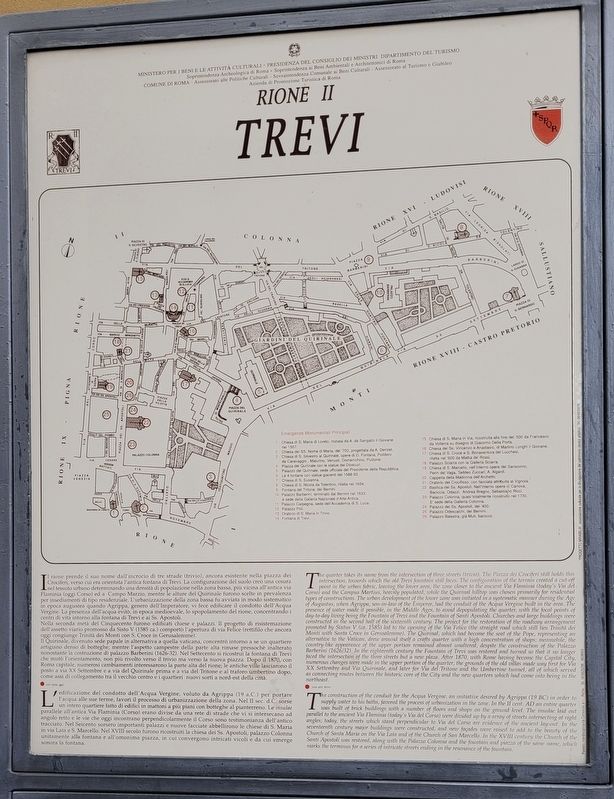
1. Trevi Marker

Il rione prende il suo nome dall'incrocio di tre strade (trivio), ancora esistente nella piazza dei Crociferi, verso cui era orientata l'antica fontana di Trevi. La configurazione del suolo creò una cesura nel tessuto urbano determinando una densità di popolazione nella zona bassa, più vicina all'antica via Flaminia (oggi Corso) ed a Campo Marzio, mentre le alture del Quirinale furono scelte in prevalenza per insediamenti di tipo residenziale. L'urbanizzazione della zona bassa fu avviata in modo sistematico in epoca augustea quando Agrippa, genero dell'Imperatore, vi fece edificare il condotto dell'Acqua Vergine. La presenza dell'acqua evitò, in epoca medioevale, lo spopolamento del rione, concentrando i centri di vita intorno alla fontana di Trevi e ai Ss. Apostoli.
Nella seconda metà del Cinquecento furono edificati chiese e palazzi. Il progetto di risistemazione dell'assetto viario promosso da Sisto V (1585 ca.) comportò l'apertura di via Felice (rettifilo che ancora oggi congiunge Trinità dei Monti con S. Croce in Gerusalemme).
Il Quirinale, divenuto sede papale in alternativa a quella vaticana,
this page online
L' edificazione del condotto dell'Acqua Vergine, voluto da Agrippa (19 a.C.) per portare l'acqua alle sue terme, favorì il processo di urbanizzazione della zona. Nel II sec. d.C. sorse un intero quartiere fatto di edifici in mattoni a più piani con botteghe al pianterreno. Le insulae parallele all'antica Via Flaminia (Corso) erano divise da una rete di strade che vi si intersecano ad angolo retto e le vie che oggi incontrano perpendicolarmente il Corso sono testimonianza dell'antico tracciato.
Photographed by James Hulse, February 28, 2024
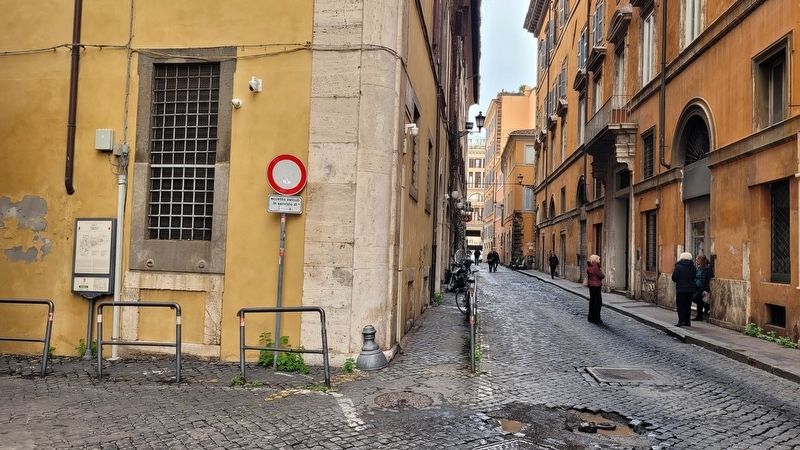
2. The view of the Trevi Marker along the street
The quarter takes its name from the intersection of three streets (trivio). The Piazza dei Crociferi still holds this intersection, towards which the old Trevi fountain still faces. The configuration of the terrain created a cut-off point in the urban fabric, leaving the lower area, the zone closer to the ancient Via Flaminia (today's Via del Corso) and the Campus Martius, heavily populated, while the Quirinal hilltop was chosen primarily for residential types of constructions. The urban development of the lower zone was initiated in a systematic manner during the Age of Augustus, when Agrippa, son-in-law of the Emperor, had the conduit of the Acqua Vergine built in the area. The presence of water made it possible, in the Middle Ages, to avoid depopulating the quarter, with the focal points of day-to-day living being the Fountain of Trevi and the Fountain of Santi Apostoli. Churches and large buildings were constructed in in the second half of the sixteenth century. The project for the restoration of the roadway arrangement promoted by Sixtus V (ca. 1585) led to the opening of the Via Felice (the straight road which still ties Trinità dei Monti with Santa Croce in Gerusalemme). The Quirinal, which had become the seat of the Pope, representing an alternative to the Vatican, drew around itself a crafts quarter with a high concentration of shops; meanwhile, the country-like appearance of the upper portion remained almost unaltered, despite the construction of the Palazzo Barberini (1626/32). In the eighteenth century the Fountain of Trevi was restored and turned so that it no longer faced the intersection of the three streets but a new plaza. After 1870, with Rome having become the Capital City, numerous changes were made in the upper portion of the quarter; the grounds of the old villas made way first for Via XX Settembre and Via Quirinale, and later for Via del Tritone and the Umbertine tunnel, all of which served as connecting routes between the historic core of the City and the new quarters which had come into being in the northeast.
The construction of the conduit for the Acqua Vergine, an initiative desired by Agrippa (19 ВС) in order to supply water to his baths, favored the process of urbanization in the zone. In the II cent. AD an entire quarter was built of brick buildings with a number of floors and shops on the ground level. The insulae laid out parallel to the ancient Via Flaminia (today's Via del Corso) were divided up by a array of streets intersecting at right angles; today, the streets which stand perpendicular to Via del Corso are evidence of the ancient lay-out. In the seventeenth century major buildings were constructed, and new façades were raised to add to the beauty of the Church of Santa Maria on the Via Lata and of the Church of San Marcello. In the XVIII century the Church of the Santi Apostoli was restored, along with the Palazzo Colonna and the fountain and piazza of the same name, which marks the terminus for a series of intricate streets ending in the resonance of the fountain.
Erected by Ministry for Cultural Heritage and Activities Office of the Prime Minister, Department of Tourism Archaeological Superintendency of Rome Superintendency for Environmental and Architectural Heritage of Rome City of Rome - Department of Cultural Policies - Municipal Superintendency of Cultural Heritage - Department of Tourism and Jubilee Tourism Promotion Agency of Rome.
Topics. This historical marker is listed in these topic lists: Architecture • Arts, Letters, Music • Industry & Commerce. A significant historical year for this entry is 1870.
Location. 41° 53.914′ N, 12° 28.953′ E. Marker is in Roma, Lazio (Latium, Rome), in Città metropolitana di Roma Capitale. It is in Trevi. It is at the intersection of Via dei Santi Apostoli and Via di S. Marcello, on the right when traveling west on Via dei Santi Apostoli. The marker is located at the corner of the building. Touch for map. Marker is in this post office area: Roma, Lazio 00187, Italy. Touch for directions.

Regionally, it is in Europe, the European Union, the Schengen Area, a coastal Mediterranean country, and the Western World. Historically, it finds itself in what was once the Roman Empire.
Other nearby markers. At least 8 other markers are within walking distance of this marker: Benedetto Brin (here, next to this marker); Pietro Raimondi (about 90 meters away, measured in a direct line); Chiesa di Santa Rita delle Vergini / Church of Santa Rita of the Virgins (about 120 meters away); Oratorio del SS. Crocifisso / Oratory of the Holy Crucifix (about 120 meters away); Palazzo Doria - Pamphilj / Doria Pamphilj Palace (about 150 meters away); Chiesa di Santa Maria dell'Umiltà / Church of Santa Maria of Humility (about 150 meters away); Palazzo Sciarra-Colonna / Sciarra-Colonna Palace (about 180 meters away); Trevi-Pantheon Route (about 210 meters away). Touch for a list and map of all markers in Roma.
Credits. This page was last revised on February 10, 2025. It was originally submitted on February 10, 2025, by James Hulse of Medina, Texas. This page has been viewed 100 times since then and 12 times this year. Photos: 1, 2. submitted on February 10, 2025, by James Hulse of Medina, Texas.
