
Trevi in Roma in Città metropolitana di Roma Capitale, Latium, Rome, Italy — Central Italy (Tyrrhenian Coast)
Oratorio del SS. Crocifisso
⎯⎯⎯
Oratory of the Holy Crucifix
Photographed by James Hulse, February 28, 2024
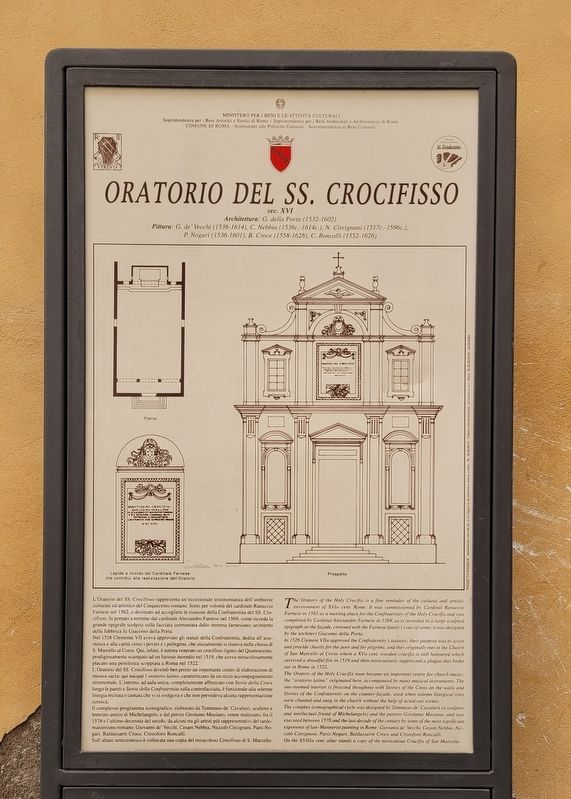
1. Oratorio del SS. Crocifisso / Oratory of the Holy Crucifix Marker

Architettura: G. della Porta (1532-1602) Pittura: G. de' Vecchi (1536-1614), C. Nebbia (1536c.-1614c.), P. Nogari (1536-1601), B. Croce (1558-1628), C. Roncalli (1552-1626) N. Circignani (1517c.-1596c.)
L'Oratorio del SS. Crocifisso rappresenta un'eccezionale testimonianza dell'ambiente culturale ed artistico del Cinquecento romano. Sorto per volontà del cardinale Ranuccio Farnese nel 1562, e destinato ad accogliere le riunioni della Confraternita del SS. Crocifisso, fu portato a termine dal cardinale Alessandro Farnese nel 1569, come ricorda la grande epigrafe scolpita sulla facciata sormontata dallo stemma farnesiano; architetto della fabbrica fu Giacomo della Porta.
Nel 1526 Clemente VII aveva approvato gli statuti della Confraternita, dedita all'assistenza e alla carità verso i poveri e i pellegrini, che inizialmente si riuniva nella chiesa di S. Marcello al Corso. Qui, infatti, è tuttora venerato un crocifisso ligneo del Quattrocento, prodigiosamente scampato ad un furioso incendio nel 1519, che aveva miracolosamente placato una pestilenza scoppiata a Roma nel 1522.
L'Oratorio del
this page online
Il complesso programma iconografico, elaborato da Tommaso de' Cavalieri, scultore e letterato amico di Michelangelo, e dal pittore Girolamo Muziano, venne realizzato, fra il 1578 e l'ultimo decennio del secolo, da alcuni tra gli artisti più rappresentativi del tardomanierismo romano: Giovanni de' Vecchi, Cesare Nebbia, Niccolò Circignani, Paris Nogari, Baldassarre Croce, Cristoforo Roncalli.
Sull'altare settecentesco è collocata una copia del miracoloso Crocifisso di S. Marcello.
Didascalie
(Foto #1) Pianta
(Foto #2) Lapide a ricordo del Cardinale Farnese che contribui alla realizzazione dell'Oratorio
(Foto #3) Prospetto
Architecture: G. della Porta
Photographed by James Hulse, February 28, 2024
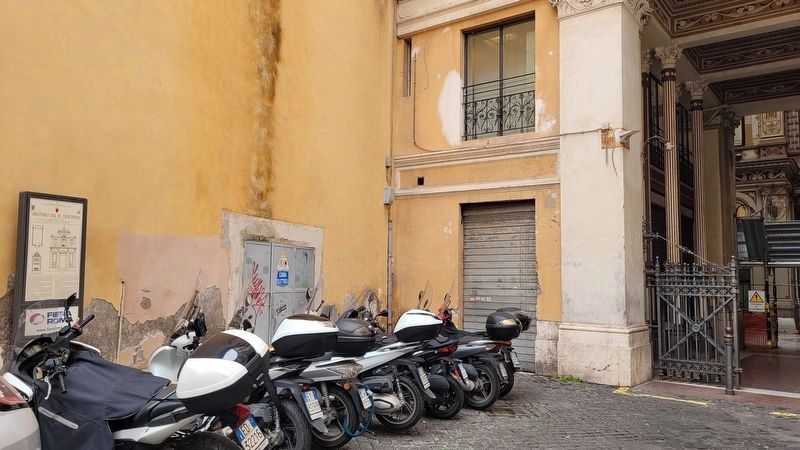
2. The view of the Oratory of the Holy Crucifix Marker along the street
The entrance to the Galleria Sciarra is located at the right side.
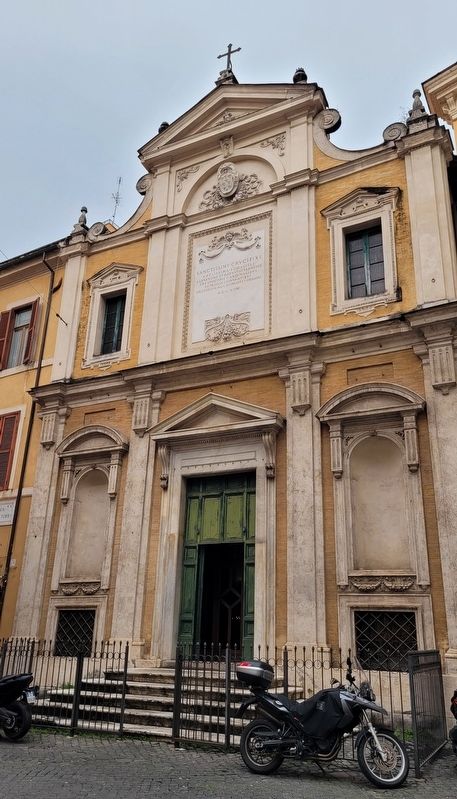
The Oratory of the Holy Crucifix is a fine reminder of the cultural and artistic environment of XVIth cent. Rome. It was commissioned by Cardinal Ranuccio Farnese in 1562 as a meeting place for the Confraternity of the Holy Crucifix and was completed by Cardinal Alessandro Farnese in 1569, as is recorded in a large sculpted epigraph on the façade, crowned with the Farnese family's coat-of-arms; it was designed by the architect Giacomo della Porta.
In 1526 Clement VIIth approved the Confraternity's statutes; their purpose was to assist and provide charity for the poor and for pilgrims, and they originally met in the Church of San Marcello al Corso where a XVth cent. wooden crucifix is still honoured which survived a dreadful fire in 1519 and then miraculously suppressed a plague that broke out in Rome in 1522.
The Oratory of the Holy Crucifix soon became an important centre for church music: the “oratorio latino” originated here, accompanied by many musical
Photographed by James Hulse, February 28, 2024
3. The front façade of the Oratory of the Holy Crucifix
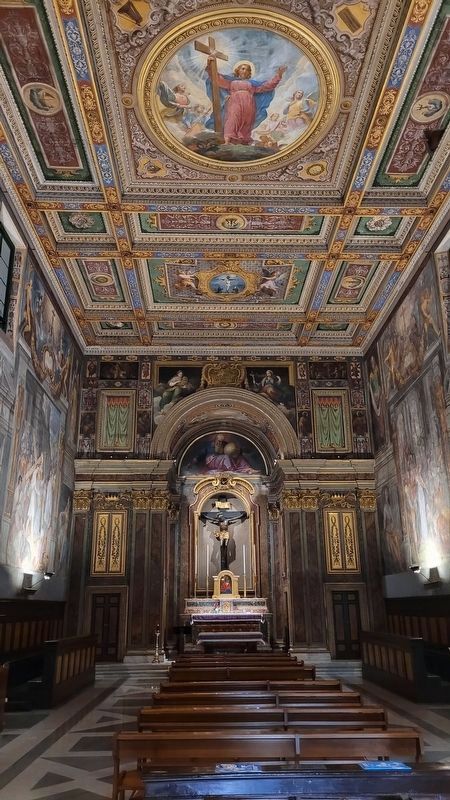
The complex iconographical cycle was designed by Tommaso de' Cavalieri (a sculptor and intellectual friend of Michelangelo) and the painter Girolamo Muziano, and was executed between 1578 and the last decade of the century by some of the most significant exponents of late-Mannerist painting in Rome: Giovanni de' Vecchi, Cesare Nebbia, Niccolò Circignani, Paris Nogari, Baldassarre Croce and Cristoforo Roncalli.
On the XVIIIth cent. altar stands a copy of the miraculous Crucifix of San Marcello.
Captions
(Photo #1) Plant
(Photo #2) Tombstone in memory of Cardinal Farnese, who contributed to the construction of the Oratory
(Photo #3) Facade
Erected by Ministry for Cultural Heritage and Activities Superintendency for Artistic and Historical Heritage of Rome Superintendency for Environmental and Architectural Heritage of Rome City of Rome - Department for Cultural
Photographed by James Hulse, February 28, 2024
4. Interior view of the Oratory of the Holy Crucifix
Topics. This historical marker is listed in this topic list: Religion & Religious Structures. A significant historical year for this entry is 1562.
Location. 41° 53.977′ N, 12° 28.925′ E. Marker is in Roma, Lazio (Latium, Rome), in Città metropolitana di Roma Capitale. It is in Trevi. It is at the intersection of Piazza dell'Oratorio and Via dell'Umiltà on Piazza dell'Oratorio. The marker is located on the east wall of the church. Touch for map. Marker is at or near this postal address: Piazza dell'Oratorio 73, Roma, Lazio 00187, Italy. Touch for directions.

Regionally, it is in Europe, the European Union, the Schengen Area, a coastal Mediterranean country, and the Western World. Historically, it finds itself in what was once the Roman Empire.
Other nearby markers. At least 8 other markers are within walking distance of this marker: Pietro Raimondi (within shouting distance of this marker); Chiesa di Santa Rita delle Vergini / Church of Santa Rita of the Virgins (within shouting distance of this marker); Palazzo Sciarra-Colonna / Sciarra-Colonna Palace (about 90 meters away, measured
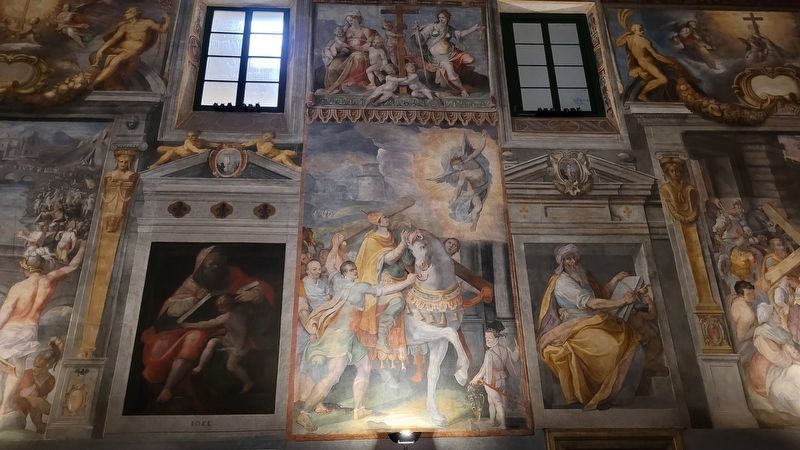
Photographed by James Hulse, February 28, 2024
5. The view of the beautiful artwork along the interior wall of the church
Also see . . . Oratory of Santissimo Crocifisso. Wikipedia
The Oratorio del Santissimo Crocifisso or the Oratory of the Most Holy Crucifix is a building in central Rome, Italy. Connected to the nearby church of San Marcello al Corso, it houses the Crucifix of San Marcello and served as a chapel and meeting place for the Archconfraternity of the Most Holy Crucifix (Arciconfraternita del Santissimo Crocifisso in Urbe) devoted to the image. It is best known, like the Oratorio del Gonfalone, which shares the same artists, for its Mannerist decorations.(Submitted on February 10, 2025, by James Hulse of Medina, Texas.)
Credits. This page was last revised on February 10, 2025. It was originally submitted on February 10, 2025, by James Hulse of Medina, Texas. This page has been viewed 147 times since then and 20 times this year. Photos: 1, 2, 3, 4, 5. submitted on February 10, 2025, by James Hulse of Medina, Texas.
