Rione IX Pigna in Roma in Città metropolitana di Roma Capitale, Latium, Rome, Italy — Central Italy (Tyrrhenian Coast)
Pigna
Rione IX
⎯⎯⎯
District IX

Photographed by James Hulse, February 28, 2024
1. Pigna Marker

Il nome deriva probabilmente da una colossale pigna bronzea, ornamento di una fontana, in seguito trasferita al Vaticano I limiti dei confini settentrionali sono segnate da via del Caravita e da via del Seminario che riprendono l'andamento del condotto dell'Acqua Vergine, alimentatore delle Terme di Agrippa. Su una vasta area denominata Saepta si riunivano in età repubblicana i comizi centuriati che provvedevano alle elezioni delle più alte magistrature. Ricco di testimonianze antiche il rione vide sorgere numerosi templi, alcuni dei quali dedicati a divinità egizie (Iside e Serapide). La comprensione della topografia classica è favorita dalla viabilità odierna, rimastale piuttosto fedele. Il rione, diversamente da molti altri, nel medioevo rimase abitato; ciò ha favorito la conservazione dell'impianto urbanistico al quale le successive trasformazioni si sono sovrapposte permettendo la lettura dei blocchi viari ed edilizi antichi. Di grande rilievo per la topografia del passato è la via Lata, penetrazione urbana dell'antica Flaminia che per tutto il medioevo, ed anche in seguito, rimase strada di grande
this page online
La zona intorno a via del Piè di Magmo fu occupata da templi di culto egiziano, di cui rimane a memoria il piede colossale che ha dato il nome alla via, il busto di una statua colossale di Iside, comunemente noto come "donna Lucrezia", e il felino marmoreo da cui prende il nome via della Gatta. Di grande rilievo fin dall'antichità per la topografia cittadina fu l'antica via Lata (Corso), penetrazione urbana della via Flaminia. Dal medioevo la via vide sorgere edifici e chiese, ma la spinta decisiva fu data da Paolo II che vi edificò un palazzo papale Lo stesso pontefice
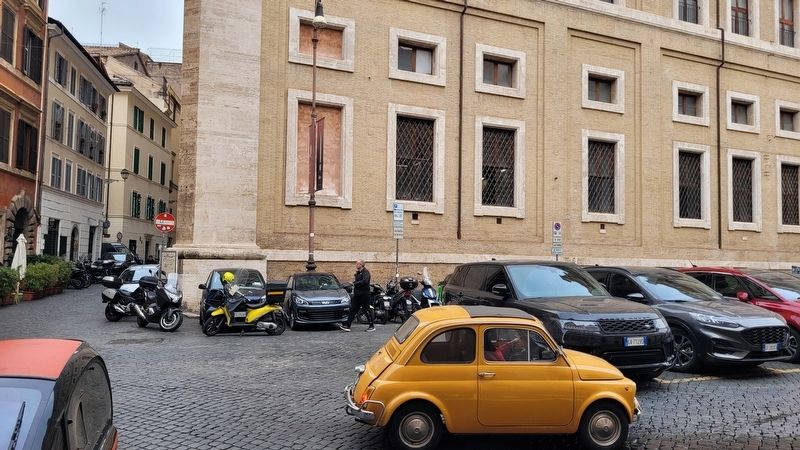
Photographed by James Hulse, February 28, 2024
2. Pigna Marker
The marker is located along the corner of the building.
This district's name probably comes from a huge bronze sculptured pinecone that decorated a fountain which was later moved to the, Vatican. The border along the north side is marked off by Via del Caravita and by Via del Seminario which take up the route of the old Vergine Acqueduct that pumped water into the Baths of Agrippa. In a large area that was known as the Saepfa, the centurial meetings were held in the Republican era for the electing of the high court magistrates. The district is full of remains from antiquity, including a number of temples, some of which are dedicated to Egyptian deities (Isis and Serapis). Today's road system is conducive with a general comprehension of the classical layout, and is more or less true to the original. In contrast to other areas, this district continued to be inhabited throughout Medieval times; this meant that the town's layout was preserved for posterity and later transformations were simply laid over the top meaning that the road networks and ancient buildings could still be made out. Via Lata is of great historical and topographical importance, this corresponds to the ancient Via Flaminia which cut through the town; in Medieval times and later as well, it was a very important road leading into the city from Piazza del Popolo. In the 16th century the first documented town planning works were carried out; at that time a great many small churches and houses with painted facades that were mentioned in writings, disappeared. The town planning scheme of 1873 led to the opening up of Corso Vittorio Emanuele II, with the opening of Vicolo Cesarini, as an extension of Via Nazionale and a connecting route between the centre and the new districts that were being built to the north-east. Between 1926 and 1929 demolitions continued during the digging up of the Sacred Argentina area and the widening of Via delle Botteghe Oscure.
The area around the Via del Pie' di Marmo was once taken up with Egyptian temples of which the only remains still visible are the gigantic foot that gave the street its name, the bust of a giant statue of Isis, commonly known as "donna Lucrezia" and the marble cat which inspired the naming of Via della Gatta (Cat). Via Lata (now Via del Corso) has always been of great historical and topographical importance since ancient times. Starting from Medieval times, a large number of buildings and churches were built here, but the turning point came when Pope Paolo II decided to build a Papal palace here. The same Pope transferred the popular games to this street and from 1466 onwards, it became a track for different types of races, hence its name, Via del Corso (Racing Street). Records have been handed down telling stories of the Carnival celebrations held here, as well as of the "berberi" races, when untamed horses with no riders were unleashed at Piazza del Popolo and galloped wildly all the way down Via del Corso, to be caught and bridled again at Piazza Venezia, this custom went on until 1882.
Erected by Ministry for Cultural Heritage and Activities Superintendency for Artistic and Historical Heritage of Rome Superintendency for Environmental and Architectural Heritage of Rome Municipality of Rome - Department of Cultural Policies - Superintendency for Cultural Heritage - Department of Tourism and Jubilee.
Topics. This historical marker is listed in these topic lists: Architecture • Arts, Letters, Music • Industry & Commerce. A significant historical year for this entry is 1873.
Location. 41° 53.871′ N, 12° 28.784′ E. Marker is in Roma, Lazio (Latium, Rome), in Città metropolitana di Roma Capitale. It is in Rione IX Pigna. It is at the intersection of Via di S. Ignazio and Piazza del Collegio Romano, on the right when traveling north on Via di S. Ignazio. The marker is located along the corner of the building. Touch for map. Marker is at or near this postal address: Via di S Ignazio 5, Roma, Lazio 00186, Italy. Touch for directions.

Regionally, it is in Europe, the European Union, the Schengen Area, a coastal Mediterranean country, and the Western World. Historically, it finds itself in what was once the Roman Empire.
Other nearby markers. At least 8 other markers are within walking distance of this marker: Palazzo Doria - Pamphilj / Doria Pamphilj Palace (about 90 meters away, measured in a direct line); Victorio Scialoja (about 120 meters away); Riccardo Grazioli Lante de la Rovere (about 120 meters away); Alessandro Fortis (about 120 meters away); Chiesa di San Macuto / Church of Saint Maclovio (about 150 meters away); Santa Maria sopra Minerva (about 150 meters away); Tommaso Badia of Modena (about 150 meters away); Tommaso de Vio, Cardinal Cajetan (about 150 meters away). Touch for a list and map of all markers in Roma.
Regarding Pigna. The marker has some damage due to graffiti.
Credits. This page was last revised on February 11, 2025. It was originally submitted on February 10, 2025, by James Hulse of Medina, Texas. This page has been viewed 120 times since then and 22 times this year. Photos: 1, 2. submitted on February 11, 2025, by James Hulse of Medina, Texas.
