Rione IX Pigna in Roma in Città metropolitana di Roma Capitale, Latium, Rome, Italy — Central Italy (Tyrrhenian Coast)
Palazzo Doria - Pamphilj
⎯⎯⎯
Doria Pamphilj Palace

Photographed by James Hulse, February 28, 2024
1. Palazzo Doria - Pamphilj / Doria Pamphilj Palace Marker

Architettura: A. Del Grande (1625-1671), C. Fontana (1638-1714), G. Valvassori (1683-1761), A. Busiri Vici (1817-1911)
La magnifica dimora, estesa tra Via del Corso, Piazza del Collegio Romano e Via del Plebiscito, ebbe origine da un nucleo residenziale della metà del '400 più volte ampliato e ricostruito. Il cardinale Giovanni Fazio Santorio acquistò il sito e vi realizzò un bel palazzo con un maestoso cortile di ispirazione bramantesca a due ordini di arcate (1505-1507). L'edificio, ancora in costruzione, piacque tanto a papa Giulio II che convinse il cardinale a farne dono al nipote Francesco Maria I della Rovere duca di Urbino. Il palazzo, trasformato in una splendida dimora rinascimentale dai Della Rovere, fu acquistato nel 1601 dal cardinale Pietro Aldobrandini. Questi, affidandosi all'architetto Giovanni Antonio de Pomis, realizzò le due ali del cortile e l'altana, ingrandì l'ala verso il Vicolo Doria, fece decorare il suo appartamento privato e la celebre cappella, per la quale Annibale Carracci ideò le sei lunette Aldobrandini (1603; ora nella Galleria Doria Pamphilj).
Nel 1647 Olimpia Aldobrandini sposò Camillo Pamphilj, nipote del regnante papa Innocenzo X, portando in dote il sontuoso palazzo. Nuovi lavori di ampliamento vennero intrapresi dai Pamphilj nell'ala prospiciente Piazza del Collegio Romano, in seguito alla demolizione del Palazzo Salviati che occupava gran parte della piazza stessa; l'impresa fu affidata all'architetto Antonio Del Grande che realizzò la facciata, il vestibolo e la scala dell'edificio (1659-1663). Parallelamente, avanzò l'opera di decorazione degli interni del palazzo, alla cui direzione si succedettero Antonio Del Grande, Giovanni Pietro Moraldi e Carlo Fontana. Al Fontana si deve, tra l'altro, la costruzione della grande cappella
this page online
Estintasi la famiglia Pamphilj, nel 1760 si insediò nel palazzo Andrea IV Doria Landi Pamphilj, discendente di Anna Pamphilj che, avendo sposato nel

Photographed by James Hulse, February 28, 2024
2. Doria Pamphilj Palace Marker
Didascalie
(Foto #1) Pianta del piano terra
(Foto #2) A - Sezione longitudinale del cortile
(Foto #3) Particolare della facciata su Via del Corso
(Foto #4) B - Veduta prospettica dell'atrio e della scala
This magnificent residence is situated between Via del Corso, Piazza del Collegio Romano and Via del Plebiscito; it sprang from a small mid-XVth cent. residential quarter and was frequently enlarged and rebuilt. Cardinal Giovanni Fazio Santorio bought the site and built a fine palace with a majestic courtyard of Bramantian influence, with two orders of arches (1505-1507). Still under construction,
Photographed by James Hulse, February 28, 2024
3. Doria Pamphilj Palace Marker
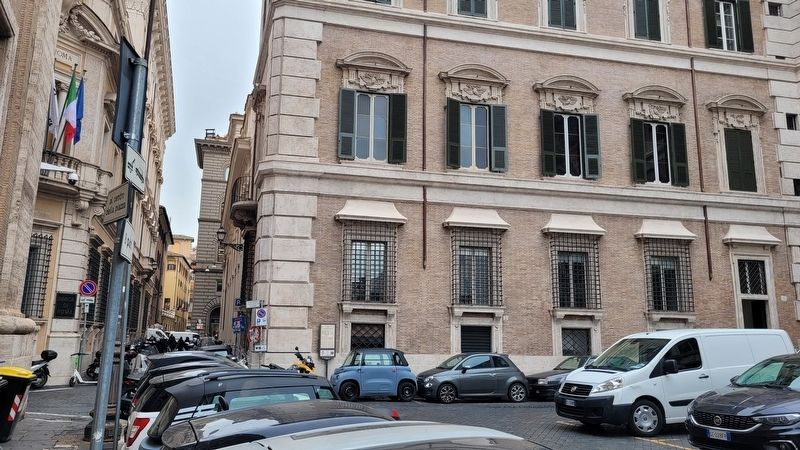
The marker is located at the corner of the building
In 1647 Olimpia Aldobrandini married Camillo Pamphilj, nephew of the ruling Pope, Innocent Xth, her dowry was the sumptuous palace. New extension work was undertaken by the Pamphilj family, in the wing that faces onto Piazza del Collegio Romano, following the demolition of Palazzo Salviati that covered most of the square. The job was assigned to the architect Antonio Del Grande who completed the façade, the vestibule and the building's stairway (1659-1663). At the same time, he began the task of decorating the palace interior and Antonio Del Grande, Giovanni Pietro Moraldi and Carlo Fontana carried on after him. Fontana also saw to the building of a large family chapel and did away with the one built by Cardinal Aldobrandini, turning it into a lobby on the master floor.
During the first half of the XVIIIth cent. the architect Gabriele Valvassori left his mark: he completed the courtyard closed the loggia above the portico, introduced the gallery rooms where most of the art collection is now kept and also designed the "Galleria degli Specchi" (Hall of Mirrors), decorated with frescoes by Aureliano Milani (1733-1734). But his most celebrated feat was the striking façade in Via del Corso, an exquisite example of late Roman Baroque (1731-1734). This is sectioned off by vertical bands of ashlar-work and three doorways flanked by columns whose capitals are embellished with lilies that appear in the Pamphilj coat-of-arms. The palace was further enlarged along today's Via del Plebiscito by the architect Paolo Ameli who based his façade design on Valvassori's style model (1744); he also designed the master stairway in Via del Corso (1748-1749).
When the Pamphilj family died out, Andrea Vin Doria Landi Pamphilj made the palace his home: he was descended from Anna Pamphilj who married Giovanni Andrea IIIrd Doria Landi in 1671 thus uniting the two families. The last architect to work on the palace was Andrea Busiri Vici who built the covered Riding Stables in Via del Plebiscito (1848), renovated the Chapel and built the stables and façades in Via della Gatta and Piazza Grazioli. The palace is filled with works of art but its greatest treasure is the famous Doria Pamphilj Gallery, a typical example of a XVIth cent. picture gallery containing one of the most valuable collections of XVIth to XVIIIth cent. paintings.
Captions
(Photo #1) Ground floor plan
(Photo #2) A - Longitudinal section of the courtyard
(Photo #3) Detail of the facade on Via del Corso
(Photo #4) B - Perspective view of the atrium and staircase
Erected by Ministry for Cultural Heritage and Activities Superintendency for Artistic and Historical Heritage of Rome Superintendency for Environmental and Architectural Heritage of Rome Municipality of Rome - Department of Cultural Policies - Superintendency for Cultural Heritage - Department of Tourism and Jubilee.
Topics. This historical marker is listed in this topic list: Notable Buildings. A significant historical year for this entry is 1601.
Location. 41° 53.888′ N, 12° 28.856′ E. Marker is in Roma, Lazio (Latium, Rome), in Città metropolitana di Roma Capitale. It is in Rione IX Pigna. It is at the intersection of Via Lata and Via del Collegio Romano on Via Lata. The marker is located along the corner of the building. Touch for map. Marker is at or near this postal address: Via Lata 88, Roma, Lazio 00186, Italy. Touch for directions.

Regionally, it is in Europe, the European Union, the Schengen Area, a coastal Mediterranean country, and the Western World. Historically, it finds itself in what was once the Roman Empire.
Other nearby markers. At least 8 other markers are within walking distance of this marker: Pigna (about 90 meters away, measured in a direct line); Victorio Scialoja (about 120 meters away); Alessandro Fortis (about 120 meters away); Riccardo Grazioli Lante de la Rovere (about 120 meters away); Benedetto Brin (about 150 meters away); Trevi (about 150 meters away); Pietro Raimondi (about 150 meters away); Chiesa di San Macuto / Church of Saint Maclovio (about 180 meters away). Touch for a list and map of all markers in Roma.
Credits. This page was last revised on February 11, 2025. It was originally submitted on February 10, 2025, by James Hulse of Medina, Texas. This page has been viewed 135 times since then and 14 times this year. Photos: 1, 2, 3. submitted on February 11, 2025, by James Hulse of Medina, Texas.
