Weaverville in Buncombe County, North Carolina — The American South (South Atlantic)
Weaverville United Methodist Church
Photographed by Mark Parker, February 10, 2025
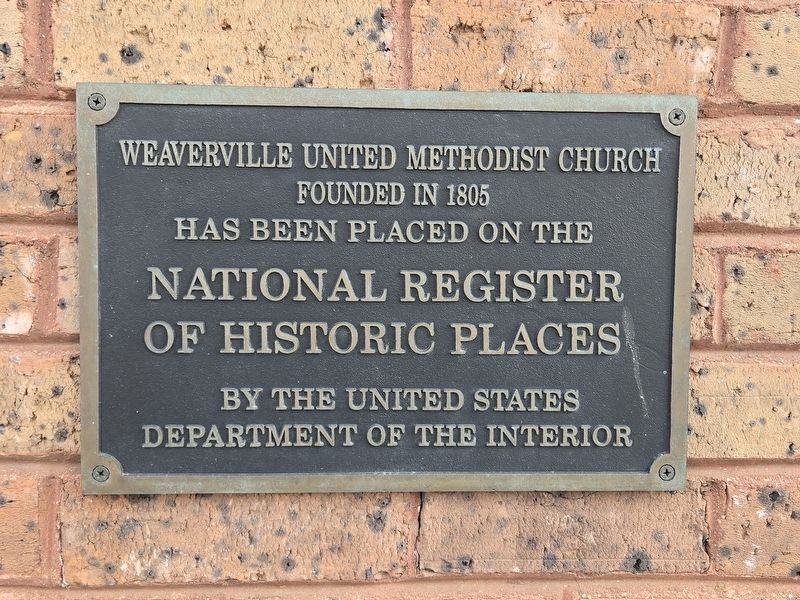
1. Weaverville United Methodist Church Marker
Founded in 1805
Has been placed on the
National Register
of Historic Places
by the United States
Department of the Interior
Erected by United States Department of the Interior.
Topics. This historical marker is listed in this topic list: Religion & Religious Structures. A significant historical year for this entry is 1805.
Location. 35° 41.961′ N, 82° 33.614′ W. Marker is in Weaverville, North Carolina, in Buncombe County. It is at the intersection of North Main Street (Business U.S. 19) and Church Street, on the left when traveling south on North Main Street. The marker is to the left of the sanctuary entrance under the portico. Touch for map. Marker is at or near this postal address: 85 N Main St, Weaverville NC 28787, United States of America. Touch for directions.

Regionally, this marker is in the Mountains and in Greater Asheville. It is also in the American South, specifically in the Upper South, in Appalachia, and specifically in Southern Appalachia. Globally, it is in North America, the Western Hemisphere, the Western World, and the Anglosphere. Historically,
this page online
Other nearby markers. At least 8 other markers are within 6 miles of this marker, measured as the crow flies: Weaver College (approx. 0.6 miles away); Zebulon B. Vance (approx. 1½ miles away); Brothers In Service (approx. 3.6 miles away); David L. Swain (approx. 4.8 miles away); Francis Asbury (approx. 4.9 miles away); Joseph Lane (approx. 4.9 miles away); Bingham School (approx. 5.6 miles away); Battle of Asheville (approx. 5.8 miles away). Touch for a list and map of all markers in Weaverville.
Another marker is no longer nearby. Zebulon B. Vance (was approx. 1½ miles away but has been replaced with another marker now near it).
Regarding Weaverville United Methodist Church. Excerpt from the Weaverville United Methodist Church Nomination Form:
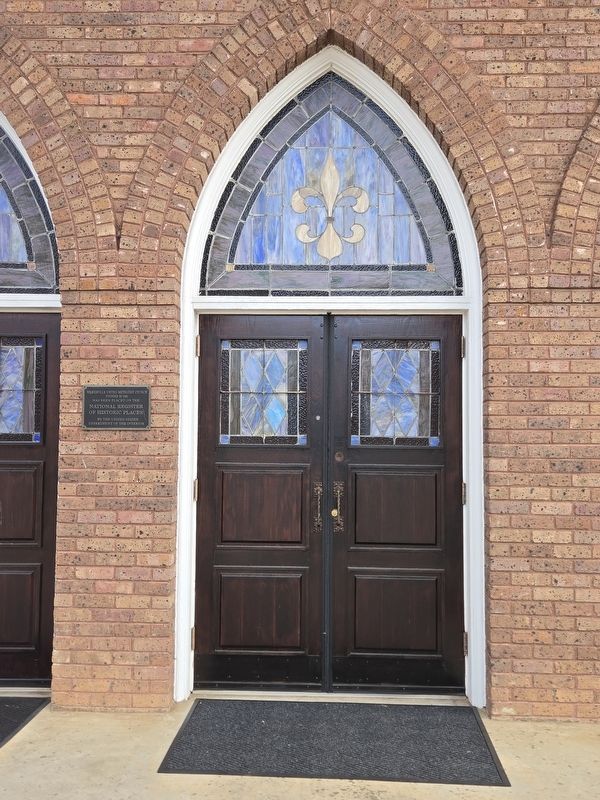
The origins of Methodism in the Reems Creek Valley are traced to a visit by Bishop Francis Asbury on one of his several circuit travels in the area: he is said tohave spent a night in the home of pioneer John Weaver. According to local tradition a log church was built here in 1805 for Methodist worship: the year of 1805 is the traditional date for the organization of the congregation which survives as the Weaverville United Methodist Church. The site of the log church is marked today by the town cemetery which developed around it on South Main Street and which contains the graves of John Weaver, numerous members of his family, and other citizens of the place that bears the family name. Around 1810 a Methodist camp meeting ground was established here, to the west of what is now the town center: it was first known as the Reems Creek Camp Meeting; however, by the early 1830s, when it was formally incorporated, it was known as the Salem Camp Ground. The Salem Camp Ground was the site of the annual meeting of the Holston Conference of the Methodist Church in 1836, by which time a conference house was built, and again in 1844: a meeting house is said to have been built on the camp grounds shortly before the 1844 meeting. The Methodist congregation at Weaverville then was in the large Holston Conference,Photographed by Mark Parker, February 10, 20252. Weaverville United Methodist Church Marker at the sanctuary entrancewhich embraced parts of North Carolina, Tennessee, Virginia, and South Carolina...Photographed by Mark Parker, February 10, 20253. Full view of Weaverville United Methodist Church
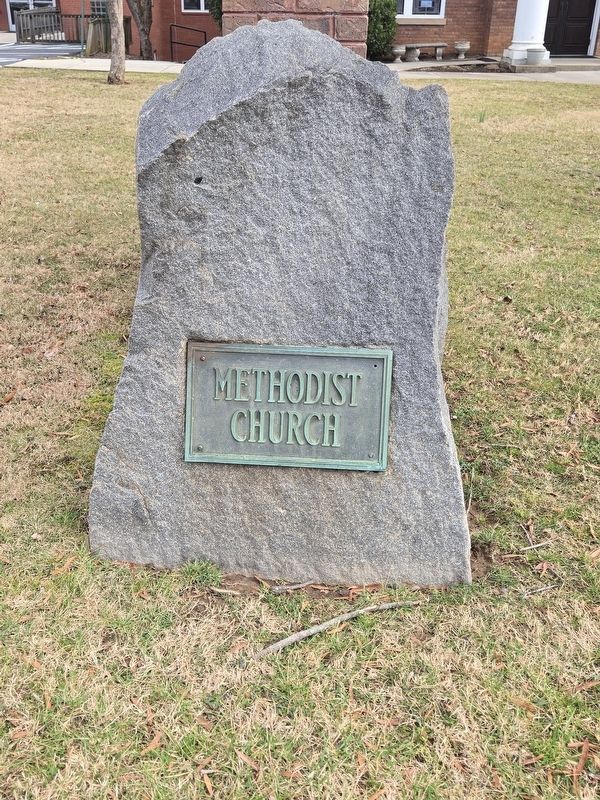
In the 1880s, there was some movement toward the construction of a new building for the Weaverville Methodist Church; however, it was not until 1890-1891 that a new church was built and occupied. It was erected on a lot on the north side of a street, now known as Church Street, about two blocks west of the present 1919-1920 church. The weatherboarded frame building, finished with lancet-arch door and window openings, had a three-bay gable-front facade with four-bay side elevations. The facade was dominated by a partially-inset three-stage center tower which contained the vestibule on the lower story and the belfry in the uppermost level: the tower was topped by a tall spire covered with wood shingles. This well-finished, conventional turn-of-the-century church building would house its congregation for twenty-six years. During this period the church saw steady growth and in 1902 it was separated from the Weaverville Circuit and made a station church on its own: the Reverend A. W. Plyler was the first full-time minister of Weaverville Methodist Churchand he remained in the pulpit until 1905 when the membership stood at 201 persons.Photographed by Mark Parker, February 10, 20254. Methodist Church plaque on attached to boulder on the front lawn

Also see . . .
1. Weaverville United Methodist Church Nomination Form (pdf). Form prepared by David Foard Hood, 1995 (Submitted on February 10, 2025, by Mark Parker of Hickory, North Carolina.)
2. Weaverville United Methodist Church. (Submitted on February 11, 2025.)
Credits. This page was last revised on February 11, 2025. It was originally submitted on February 10, 2025, by Mark Parker of Hickory, North Carolina. This page has been viewed 201 times since then and 27 times this year. Photos: 1, 2, 3, 4. submitted on February 10, 2025, by Mark Parker of Hickory, North Carolina. • Bernard Fisher was the editor who published this page.
