Amherst in Lorain County, Ohio — The American Midwest (Great Lakes)
Shupe Homestead
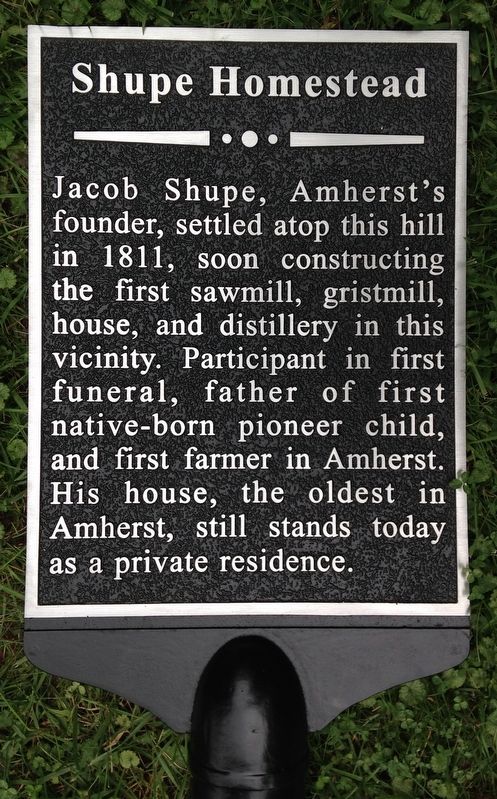
Photographed by Matt Nahorn, September 11, 2014
1. Shupe Homestead Marker
Erected 2014 by New Indian Ridge Museum.
Topics. This historical marker is listed in this topic list: Settlements & Settlers. A significant historical year for this entry is 1811.
Location. 41° 24.997′ N, 82° 13.565′ W. Marker is in Amherst, Ohio, in Lorain County. It can be reached from Cooper Foster Park Road just west of North Main Street, on the right when traveling south. Marker is located next to driveway gate, leading to the Historic Shupe Homestead (private residence). Touch for map. Marker is at or near this postal address: 480 Park Ave, Amherst OH 44001, United States of America. Touch for directions.

Regionally, this marker is in Greater Cleveland, on the Lake Erie Shore, and in the Western Reserve. It is also in the American Midwest. Globally, it is in North America, on the Great Lakes, in the Western Hemisphere, in the Western World, and in the Anglosphere. Historically, it finds itself in what was once the Haudenosaunee (Iroquois) Confederacy, the territory of the Mississippian Culture, and the Northwest Territory.
Other nearby markers. At least 8 other markers are within 4 miles of this marker, measured as the crow flies: Lorain County Vietnam Veterans Memorial (approx. one mile away); Sandstone Center of the World (approx. 1.3 miles away); Eagle & Auxiliary Veterans Memorial (approx. 1.3 miles away); Amherst World War Memorial (approx. 1.3 miles away); Vermilion (approx. 3.2 miles away); Helen Steiner Rice (approx. 3.4 miles away); General Quincy Adams Gillmore
this page online
Regarding Shupe Homestead. Jacob Shupe (1778-1832) and his wife Catharine (1780-1871) came to the area of what would become Amherst (then part of Black River Township in Huron County), with their family and a hired carpenter, Ralph Lyons, in 1810, from Pennsylvania. By 1811 they permanently settled on what is today known as the Historic Shupe Homestead. The Shupes purchased several hundred acres of land, and in one deed, it states that the property “encompassed the waters of Beaver Creek.” The Shupes settled on this site, constructing a very crude, rough log house for a temporary dwelling, where they attached their covered wagon to add a bit more space. They were the parents of the first native-born pioneer child in Amherst, Betsy.
Early histories state that in 1811, he and his hired carpenter, constructed the first sawmill in this area. It was an early, up-and-down sash-style sawmill, powered off of Beaver Creek. A millrace was cut across the floodplain of Beaver Creek, from one end of the Creek’s channel
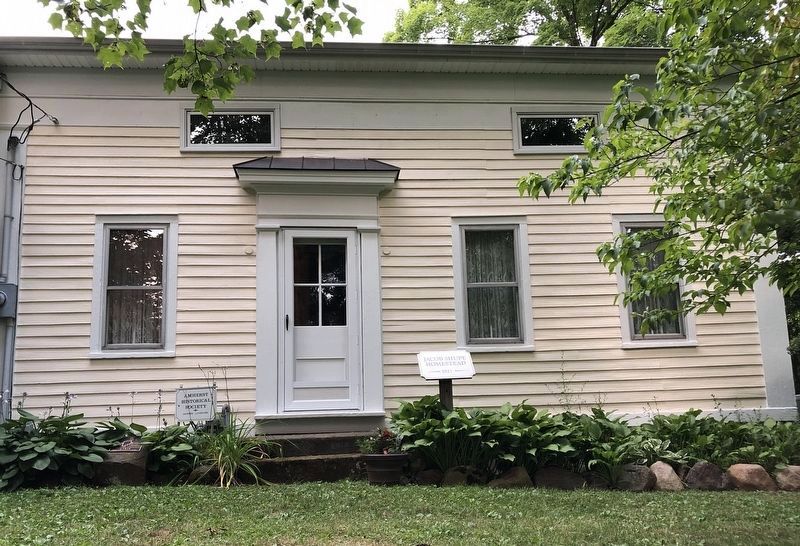
Photographed by Matt Nahorn, 2023
2. Shupe Homestead (c.1811)
The Jacob and Catharine Shupe House, constructed not long after they arrived here. It still stands today, on its original foundation, and still used as a private residence. It is the oldest house in Amherst and built before Lorain County, Ohio was formed.
No tax records were kept that early, but Shupe’s house is listed on the earliest Huron County, then Lorain County records, respectively. At the time, this area was a part of Huron County, as Lorain County would not be created until 1822. Huron County’s boundary originally met Cuyahoga County at the middle of the Black River. Lorain County was carved from Cuyahoga, Huron, and Medina Counties. Tax records (for land) go back to 1815 in Huron County, and as part of my in-depth research efforts, I closely studied those at the Norwalk Courthouse. But, houses were still not taxed, or at least noted, on those records, until 1819. Shupe’s house appears on those records, but it was constructed before that time, c. 1812. (We are confident of this, having studied other similar early settlement areas.)

Photographed by Matt Nahorn, October 9, 2014
3. Shupe Homestead Marker
By 1813, he expanded the sawmill with the addition of a gristmill. Both were powered off of the same undershot waterwheel powered off of Beaver Creek. The Creek was a more powerful stream and had more constant flow at the time, for various reasons. The millrace, excavated across the valley, which directed the water’s flow, was quite effective in powering these “thundershower mills.” Grist stones used to grind the grain were hand-carved of granite boulders (Canadian Shield bedrock), which began as large glacial erratic boulders pushed here from Canada by the glaciers, thousands of years ago. The grist stone monument that stood at Amherst’s old Central School from 1934-2013, originated from Shupe’s mill and is now “back home” at the Shupe Homestead. By 1815, Jacob Shupe began a distillery operation. These mills spurred development in this area, making it more practical for early settlers to live here, as other closest mills were located at the Huron River or Chagrin Falls – a journey the duration of three days.
Jacob Shupe was killed on June 9, 1832 at the age of 54 when a timber fell on him as he was making an extension to his mill. His funeral was held in the Shupe house, as was customary in those early days. He was buried in the Cleveland Street Cemetery. Mr. Shupe’s original gravestone of sandstone was later removed from the Cemetery and replaced by the present monument (where he and his wife Catharine are both named on the same stone), after his wife passed away at nearly 91 years of age (certainly an accomplishment for that time). She operated the mills after his death and later lived with youngest son Isaac and his wife Minerva. The original gravestone was given to Isaac Shupe. It was found near their house, which still stands today, originally off of Elyria Avenue, now accessed by Shupe Avenue. It was acquired by a local historian and later donated for preservation at the Shupe Homestead.
Credits. This page was last revised on February 15, 2025. It was originally submitted on January 26, 2025, by Matt Nahorn of Amherst, Ohio. This page has been viewed 879 times since then and 92 times this year. Last updated on February 15, 2025, by Matt Nahorn of Amherst, Ohio. Photos: 1, 2. submitted on January 26, 2025, by Matt Nahorn of Amherst, Ohio. 3. submitted on February 15, 2025, by Matt Nahorn of Amherst, Ohio. • J. Makali Bruton was the editor who published this page.
Editor’s want-list for this marker. A wide shot of the marker in context. • Can you help?
