Union Station in Denver in Denver County, Colorado — The American Mountains (Southwest)
Union Station

Photographed by Conrad Ward, August 26, 2024
1. Union Station Marker
Denver Makes Tracks
Steam-powered railroad trains brought monumental changes to the dusty town of Denver. Built in 1881, Union Station symbolized Denver's dream to become the major urban center of the Rocky Mountain West.
Evolving Elegance
Union Station was designed in the Italianate style with a tree-lined park along Wynkoop Street. After a fire in 1894, the station was remodeled in the Romanesque Revival style. Then in 1914, the central building was demolished and replaced with a splendid Beaux-Arts terminal.
Steaming Into Colorado
The history of Colorado's settlement and growth is largely a story of its railroads. Starting in 1870, passenger trains from both coasts delivered thousands of new residents to the area, many of them immigrants from lands across the globe.
Freight trains connected local mining and agriculture industries to national markets. Vital to Colorado's economy even today, many daily freight trains still cross the South Platte Valley along the consolidated main line.
Mysterious Welcome
In 1905, a group of prominent Denverites set out to improve the city's image. Inspired by the
this page online
Decorated with iron lace and sparkling electric lights, the arch quickly became a Denver icon. Numerous statesmen and celebrities, including four U.S. Presidents, passed through the structure and marveled at its imposing beauty.
Visitors also puzzled over the meaning of the word "Mizpah" emblazoned atop the gateway. The mysterious greeting referred to a sacred monument in ancient Palestine. According to Biblical tradition, Mizpah symbolized the covenant between departing friends: "The Lord watch over me and thee when we are absent one from another."
"More Plain Than Queenly"
Already struggling with economic woes, Denver nearly folded in 1867 when the Union Pacific Railroad picked Cheyenne as the regional stop on its transcontinental route. Fearing geographic isolation and high freight costs, a group of local businessmen built their own rail network, linking Denver to Cheyenne

Photographed by Conrad Ward, August 26, 2024
2. Union Station Marker
But despite its rapid growth, Denver remained a ramshackle cow town, not even close to its boastful slogan, "Queen City of the Plains." One British tourist remarked in 1897 that the city looked "more plain than queenly." Indeed, trash littered the town's unpaved streets. Downtown saloons and brothels ran booming businesses. Surrounded by spectacular natural beauty, much of Denver itself was a sordid mess.
David Moffat And His Station
David Moffat came to Denver in 1860 at the age of 21 and quickly became a central figure in the local banking community. By 1865, he was president of the First National Bank of Denver. As the leader of Colorado's largest financial institution, Moffat invested much of the bank's holdings in mining operations. His banking and mining empires produced his personal fortune of $25 million by 1902.
Moffat's dream was to build the Moffat Road, the first major railroad line to cut directly through the Rocky Mountains. But the new road would compete with the longer routes to Salt Lake City offered by Union Pacific
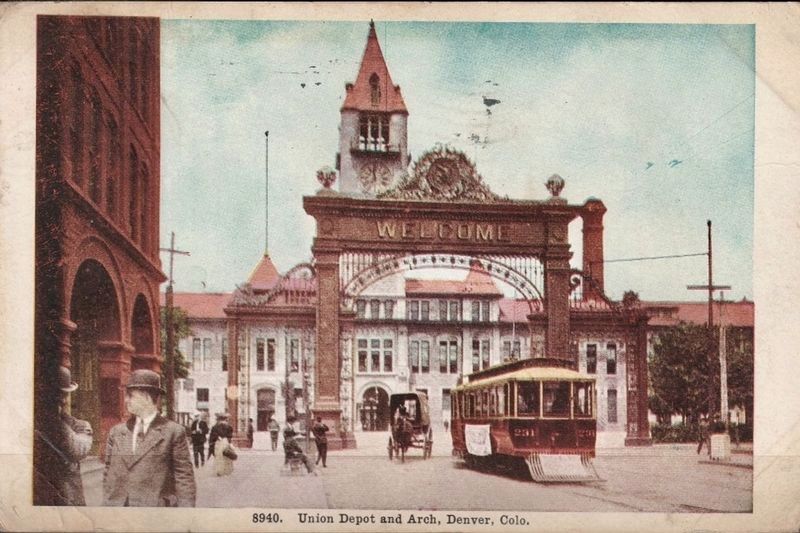
circa 1909
3. Union Depot and Arch (both mentioned on marker)
Working the Rails
Black porters were assigned to cars with orders to attend to their passengers' every whim. They were expected to be models of courtesy and efficiency as they saw to baggage, fluffed pillows and tidied up the cars. Waiters began their days at 5 a.m., working until long after the passengers had turned in for the night.
Despite the drudgery and hardships, railroad jobs were coveted. Well into the 20th Century, black men had few opportunities for jobs that offered long-term employment and a livable wage. But to make real money, porters and waiters relied on tips.
Author, director and photographer Gordon Park worked as a porter in his earlier years. So did Pulitzer Prize winner James MacPherson, painter Robert Colescott and Wiley W. Manuel, the first black California Supreme Court Justice.
Erected by Mayor's South Platte River Commission.
Topics. This historical marker is listed in these topic lists: African Americans • Architecture • Industry & Commerce • Railroads & Streetcars. A significant historical year for this entry is 1881.
Location. 39° 45.305′ N, 105° 0.325′ W. Marker is in Denver, Colorado, in Denver County. It is in Union Station. It is at the intersection of Little Raven Street and 16th Street, on the left when traveling north on Little Raven Street. Touch for map. Marker is in this post office area: Denver CO 80202, United States of America. Touch for directions.

Regionally, this marker is in Colorado’s Front Range. It is also in the American Mountain West. Globally, it is in North America, the Rocky Mountains, the Western Hemisphere, the Western World, and the Anglosphere. Historically, it finds itself in what was once the Louisiana Purchase.
Other nearby markers. At least 8 other markers are within walking distance of this marker: Riverfront Park (here, next to this marker); Little Raven (within shouting distance of this marker); Cheyenne Dog Soldiers (within shouting distance of this marker); Commons Park (about 700 feet away, measured in a direct line); Confluence Park: Reclaiming Denver's Birthplace (approx. 0.2 miles away); Trolley Town (approx. 0.2 miles away); Denver Tramway Power Plant (approx. 0.2 miles away); When the Depot Became a Station (approx. 0.3 miles away). Touch for a list and map of all markers in Denver.
Credits. This page was last revised on February 18, 2025. It was originally submitted on February 16, 2025, by Conrad Ward of Guilford, Connecticut. This page has been viewed 212 times since then and 33 times this year. Photos: 1, 2. submitted on February 16, 2025, by Conrad Ward of Guilford, Connecticut. 3. submitted on February 18, 2025. • Andrew Ruppenstein was the editor who published this page.
