Douaumont near Douaumont-Vaux in Meuse, Alsace, Lorraine, Champagne-Ardenne, France — Western Europe
De la tranchée des fusils à la Tranchée des Baïonnettes
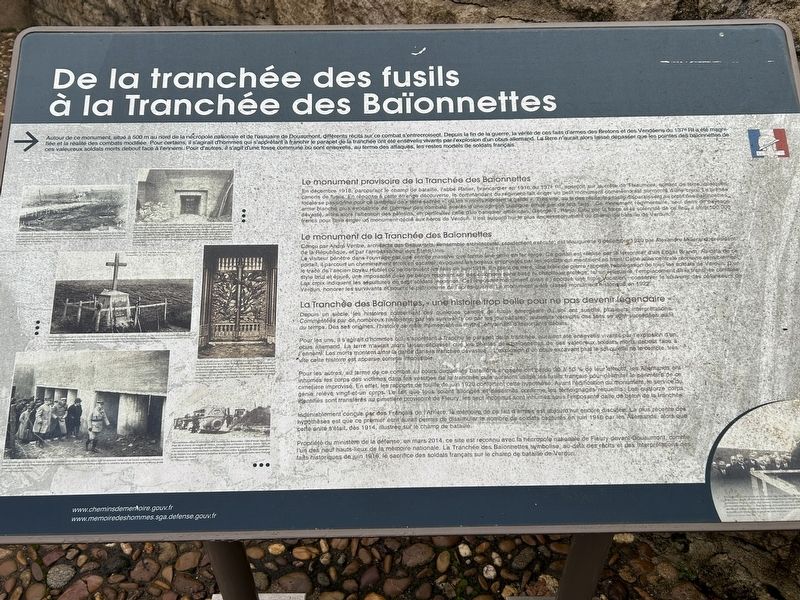
Photographed by Steve Stoessel, November 17, 2024
1. De la tranchée des fusils à la Tranchée des Baïonnettes Marker

Autour de ce monument, situé à 500 m au nord de la nécropole nationale et de l'ossuaire de Douaumont, différents récits sur ce combat s'entrecroisent. Depuis la fin de la guerre, la vérité de ces faits d'armes des Bretons et des Vendéens du 137e Ria, été magnifiée et la réalité des combats modifiée. Pour certains, il s'agirait d'hommes qui s'apprêtant à franchir le parapet de la tranchée ont été ensevelis vivants par l'explosion d'un obus allemand. La terre n'aurait alors laissé dépasser que les pointes des baïonnettes de ces valeureux soldats morts debout face à l'ennemi. Pour d'autres, il s'agit d'une fosse commune où sont ensevelis, au terme des attaques, les restes mortels de soldats français
Le monument provisoire de la Tranchée des Baïonnettes
En décembre 1918, parcourant le champ de bataille, l'abbé Ratier, brancardier en 1916 du 1370 RI, aperçoit sur la crête de Thiaumont, sortant de terre quelques canons de fusils. En réponse à cette étrange découverte, le commandant du régiment tait ériger un petit monument commémoratif surmonte d'une croix. La presse locale se passionne pour ce lambeau de « terre
this page online
Le Monument de la Tranchée des Baïonnettes
Conçu par André Ventre, architecte des Beaux-arts l’ensemble architectural rapidement exécuté, est inauguré le 8 décembre 1920 par Alexandre Millerand, président de la République, et par l'ambassadeur des États, Unis.
Le visiteur pénètre dans l’ouvrage par une entrée massive que terme une grille en fer forge. Ce portail est réalisé par le ferronnier d'an Edgar Brandt, Au-delà de ce portail, il parcourt un cheminement étroit en escalier, évoquant les boyaux empruntes par les soldats qui montaient au front. Cette

Photographed by Steve Stoessel, November 17, 2024
2. De la tranchée des fusils à la Tranchée des Baïonnettes Marker
La Tranchée des Baïonnettes, « une histoire trop belle pour ne pas devenir légendaire »
Depuis un siècle, les histoires concernant ces quelques canons de fusils émergeant du sol ont suscité plusieurs interprétations. Commentées par de nombreux historiens par les survivants ou par les journalistes, plusieurs versions des faits se sont succédées au fil du temps, Dès ses origines, l’histoire se mêle intimement au mythe entrainant d’importants débats.
Pour les uns, il s'agirait d'hommes
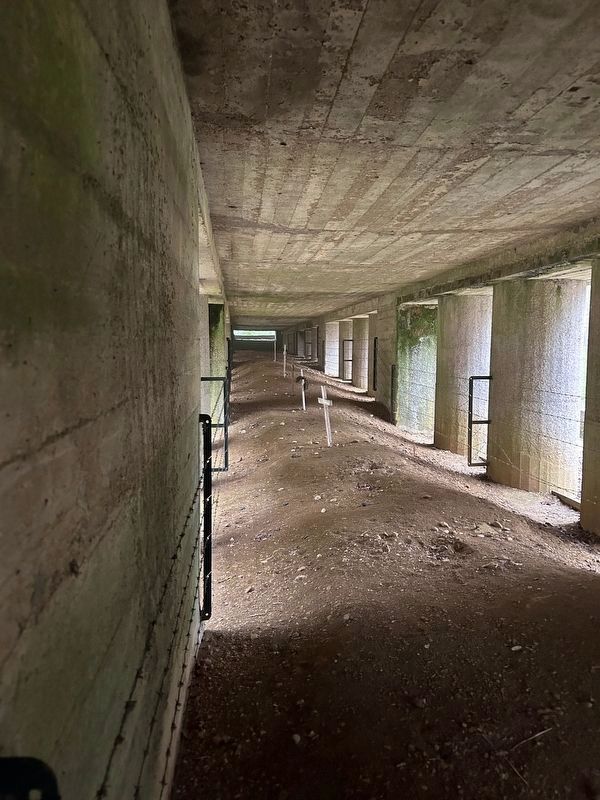
Photographed by Steve Stoessel, November 17, 2024
3. La Tranchée des Baïonnettes
Pour les autres, au terme de ce combat au cours duquel les bataillons engages ont perdu 30 à 50% de leur effectif, les Allemands ont inhumés les corps des victimes dans les vestiges de la tranchée puis auraient utilisé les fusils français pour délimiter le périmètre de ce cimetière improvisé. En effet, les rapports de fouille, de juin 1920 confortent cette hypothèse. Avant l'édification du monument, te service du génie relève vingt-et-un corps. Le fait que tous soient allongés et désarmes confirme les témoignages recueillis. Les quatorze corps identifiés sont transférés au cimetière provisoire de Fleury, les sept inconnus sont inhumés sous l'imposante dalle de béton de la tranchée.
Indéniablement concue par des

Photographed by Steve Stoessel, November 17, 2024
4. Tranchée des Baïonnettes Sign
Propriété du ministère de la défense, en mars 2014, ce site est reconnu avec la nécropole nationale de Fleury-devant-Douaumont, comme l'un des neuf hauts-lieux de la mémoire nationale. La Tranchée des Baïonnettes symbolise, au-delà des récits et des interprétations des faits historiques de juin 1916, le sacrifice des soldats français sur le champ de bataille de Verdun.
From the Rifle Trench to the Bayonet Trench
Around this monument, located 500 m north of the national necropolis and the Douaumont ossuary, different stories about this battle intertwine. Since the end of the war, the truth of these feats of arms of the Bretons and Vendeans of the 137th Ria, has been magnified and the reality of the fighting modified. For some, these were men who were about to cross the parapet of the trench and were buried alive by the explosion of a German shell. The earth would then have left only the points of the bayonets of these valiant soldiers who died standing facing the enemy. For others, it is a mass grave where the mortal remains of French soldiers are buried at the end of the attacks
The temporary monument of the Trench of Bayonets
In December 1918, while walking across the battlefield, Abbé Ratier, a stretcher-bearer in 1916 of the 1370th RI, saw a few rifle barrels sticking out of the ground on the Thiaumont ridge. In response to this strange discovery, the regimental commander erected a small commemorative monument topped with a cross. The local press was fascinated by this piece of "sacred land", where the "dead stand guard". Very quickly, as the stories progressed, rifles disappeared in favor of bayonets, a bladed weapon more evocative of the horror of the fighting for a public opinion moved by such events. This regimental monument, alone in a devastated landscape, then attracted the attention of pilgrims, in particular that of an American banker, George T. Rand. Moved by the strength and solemnity of this place, he offered: 500,000 francs to erect a monument dedicated to the heroes of Verdun. It is today the oldest monument on the Verdun battlefield.
The Monument of the Trench of Bayonets
Designed by André Ventre, architect of the Beaux-arts, the architectural ensemble quickly executed, was inaugurated on December 8, 1920 by Alexandre Millerand, President of the Republic, and by the ambassador of the United States.
The visitor enters the work by a massive entrance that ends a wrought iron gate. This gate was made by the ironworker Edgar Brandt. Beyond this gate, there is a narrow staircase path, reminiscent of the trenches used by the soldiers who went to the front. This central path substantially covers the route of the old Hublet trench where the events of June 1916 took place. In the spotlight, a stone cross recalls the self-sacrifice of all the soldiers of Verdun. In a raw and refined style, an imposing concrete wing resting on columns without a base or protected capital, like a reliquary, marks the location of the filled-in trench. The crosses indicate the graves of six unknown soldiers. At the time, this imposing monument had a triple purpose: to preserve the memory of the defenders of Verdun, to honor the survivors and to nourish post-war patriotism. The monument was classified as a historical monument in 1922
The Trench of Bayonets, "a story too beautiful not to become legendary"
For a century, the stories concerning these few rifle barrels emerging from the ground have given rise to several interpretations. Commented on by many historians, survivors or journalists, several versions of the facts have succeeded one another over time. From its origins, history has been closely intertwined with myth, leading to major debates.
For some, these were men who, preparing to cross the parapet of the trench, were buried alive by the explosion of a German shell. The earth would then have left only the points of the bayonets of these valiant soldiers who died standing facing the enemy. The dead thus stand guard in the devastated trench... The explosion of a shell excavating more soil than filling it, this story very quickly appeared impossible.
For the others, at the end of this fight during which the battalions engaged lost 30 to 50% of their personnel, the Germans buried the bodies of the victims in the remains of the trench and then used French rifles to demarcate the perimeter of this improvised cemetery. Indeed, the excavation reports of June 1920 support this hypothesis. Before the construction of the monument, the engineering service found twenty-one bodies. The fact that all were lying down and disarmed confirms the testimonies collected. The fourteen identified bodies were transferred to the temporary cemetery of Fleury, the seven unknowns were buried under the imposing concrete slab of the trench.
Undeniably conceived by French people from the rear, the memory of this feat of arms is still debated today. The most recent of the hypotheses is that this first writing would have made it possible to conceal the number of soldiers captured in June 1916 by the Germans, while this unit had distinguished itself on the battlefield since 1914.
Ownership of the Ministry of Defense, in March 2014, this site was recognized with the national necropolis of Fleury-devant-Douaumont, as one of the nine high places of national memory. Beyond the stories and interpretations of the historical facts of June 1916, the Bayonet Trench symbolizes the sacrifice of French soldiers on the battlefield of Verdun.
Topics. This memorial is listed in this topic list: War, World I. A significant historical month for this entry is December 1918.
Location. 49° 12.799′ N, 5° 25.557′ E. Memorial is near Douaumont-Vaux, Grand Est (Alsace, Lorraine, Champagne-Ardenne), in Meuse. It is in Douaumont. It is on Grand Est Route 913 half a kilometer north of Route 913C, on the right when traveling north. Touch for map. Memorial is at or near this postal address: 1 D913, Douaumont-Vaux, Grand Est 55100, France. Touch for directions.

Regionally, it is in the North Atlantic Region, Europe, the European Union, Atlantic Europe, the Schengen Area, Western Europe, a coastal Mediterranean country, and the Western World. Historically, it finds itself in what was once a French colony, the Roman Empire, and specifically the Holy Roman Empire.
Other nearby markers. At least 8 other markers are within 2 kilometers of this marker, measured as the crow flies: La Tranchée des Baïonnettes (here, next to this marker); Les Sentiers du Champ de Bataille (a few steps from this marker); 137th R.I. / 137e R.I. (within shouting distance of this marker); “We have reconciled” (approx. 0.6 kilometers away); La nécropole nationale de Fleury-devant-Douaumont (approx. 0.6 kilometers away); a different marker also named La nécropole nationale de Fleury-devant-Douaumont (approx. 0.8 kilometers away); Fleury-devant-Douaumont (approx. 1.7 kilometers away); Fleury / Hohenlinden (approx. 1.7 kilometers away). Touch for a list and map of all markers in Douaumont-Vaux.
Credits. This page was last revised on February 16, 2025. It was originally submitted on February 16, 2025, by Steve Stoessel of Niskayuna, New York. This page has been viewed 1,014 times since then and 30 times this year. Photos: 1, 2, 3, 4. submitted on February 16, 2025, by Steve Stoessel of Niskayuna, New York.
