Pleasant Street in Gainesville in Alachua County, Florida — The American South (South Atlantic)
St. Augustine, the Episcopal Mission Church and School
Photographed by Tim Fillmon, February 11, 2025
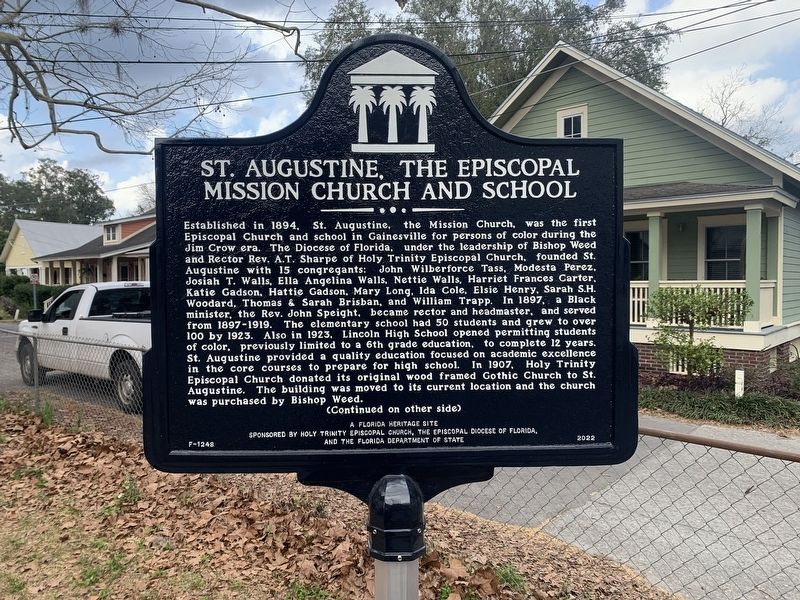
1. St. Augustine, the Episcopal Mission Church and School Marker, Side One
Established in 1894, St. Augustine, the Mission Church, was the first Episcopal Church and school in Gainesville for persons of color during the Jim Crow era. The Diocese of Florida, under the leadership of Bishop Weed and Rector Rev. A.T. Sharpe of Holy Trinity Episcopal Church, founded St. Augustine with 15 congregants: John Wilberforce Tass, Modesta Perez, Josiah T. Walls, Ella Angelina Walls, Nettie Walls, Harriet Frances Carter, Katie Gadson, Hattie Gadson, Mary Long, Ida Cole, Elsie Henry, Sarah S.H. Woodard, Thomas & Sarah Brisban, and William Trapp. In 1897, a Black minister, the Rev. John Speight, became rector and headmaster, and served from 1897-1919. The elementary school had 50 students and grew to over 100 by 1923. Also in 1923, Lincoln High School opened permitting students of color, previously limited to a 6th grade education, to complete 12 years. St. Augustine provided a quality education focused on academic excellence in the core courses to prepare for high school. In 1907, Holy Trinity Episcopal Church donated its original wood framed Gothic Church to St. Augustine. The building was moved to its current
this page online
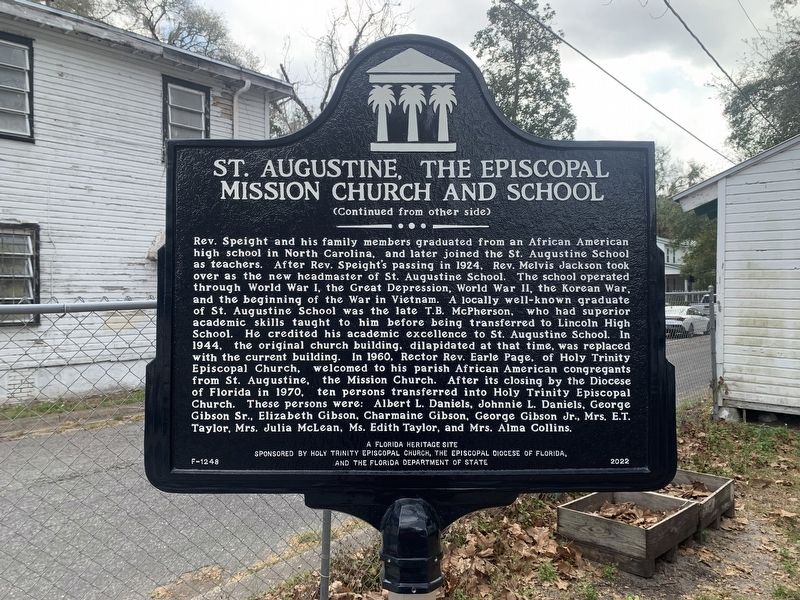
Rev. Speight and his family members graduated from an African American high school in North Carolina, and later joined the St. Augustine School as teachers. After Rev. Speight’s passing in 1924, Rev. Melvis Jackson took over as the new headmaster of St. Augustine School. The school operated through World War I, the Great Depression, World War II, the Korean War, and the beginning of the War in Vietnam. A locally well-known graduate of St. Augustine School was the late T.B. McPherson, who had superior academic skills taught to him before being transferred to Lincoln High School. He credited his academic excellence to St. Augustine School. In 1944, the original church building, dilapidated at that time, was replaced with the current building. In 1960, Rector Rev. Earle Page, of Holy Trinity Episcopal Church, welcomed to his parish African American congregants from St. Augustine, the Mission Church. After its closing by the Diocese of Florida in 1970, ten persons transferred into Holy Trinity Episcopal Church. These persons were: Albert L. Daniels, Johnnie L. Daniels, George Gibson
Photographed by Tim Fillmon, February 11, 2025
2. St. Augustine, the Episcopal Mission Church and School Marker, Side Two
A Florida Heritage Site
Erected 2023 by Holy Trinity Episcopal Church, The Episcopal Diocese of Florida, and the Florida Department of State. (Marker Number F-1248.)
Topics. This historical marker is listed in these topic lists: African Americans • Education • Religion & Religious Structures. A significant historical year for this entry is 1894.
Location. 29° 39.28′ N, 82° 19.726′ W. Marker is in Gainesville, Florida, in Alachua County. It is in Pleasant Street. It is at the intersection of Northwest 4th Avenue and Northwest 4th Street, on the left when traveling west on Northwest 4th Avenue. Touch for map. Marker is at or near this postal address: 402 NW 4th Ave, Gainesville FL 32601, United States of America. Touch for directions.

Regionally, this marker is in North Florida. It is also in the American South. Globally, it is in the North Atlantic Region, North America, a Gulf of Mexico state, the Western Hemisphere, the Western World, and the Anglosphere. Historically,
Photographed by Tim Fillmon, February 11, 2025
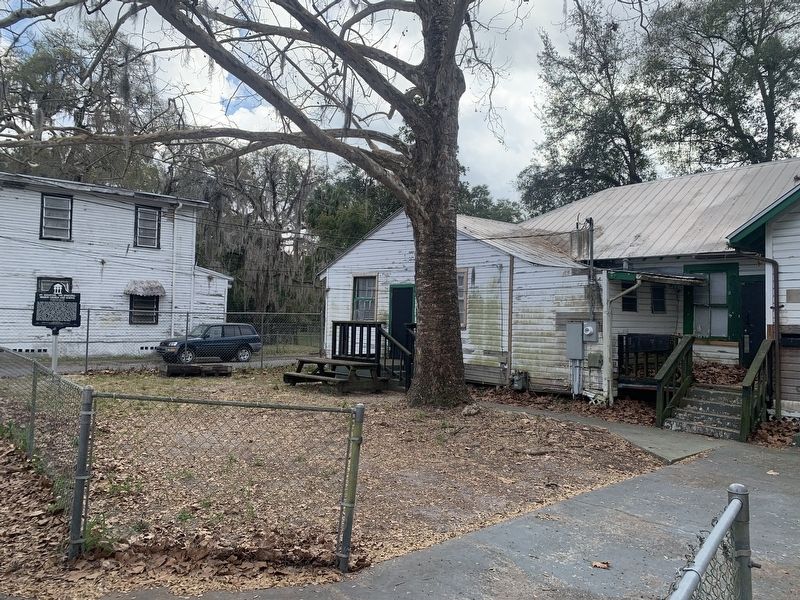
3. St. Augustine, the Episcopal Mission Church and School Marker
Other nearby markers. At least 8 other markers are within walking distance of this marker: Mt. Carmel Baptist Church (about 300 feet away, measured in a direct line); Gainesville's Railroads / Past Railroads of Gainesville (about 600 feet away); "The Great Endurance Run" (approx. ¼ mile away); Mount Pleasant United Methodist Church (approx. ¼ mile away); Josiah T. Walls (approx. ¼ mile away); Alachua County Courthouse (approx. 0.3 miles away); Lynching in America / Reconstruction-Era Lynchings in Gainesville (approx. 0.3 miles away); Roper Park / Old City Park (approx. 0.4 miles away). Touch for a list and map of all markers in Gainesville.
Another marker is no longer nearby. Confederate Soldier Memorial (was approx. 0.3 miles away but has been permanently removed).
Photographed by Tim Fillmon, February 11, 2025
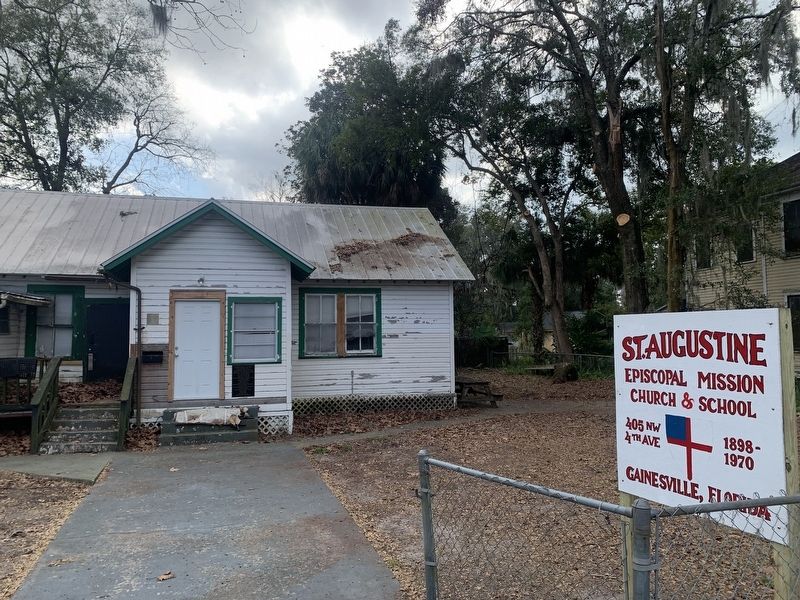
4. St. Augustine, the Episcopal Mission Church and School Marker
Credits. This page was last revised on June 30, 2025. It was originally submitted on February 17, 2025, by Tim Fillmon of Webster, Florida. This page has been viewed 252 times since then and 59 times this year. Photos: 1, 2, 3, 4. submitted on February 17, 2025, by Tim Fillmon of Webster, Florida.
