Near Bras-sur-Meuse in Meuse, Alsace, Lorraine, Champagne-Ardenne, France — Western Europe
Fontaine du Roi Prusse
Les Sentiers De Découverte - Discovery Trails - Entdeckungsrundgänge

Photographed by Steve Stoessel, November 17, 2024
1. Fontaine du Roi Prusse Marker

Dominant le ravin du Pied du Gravier et le ravin des Vignes, le secteur de la fontaine du Roi de Prusse constitua durant les dix mois de la bataille de 1916 une des principales entrées vers les lignes de combat. Par ces portes ouvertes des deux côtés du front, sur les Hauts de Meuse entrecoupés de profonds ravins et sillonnés par les boyaux, cheminaient les soldats, les armes, le ravitaillement et les munitions, mais aussi une profusion de matériels de tous types, Camions, roulantes, charrois, trains militaires à vole étroite participaient à l'approvisionnement, mais à l'approche du terrain dévaste l'homme-soldat devenait aussi porteur et bête de somme, parfois accompagné de mules. En chemin vers le fort de Douaumont, gravissant le ravin d'Hasoule, "les mulets portent des rouleaux de fil de fer, des piquets à vis, du ciment, du pain, des boites de conserve de viande et de l'eau" relate Werner Beumelburg. Ici, malgré l'aide des animaux, les times centaines de mètres devront être assurées à dos d'homme.
Car il y a surtout les hommes. Côté français, au débouché de la Voie
this page online
Werner Beumelburg, dans Combattants allemands à Verdun, témoigne de cette épreuve qu'était la montée en ligne, effectuée de nuit sous le poids d'un barda surchargé de musettes, de grenades, de munitions, rythmée par les cris : "Attention, fil de fer / serrez / ralentissez en tête” et avec 'angoisse de se perdre, de s'enliser dans la boue d'un entonnoir, ou d'être pris sous le tir d'une batterie ennemie.
*Dans tout le secteur de Louvemont, il n'y a pas d'autre possibilité que de cheminer par le ravin des Fosses. Celui-ci n'est en fait que le déversoir
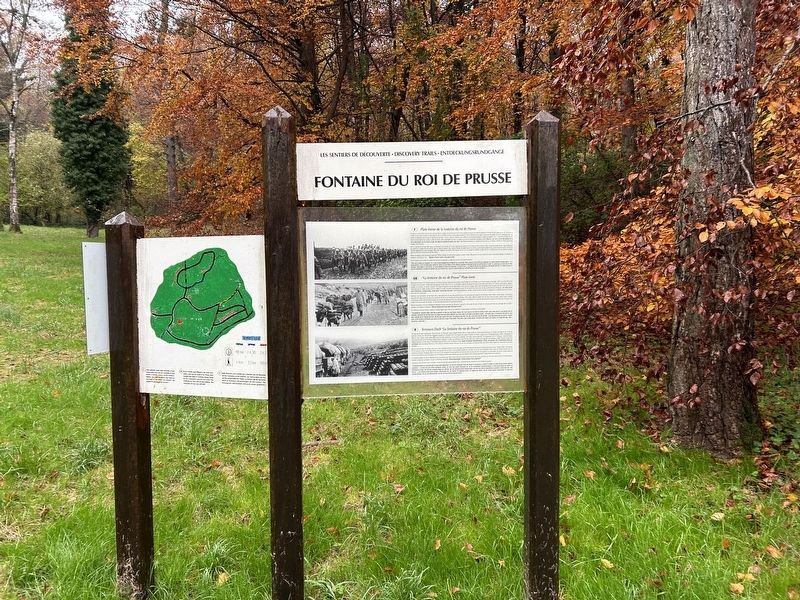
Photographed by Steve Stoessel, November 17, 2024
2. Fontaine du Roi Prusse Marker
High above the ravines at Le Pied du Gravier and Les Vignes, the sector around the spring known as the Fontaine du Roi de Prusse was, for the ten months of the battle in 1916, one of the main points of access to the front lines, Through these two openings on both sides of the Front, on the Meuse Heights interspersed with deep ravines and crisscrossed by the trenches, came soldiers, weapons, supplies and munitions, as well as a profusion of all types of equipment. Lorries, field kitchens, carts, and narrow-gauge military

Photographed by Steve Stoessel, November 17, 2024
3. Fontaine du Roi Prusse Marker
Manpower was a key element. On the French side, a never-ending flow of relief units reached the end of the Voie Sacrée and headed for the front lines. Some of them crossed Verdun, marched along the banks of the Meuse and, just before Bras, turned into the ravines out into the heart of the battlefield. These routes, which were hidden from the direct view of the enemy, quickly became umbilical cords between the front and the logistical stages set out at the rear. Because of this, they were subjected to the tyrannical fire of guns that devastated the ravines and decimated the unfortunate units caught in the snare between the hillsides. The men were strafed by

Photographed by Steve Stoessel, November 17, 2024
4. Fontaine du Roi Prusse Marker
Werner Beumelburg, in his work Combattants allemands Verdun, described the difficulty of reaching the Front under the cover of darkness, carrying a pack that was overloaded with haversacks. grenades, and munitions, to shouts of: "Mind out! Barbed wire! Close ranks! Slow down in front!”
And all the time, there was the fear of getting lost, being bogged down in the mud in a shell-hole, or being caught in the fire from an enemy battery:
"Throughout the Louvemont sector, there was no alternative to the Ravin des Fosses. Actually, this ravine was no more than the overflow of half-a-dozen other ravines. It was shelled from all directions, especially from the other bank of the Meuse where the French batteries were set as close to each other as the bilberry bushes in the woods. None of the trenches here held for more than a fortnight and no networks were built. Nobody took a gentle stroll here if he wanted to stay alive. The floor of the ravine was like porridge - it had been turned over and stirred a hundred times. At the entrance to the trench, you could just make out a group of dead bodies. There was a stink of fresh sulfur. The bodies were those of men detailed off to make the soup. They'd been hit by a mortar shell.”
Das oberhalb der engen Talschluchten "Pied du Gravier“ und 'Ravin des Vignes" gelegene Gelände um die Fontaine du Roi de Prusse (Quelle des Königs von Preußen) war während der 10 Monate dauernden Schlacht von 1916 einer der wichtigsten Zugänge zur vordersten Front. Durch diesen nach beiden Frontseiten hin offenen Zugang wurden Verstärkungstruppen, Waffen, Verpflegung und Munition sowie zahllose andere Gerätschaften durch die tiefen Schluchten und das dichte Grabennetz in die Maas-Anhöhen geschafft. Die Ausrüstung wurde in Lastwagen, Feldküchenwagen Transporkarren oder mit der Schmalspur-Militäreisen bahn angeliefert. Je näher man allerdings a die Front kam, desto mehr mußte von den Soldaten selbst getragen werden. Bisweilen wurden auch Packesel eingesetzt. Auf dem Weg zur Verteldigungsanlage Douaumont, das Tal Hassoule' hinauf, Tragen die Maulesel Stacheldrahtrollen, Pflöcke, Zemensäcke, Brot, Fleisch-Konservenbüchsen und Wasser", berichtete Werner Beumelburg. Aber selbst die Lastentiere konnten nicht ganz bis zum Ziel vordringen, und über die letzten paar hundert Meter mußten die Landser die Waren selber schleppen.
Doch es waren vor allem die Soldaten selbst, die in nicht abreißenden Kolonnen a die Front zogen. Auf der französischen Seite kamen die Ablösungstruppen von der "Helligen Straße" (Voie Sacrée) Ein Teil zog durch Verdun, an der Maas entlang und bog dann kurz vor Bras in die verzweigten Flußtaler ein, die direkt bis ins Herz des Schlachtfelds führten. Diese der direkten Einsicht durch die feindlichen Beobachter entzogenen Wege wurden bald zu den wichtigsten Versorgungslinien zwischen der Front und den hinter der Front liegenden Umschlagplätzen. Aus diesem Grunde blieben sie auch von dem heimtückischen Artilleriefeuer und den Splittergeschossen nicht verschont, dass die in den Talhängen ohne Deckung agierenden Truppeneinheiten stark dezimierte.
In "Deutsche Soldaten vor Verdun" beschrieb Werner Beumelburg diese Tortur, die der nächtliche Vorstoß an die Front für den Landser darstellte, der unter dem Gewicht seines mit Schultertaschen, Granaten und Munition überladenen Tornisters im Rhythmus der Befehle "Vorsicht Stacheldraht, Reihen schließen! Vorne langsamer!" marschierte, unter der Gefahr, sich zu verlaufen, in einem Schlammloch steckenzubleiben oder in die Schußlinie einer feindlichen Geschützstellung zu geraten: "Im gesamten Gebiet um Louvemont gibt es keine andere Möglichkelt, als durch die Talschlucht "Ravin des Fosses" zu marschieren. In diesem Tal fließen ein halbes Dutzend weiterer Bächlein zusammen (...) Es kann von allen Seiten beschossen werden, vor allem vom anderen Meuseufer aus, wo die französischen Geschützstellungen so dicht aneinandergereiht sehen wie Heidelbeeren im Wald. Hier hält kein Laufgraben länger als 2 Wochen, darf das Stollennetz keinen Ausgang haben. Hier kann man nicht im Spaziertempo marschieren, wenn einem das Leben lieb ist (...) Die Talsohle gleicht einem einzigen, schlammigen Brei, der hundert mal umgewälzt wurde. Am Eingang zum Graben liegt ein Haufen Leichen durcheinander. Es stinkt mach frischem Schwefel. Das war eine Küchenkolonne, die hier von einem Geschoß getroffen wurde."
Topics. This historical marker is listed in this topic list: War, World I. A significant historical year for this entry is 1916.
Location. 49° 11.477′ N, 5° 23.405′ E. Marker is near Bras-sur-Meuse, Grand Est (Alsace, Lorraine, Champagne-Ardenne), in Meuse. It is on Grand Est Route 913B one kilometer east of Route 964, on the left when traveling east. The parking area for trail is a little north of the highway. Touch for map. Marker is in this post office area: Bras-sur-Meuse, Grand Est 55100, France. Touch for directions.

Regionally, it is in the North Atlantic Region, Europe, the European Union, Atlantic Europe, the Schengen Area, Western Europe, a coastal Mediterranean country, and the Western World. Historically, it finds itself in what was once a French colony, the Roman Empire, and specifically the Holy Roman Empire.
Other nearby markers. At least 8 other markers are within 3 kilometers of this marker, measured as the crow flies: Champ de Bataille 14-18 (here, next to this marker); L'abri de combatMeuse - Froideterre 1: MF1 (approx. 0.4 kilometers away); L'abri de combat Meuse - Froideterre 2: MF2 (approx. 0.4 kilometers away); Retranchement d'infanterie (approx. 0.7 kilometers away); L'abri des Quatre Cheminées (approx. 1.8 kilometers away); a different marker also named L'abri des Quatre Cheminées (approx. 1.8 kilometers away); Pierre Cazalis de Fondouce (approx. 1.8 kilometers away); Fleury-devant-Douaumont Enjeu de la Bataille de Verdun (approx. 2.8 kilometers away). Touch for a list and map of all markers in Bras-sur-Meuse.
Credits. This page was last revised on February 19, 2025. It was originally submitted on February 18, 2025, by Steve Stoessel of Niskayuna, New York. This page has been viewed 213 times since then and 55 times this year. Photos: 1, 2, 3, 4. submitted on February 18, 2025, by Steve Stoessel of Niskayuna, New York.
