Near Rutherfordton in Polk County, North Carolina — The American South (South Atlantic)
Green River Plantation
Photographed by Mark Parker, February 7, 2025
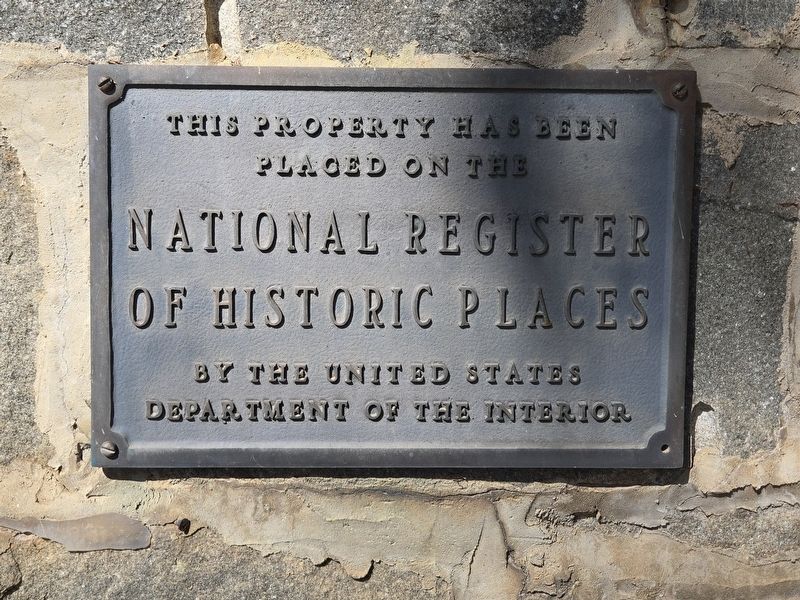
1. Green River Plantation Marker
Placed on the
National Register
of Historic Places
by the United States
Department of the Interior
Erected by United States Department of the Interior.
Topics. This historical marker is listed in this topic list: Notable Buildings.
Location. 35° 17.095′ N, 82° 1.192′ W. Marker is near Rutherfordton, North Carolina, in Polk County. It can be reached from Coxe Road (State Road 1005) 0.4 miles west of Calton Hill Lane, on the right when traveling east. Touch for map. Marker is at or near this postal address: 6333 Coxe Rd, Rutherfordton NC 28139, United States of America. Touch for directions.

Regionally, this marker is in North Carolina’s Mountains. It is also in the American South, specifically in the Upper South, in Appalachia, and specifically in Southern Appalachia. Globally, it is in North America, the Western Hemisphere, the Western World, and the Anglosphere. Historically, it finds itself in what was once the original Cherokee Nation, the territory of the Mississippian Culture, one of the original Thirteen Colonies,
this page online
Other nearby markers. At least 8 other markers are within 7 miles of this marker, measured as the crow flies: Overmountain Men (approx. 3.7 miles away); Rutherfordton (approx. 6.6 miles away); Tryon's March (approx. 6.8 miles away); North Carolina / South Carolina (approx. 6.8 miles away); Stoneman's Raid (approx. 6.8 miles away); Ibra Charles Blackwood (approx. 6.8 miles away in South Carolina); Rutherford County (approx. 6.8 miles away); Rutherfordton Confederate Monument (approx. 6.8 miles away). Touch for a list and map of all markers in Rutherfordton.
Another marker is no longer nearby. Green River Plantation (was a few steps from this marker but has been confirmed missing).
More about this marker. The Green River Plantation is a private residence. Tours of the home and private events are available by reservation only. At the time of this visit, the home and grounds were being restored due to extensive damage from Hurricane Helene in September 2024.
Regarding Green River Plantation. Excerpts from the Green River Plantation Nomination Form:
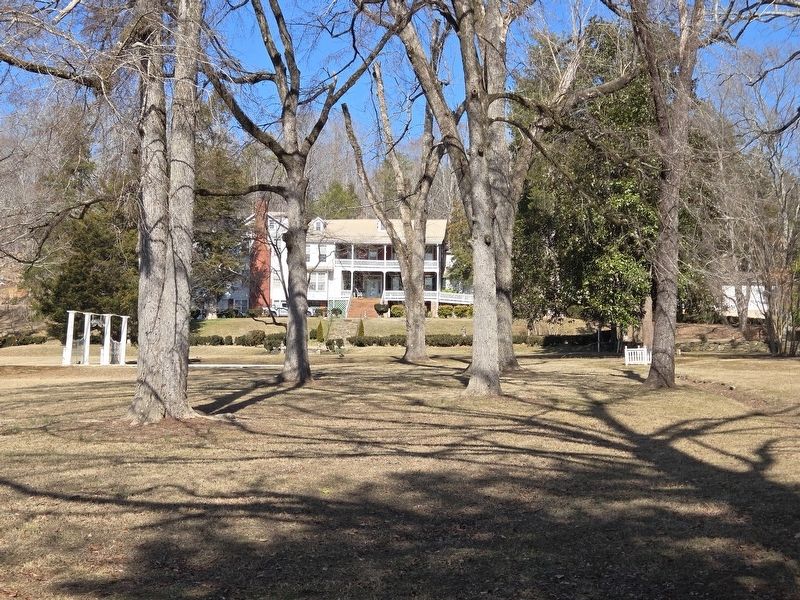
Perchedon a rise overlooking the flood plain of the Green River is a rambling two-story house called Green River Plantation. It is composite of three major construction periods. It started as a frame Federal-style house facing west. During the Greek Revival period a separate two-story brick structure of similar proportions was built slightly to the rear (east) of the structure, facing south. Early in the twentieth century these two structures were united with a two-story section.Photographed by Mark Parker, February 7, 20252. Green River Plantation attached to the right post at the entrance to the grounds
Joseph McDowell Carson, the probable builder of Green River Plantation was the son of Colonel John Carson, an early settler of Burke County and a Revolutionary soldier. Joseph left his father's home, Pleasant Gardens, and settled in Rutherford County where in 1807 he bought 600 acres on both sides of Green River for $3,000.
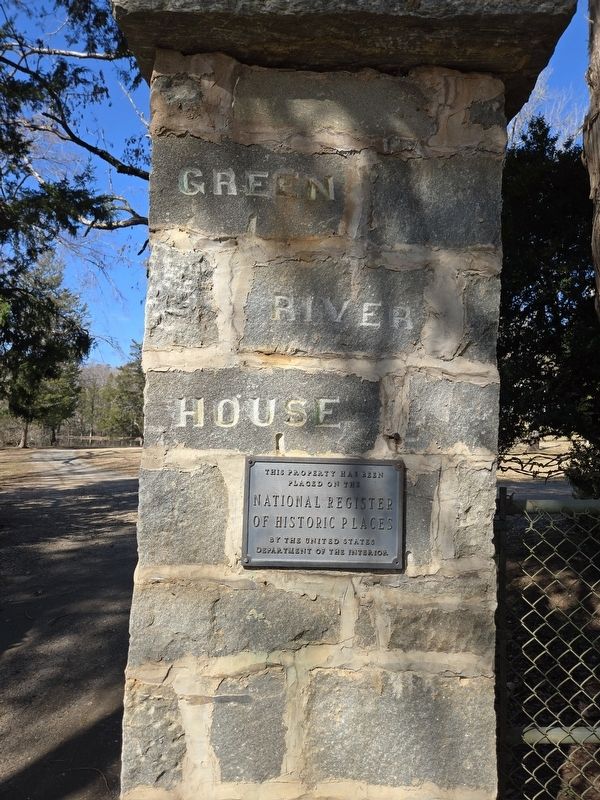
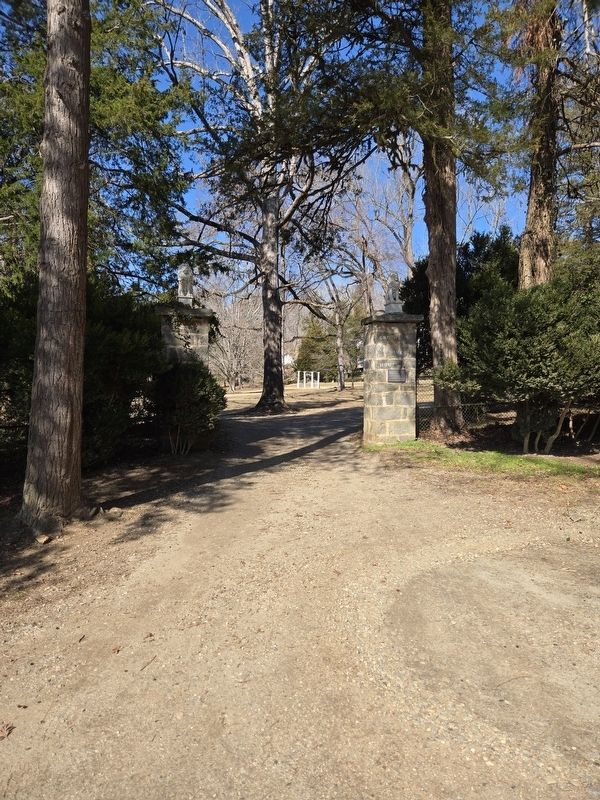
Joseph McDowell Carson was a distinguished lawyer and represented Rutherford County in the North Carolina House of Commons in 1813 and l814. He was elected to the state senate in 1832, 1836, and I838. He was a delegate to the Constitutional Convention of 1835 and was a commissioner for the implementation of the public school plan provided forby the resultant amended constitution.Photographed by Mark Parker, February 7, 20253. Green River Plantation entrance. Marker is on the right stone post
A person of note whom Joseph McDowell Carson brought to live with him at Green River was his half-brother, Samuel Price Carson. When only twenty-four, Samuel Carson embarked on a political career as a United States senator and later as an officer in Sam Houston's government of Texas. He was married at Green River in 1831 to the sister of Joseph McDowell Carson' wife.
Green River was put up for sale and bought by Franklin Coxe, who had married there in l86l a kinswoman of the Carsons, Mary Mills. When the house became available in 1878, be bought it for $6,005, together with the 535-acre tract. Coxe was a grandson of Tench Coxe of Philadelphia, assistant secretary of the United States Treasury, and, under Thomas Jefferson, "purveyor of public supplies". For his work in developing the cotton industry Tench Coxe has been called president the of the "Father of American Cotton Industry." Franklin Coxe was president of the Commercial National Bank at Charlotte when he bought Green River Plantation. It became his summer home when he moved to Philadelphia in 1882. Coxe, who was instrumental in thedevelopment of Asheville was associated with A. B. Andrews in the building of the Western North Carolina Railroad and built Asheville's Battery Park Hotel, "the first modern hotel in the state," which opened in 1886.Photographed by Mark Parker, February 7, 20254. Green River Plantation House in the distanceProperty is currently under restoration due to damage from Hurricane Helene in September 2024. The home is a private residence, but does offer reserved tours and hosts private events.
Also see . . .
1. History of the Mansion. Green River House website
Green River Plantation was listed on the National Register of Historic Places in 1973. And in the tradition of landscaping grand homes of the 19th century, an English garden was designed for the plantation's front lawn by its early inhabitants. Today, many of the original boxwoods still stand. Surrounding the "big house" were various structures including: a smoke house, ice house, plantation kitchen and stables. Joseph McDowell Carson's half brother Samuel Price Carson lived at the home for a time and was a Senator for North Carolina and a U.S. Representative for Western North Carolina. He fought one of the most famous duels of its time between he and Dr. Robert Vance of Asheville, NC. The duel left Dr. Vance mortally wounded from just one shot.(Submitted on February 19, 2025, by Mark Parker of Hickory, North Carolina.)
2. Green River Plantation Nomination Form (pdf). Form prepared by Survey and Planning Unit, North Carolina Division of Archives and History, 1973
Historical photos of the property are included with the nomination form(Submitted on February 19, 2025, by Mark Parker of Hickory, North Carolina.)
Credits. This page was last revised on March 22, 2025. It was originally submitted on February 19, 2025, by Mark Parker of Hickory, North Carolina. This page has been viewed 276 times since then and 65 times this year. Photos: 1, 2, 3, 4. submitted on February 19, 2025, by Mark Parker of Hickory, North Carolina. • Bernard Fisher was the editor who published this page.
