Prati in Roma in Città metropolitana di Roma Capitale, Latium, Rome, Italy — Central Italy (Tyrrhenian Coast)
Ponte Umberto I
⎯⎯⎯
Umberto I Bridge
Photographed by James Hulse, March 3, 2024
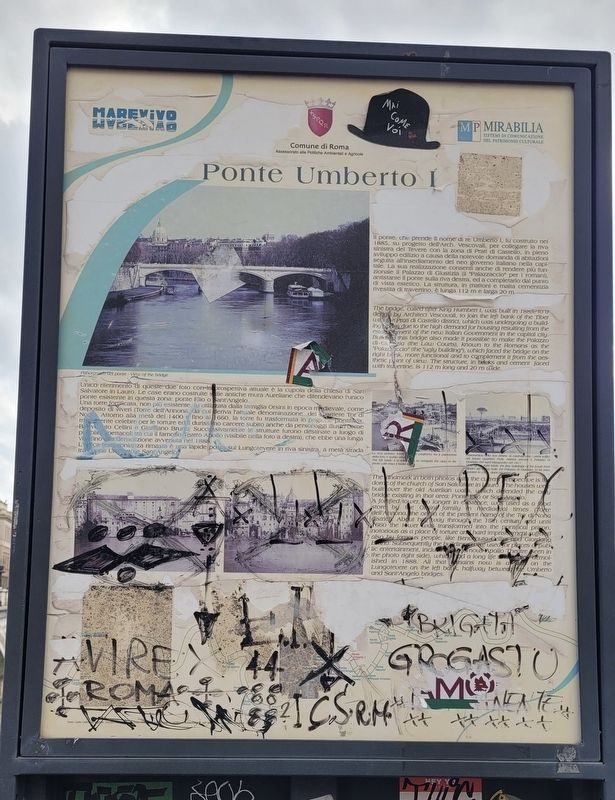
1. Ponte Umberto I / Umberto I Bridge Marker

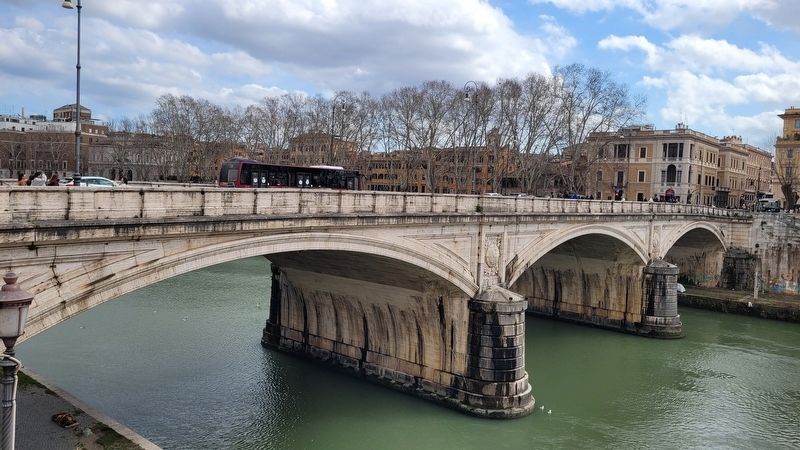
Il ponte, che prende il nome di re Umberto I, fu costruito nel 1885, su progetto dell'Arch. Vescovali, per collegare la riva sinistra del Tevere con la zona di Prati di Castello, in pieno sviluppo edilizio a causa della notevole domanda di abitazioni seguita all'insediamento del neo governo italiano nella capitale. La sua realizzazione consentì anche di rendere più funzionale il Palazzo di Giustizia (il "Palazzaccio" per i romani), antistante il ponte sulla riva destra, ed a completarlo dal punto di vista estetico. La struttura, in mattoni e malta cementizia rivestita di travertino, è lunga 112 m e larga 20 m.
Unico riferimento di queste due foto con la prospettiva attuale è la cupola della chiesa di San Salvatore in Lauro. Le case erano costruite sulle antiche mura Aureliane che difendevano l'unico ponte esistente in questa zona: ponte Elio o Sant'Angelo. Una torre fortificata, non più esistente, fu utilizzata dalla famiglia Orsini in epoca medievale, come deposito di viveri (Torre dell'Annona, da cui deriva l'attuale denominazione del quartiere Tor di Nona). Attorno alla metà del 1400 e fino al 1660,
this page online
Didascalie
(Foto #1) Panoramica del ponte.
(Foto #2) La riva sinistra: è interessante confrontare la vista nella foto con quella odierna.
(Foto #3) Panoramica della riva destra: si costruiscono i primi edifici nel futuro quartiere Prati; manca ancora il Palazzo di Giustizia che sarà inaugurato nel 1911.
The bridge, called after King Humbert I, was built in 1885, to a design by Architect Vescovali, to join the left bank of the Tiber with the Prati di Castello district, which was undergoing a building boom due to the high demand for housing resulting from the establishment of the new Italian Government
Photographed by James Hulse, March 3, 2024
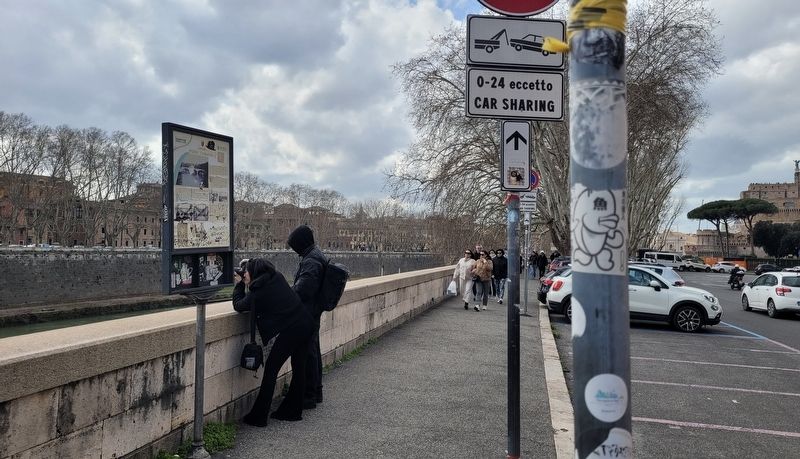
2. He owe of the Umberto I Bridge Marker along the path
The landmark in both photos with the current perspective is the dome of the church of San Salvatore in Lauro. The houses were built over the old Aurelian walls, which defended the only bridge existing in that area: Ponte Elio or Sant'Angelo. A fortified tower, no longer in existence, was used as a food store by the Orsini family in mediaeval times (Torre dell'Annona, the origin of the present name of the Tor di Nona district). About half way through the 15th century and until 1660 the tower was transformed into the pontifical prison, notorious as a place of torture and hard imprisonment suffered also by famous people, like Benvenuto Cellini and Giordano Bruno. Subsequently the buildings were used for places of public entertainment, including the famous Apollo
Photographed by James Hulse, March 3, 2024
3. Umberto I Bridge
Captions
(Photo #1) View of the bridge.
(Photo #2) The left bank: it is interesting to compare the view in the photo with how it looks today.
(Photo #3) View of the right bank: the first bulldings of the future Prati district are being built; the Palazzo di Giustizia, to be inaugurated in 1911, does not exist yet.
Erected by Comune di Roma Assessorato alle Politiche Ambientali e Agricole.
Topics. This historical marker is listed in this topic list: Bridges & Viaducts. A significant historical year for this entry is 1885.
Location. 41° 54.187′ N, 12° 28.249′ E. Marker is in Roma, Lazio (Latium, Rome), in Città metropolitana di Roma Capitale. It is in Prati. It is at the intersection of Piazza dei Tribunali and Ponte Umberto I, on the left when traveling west on Piazza dei Tribunali. The marker is located along the street by the river. Touch for map. Marker is at or near this postal address: Piazza dei Tribunali 49, Roma, Lazio 00193, Italy. Touch for directions.

Regionally, it is in Europe, the European Union, the Schengen Area, a coastal Mediterranean country, and the Western World. Historically, it finds itself in what was once the Roman Empire.
Other nearby markers. At least 8 other markers are within walking distance of this marker: Monumento a Camillo Benso Conte di Cavour / Monument to Camillo Benso Count of Cavour (about 240 meters away, measured in a direct line); Vincenzo Monti and Costanza Monti Perticari (approx. half a kilometer away); Palazzo Incontro (approx. half a kilometer away); Chiesa di San Luigi dei Francesi / Church of St. Louis of the French (approx. half a kilometer away); San Luigi dei Francesi / Saint Louis of the French (approx. half a kilometer away); Pilastro dello Stadio di Domiziano / Pillar of the Stadium of Domitian (approx. half a kilometer away); Ponte Vittorio Emanuele II / Victor Emmanuel II Bridge (approx. 0.6 kilometers away); Convento ed Oratorio dei Filippini alla Vallicella / Convent and Oratory of Saint Philip Neri (approx. 0.6 kilometers away). Touch for a list and map of all markers in Roma.
More about this marker. This marker has been damaged with graffiti and some of the inscriptions have been modified to match the missing letters and words.
Credits. This page was last revised on February 23, 2025. It was originally submitted on February 20, 2025, by James Hulse of Medina, Texas. This page has been viewed 171 times since then and 28 times this year. Photos: 1, 2, 3. submitted on February 23, 2025, by James Hulse of Medina, Texas.
