St. George in Washington County, Utah — The American Mountains (Southwest)
Dixie Pioneers
Photographed by Jeremy Snow, February 23, 2025
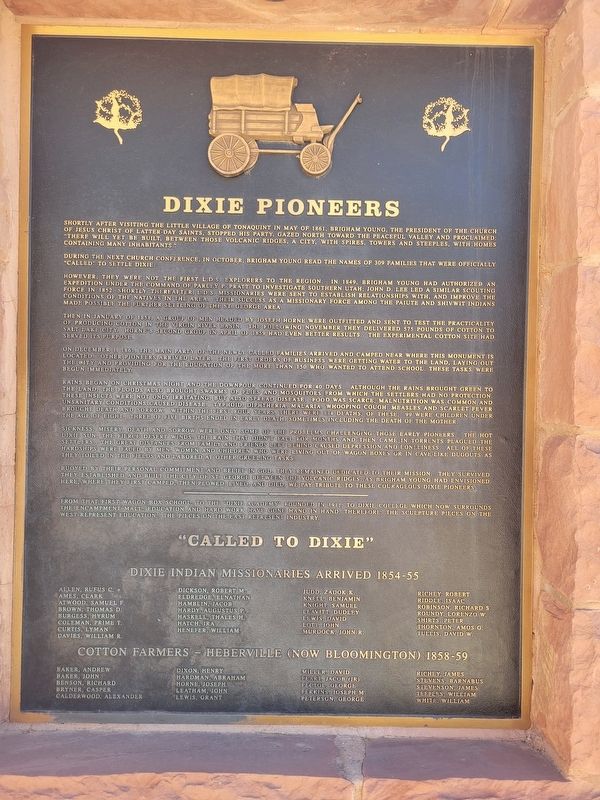
1. Dixie Pioneers Marker
Shortly after visiting the little village of Tonaquint in May of 1861, Brigham Young, the president of the Church of Jesus Christ of Latter Day Saints, stopped his party, gazed north toward the peaceful valley and proclaimed "there will yet be built between those volcanic ridges, a city, with spires, towers and steeples, with homes containing many inhabitants."
During the next church conference, in October, Brigham Young read the names of 309 families that were officially "called" to settle Dixie.
However they were not the first LDS explorers to the region. In 1849, Brigham Young had authorized an expedition under the command of Parley P. Pratt to investigate southern Utah; John D. Lee led a similar scouting force in 1852/ Shortly thereafter LDS missionaries were sent to establish relationships with, and improve the conditions of the natives in the areas. Their success as a missionary force among the Paiute and Shiv Wit Indians made possible the further settling of the St. George area.
Then in January of 1858, A group of men headed by Joseph Horne were outfitted and sent to test the practicality of producing cotton
this page online
On December 1, 1861, the main party of the newly called families arrived and camped near where this monument is located. Other pioneers arrived later. The first orders of business were getting water to the land, laying out the city and providing for the education of the more than 150 who wanted to attend school. These tasks were begun immediately.
Rains began on Christmas night and the downpour continued for 40 days. Although the rains brought green to the land, the floods also brought swarms of flies and mosquitoes from which the settlers had no protection. These insects were not only irritating, but also spread disease. Food was scarce malnutrition was common and unsanitary conditions caused disease. Typhoid, diphtheria, malaria, whooping cough, measles and scarlet fever brought death and sorrow. Within the first four years, there were 134 deaths, of these, 99 were children under the age of eight. Three of
Photographed by Jeremy Snow, February 23, 2025
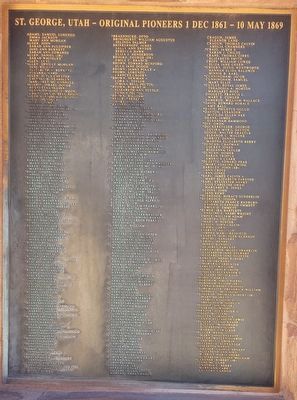
2. Dixie Pioneers Marker - St. George - Original Pioneers Panel 1
Sickness, misery, death and sorrow were only some of the problems challenging those early pioneers. The hot Dixie sun, the fierce desert winds, the rain that didn't fall for months and then came in torrents plagued the settlers. The great distances from family and friends left behind caused depression and loneliness. All of these hardships were faced by men, women and children who were living out of wagon boxes or in cave-like dugouts as they toiled in the fields and labored at other grueling tasks.
Buoyed by their personal commitment and belief in God, they remained dedicated to their mission. They survived. They established and built the city of St. George between the volcanic ridges, as Brigham Young had envisioned. Here where they first camped, then plowed, lived and died. We pay tribute to these courageous Dixie pioneers.
From that first wagon box school, to the "Dixie Academy" founded in 1911, to Dixie College which now surrounds the encampment mall, education and hand work have gone hand in hand. Therefore, the sculpture pieces on the west
Photographed by Jeremy Snow, February 23, 2025
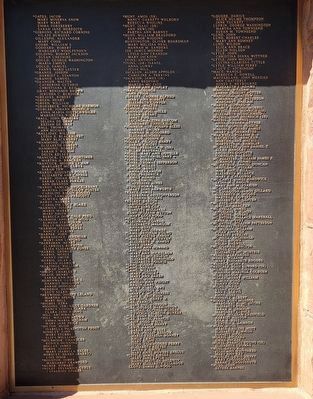
3. Dixie Pioneers Marker - St. George - Original Pioneers Panel 2
"Called to Dixie"
Dixie Indian Missionaries Arrives 1854-55
List of names
Cotton Farmers - Heberville (now Blommington) 1858-59
List of Names
Topics. This historical marker is listed in this topic list: Settlements & Settlers. A significant historical month for this entry is May 1861.
Location. 37° 6.244′ N, 113° 33.913′ W. Marker is in St. George, Utah, in Washington County. It can be reached from East 300 North. The marker is located in the Heritage Cove just east of the Utah Tech University Gardner Student Center. Touch for map. Marker is at or near this postal address: 975 E 300 N, Saint George UT 84770, United States of America. Touch for directions.

Regionally, this marker is in Color Country. It is also in the American Southwest, in the Mountain West, and on the Colorado Plateau. Globally, it is in North America, the Rocky Mountains, the Western Hemisphere, the Western World, and the Anglosphere. Historically, it finds itself in what was once New Spain and also Mexico’s Alta California.
Other nearby markers. At least 8 other markers are within walking
Photographed by Jeremy Snow, February 23, 2025
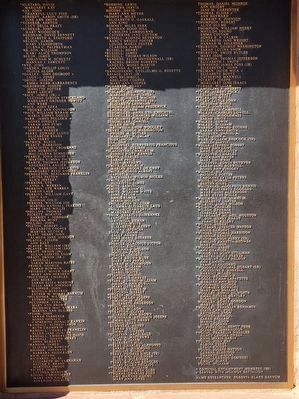
4. Dixie Pioneers Marker - St. George - Original Pioneers Panel 3
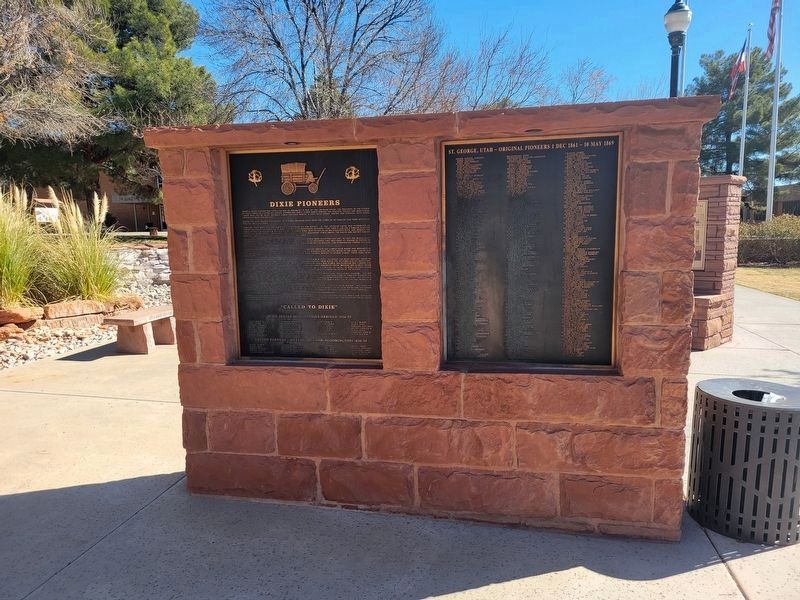
Photographed by Jeremy Snow, February 23, 2025
5. Dixie Pioneers Marker
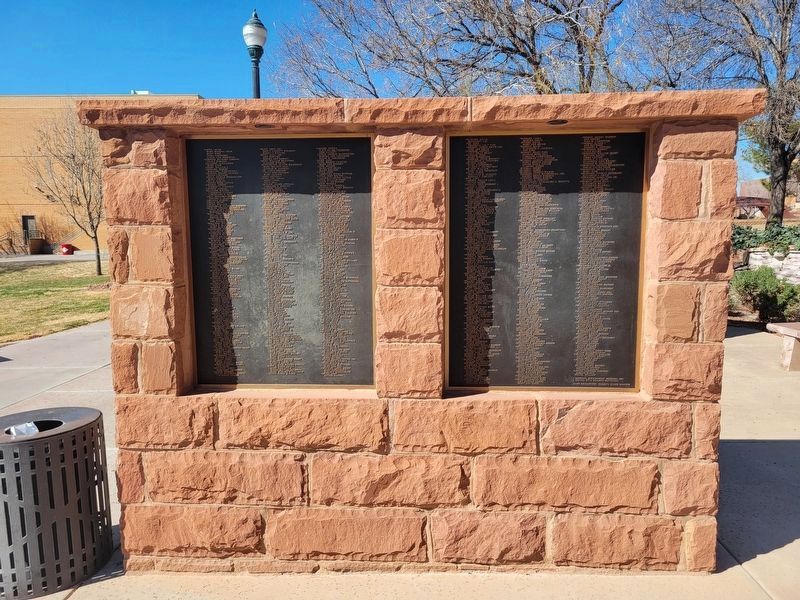
Photographed by Jeremy Snow, February 23, 2025
6. Dixie Pioneers Marker Reverse
Credits. This page was last revised on March 3, 2025. It was originally submitted on February 23, 2025, by Jeremy Snow of Cedar City, Utah. This page has been viewed 421 times since then and 132 times this year. Photos: 1, 2, 3, 4, 5, 6. submitted on February 23, 2025, by Jeremy Snow of Cedar City, Utah. • J. Makali Bruton was the editor who published this page.
