Terry Sanford in Fayetteville in Cumberland County, North Carolina — The American South (South Atlantic)
Fayetteville’s 250th Anniversary
Photographed by Brandon D Cross
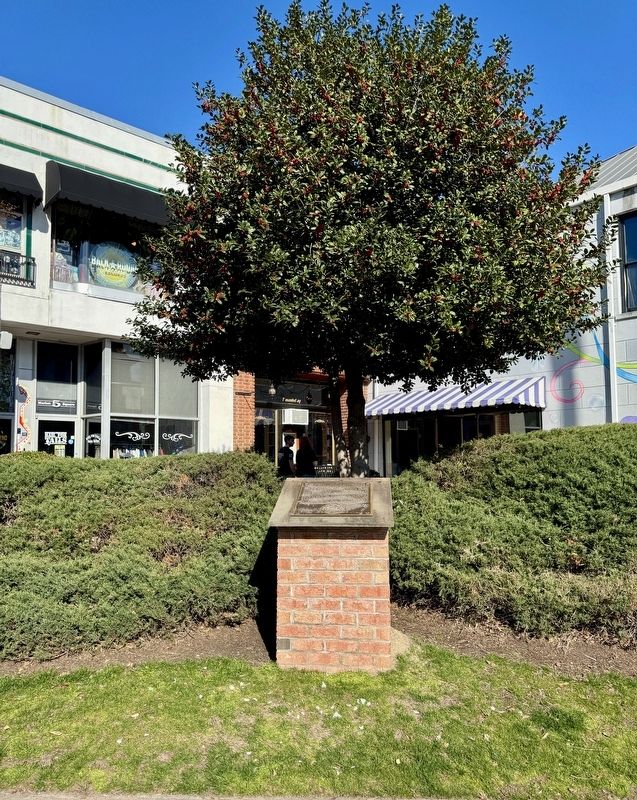
1. Fayetteville’s 250th Anniversary Marker
Inscription.
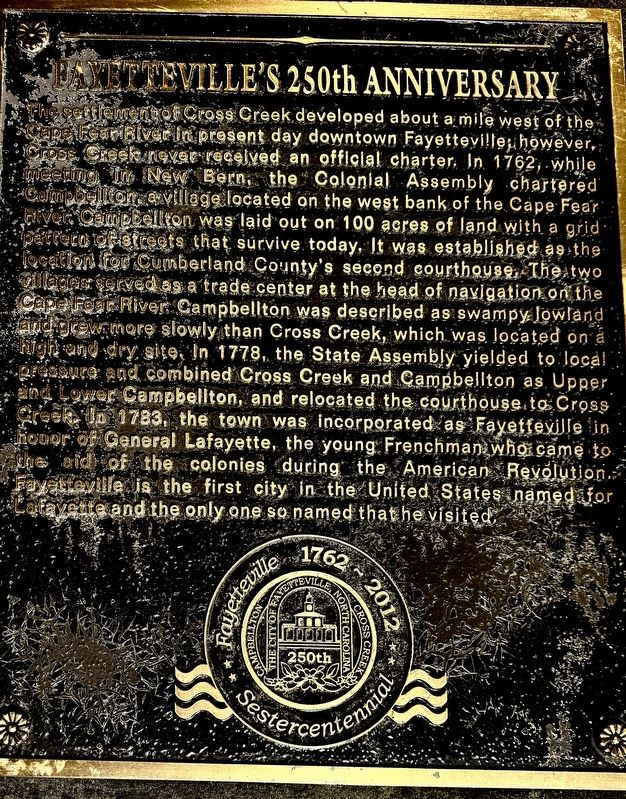
Fayetteville’s 250th Anniversary. . The settlement of Cross Creek developed a mile west of the Cape Fear River in present day downtown Fayetteville; however, Cross Creek never received an official charter. In 1762, while meeting in New Bern, the Colonial Assembly chartered Campbellton, a village located on the West Bank of the Cape Fear River. Campbellton was laid out on 100 acres of land with a grid pattern of streets that survive today. It was established as the location for Cumberland County’s second courthouse. The two villages served as a trade center at the head of navigation on the Cape Fear River. Campbellton was described as swampy lowland and grew more slowly than Cross Creek, which was located on a high and dry site. In 1778, the State Assembly yielded to local pressure and combined Cross Creek and Campbellton as Upper and Lower Campbellton, and relocated the courthouse to Cross Creek. In 1783, the town was incorporated as Fayetteville in honor of General Lafayette, the young Frenchman who came to the aid of the colonies during the American Revolution. Fayetteville is the first city in the United States named for Lafayette and the only one so named that he visited.
The settlement of Cross Creek developed a mile west of the Cape Fear River in present day downtown Fayetteville; however, Cross Creek never received an official charter. In 1762, while meeting in New Bern, the Colonial Assembly chartered Campbellton, a village located on the West Bank of the Cape Fear River. Campbellton was laid out on 100 acres of land with a grid pattern of streets that survive today. It was established as the location for Cumberland County’s second courthouse. The two villages served as a trade center at the head of navigation on the Cape Fear River. Campbellton was described as swampy lowland and grew more slowly than Cross Creek, which was located on a high and dry site. In 1778, the State Assembly yielded to local pressure and combined Cross Creek and Campbellton as Upper and Lower Campbellton, and relocated the courthouse to Cross Creek. In 1783, the town was incorporated as Fayetteville in honor of General Lafayette, the young Frenchman who came to the aid of the colonies during the American Revolution. Fayetteville is the first city in the United States named for Lafayette and the only one so named
Click or scan to see this page online
that he visited.
Erected 2012.
Topics. This historical marker is listed in this topic list: Settlements & Settlers. A significant historical year for this entry is 1762.
Location. 35° 3.16′ N, 78° 52.68′ W. Marker is in Fayetteville, North Carolina, in Cumberland County. It is in Terry Sanford. It is at the intersection of Green Street and Person Street, on the right when traveling north on Green Street. Touch for map. Marker is at or near this postal address: 116 Green Street, Fayetteville NC 28301, United States of America. Touch for directions.

Regionally, this marker is in North Carolina’s Coastal Plain. It is also in the American South and specifically in the Upper South. Globally, it is in North America, the Western Hemisphere, the Western World, and the Anglosphere. Historically, it finds itself in what was once the territory of the Mississippian Culture, one of the original Thirteen Colonies, one of the Confederate States of America, and the Antebellum South.
Other nearby markers. At least 8 other markers are within walking distance of this marker: The Market House (a few steps from this marker); Old Town Hall
Photographed by Brandon D Cross
2. Fayetteville’s 250th Anniversary Marker
(within shouting distance of this marker); 1963 Protests (within shouting distance of this marker); Plank Roads (within shouting distance of this marker); Town House (within shouting distance of this marker); Liberty Row (within shouting distance of this marker); Flora MacDonald (within shouting distance of this marker); James Dobbin McNeill (within shouting distance of this marker). Touch for a list and map of all markers in Fayetteville.
Credits. This page was last revised on February 25, 2025. It was originally submitted on February 25, 2025, by Brandon D Cross of Flagler Beach, Florida. This page has been viewed 225 times since then and 28 times this year. Photos:1, 2. submitted on February 25, 2025, by Brandon D Cross of Flagler Beach, Florida. • Andrew Ruppenstein was the editor who published this page.