North End in Boise in Ada County, Idaho — The American West (Mountains)
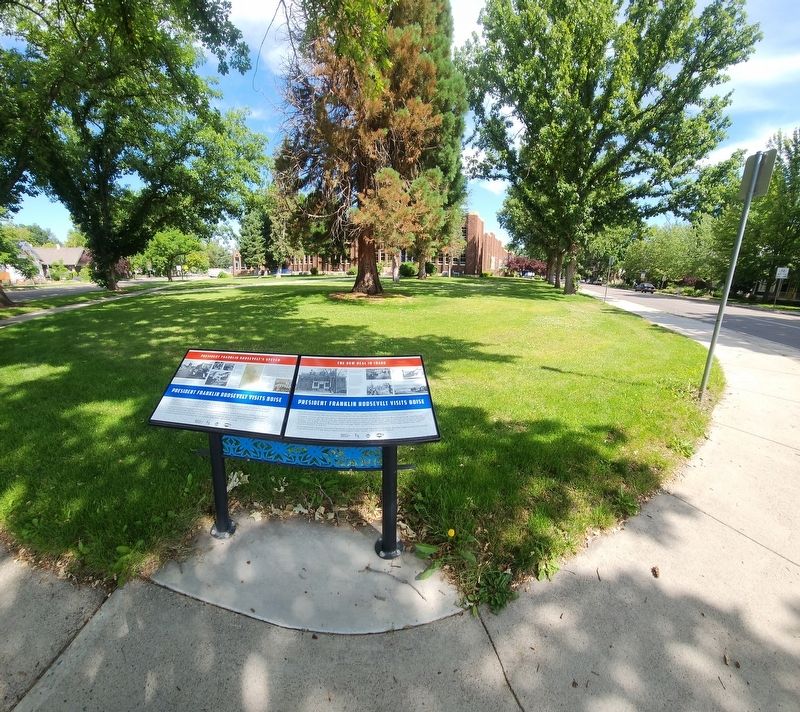
President Franklin Roosevelt Visits Boise
The New Deal in Idaho
Photographed by Douglass Halvorsen, June 26, 2023
1. President Franklin Roosevelt Visits Boise Marker
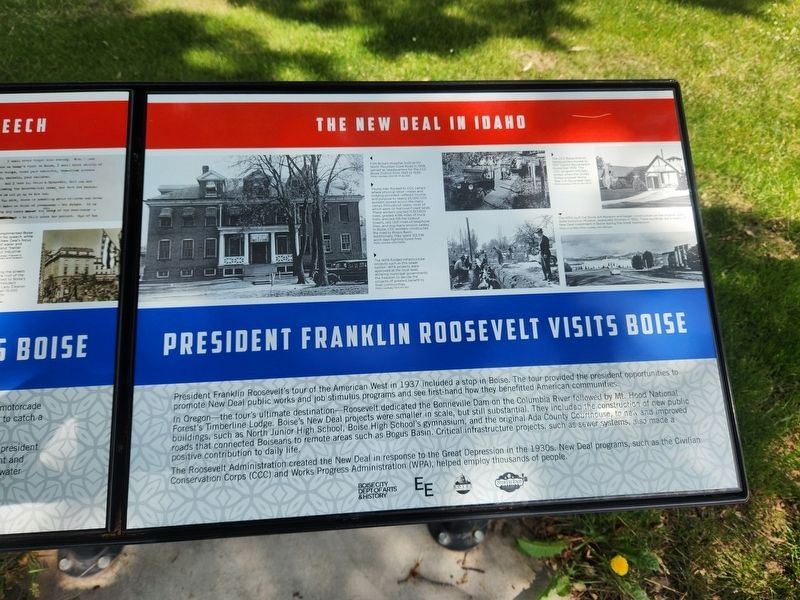
President Franklin Roosevelt’s tour of the American West in 1937 included a stop in Boise. The tour provided the president opportunities to promote New Deal public works and job stimulus programs and see first-hand how they benefitted American communities.
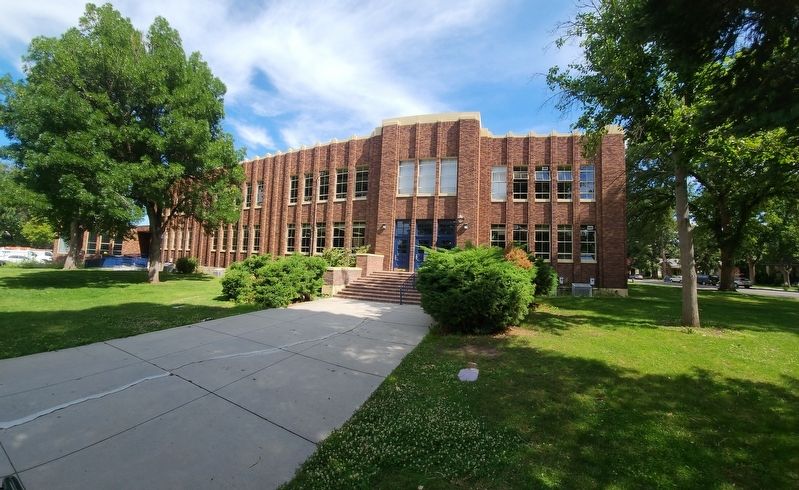
In Oregon—the tour’s ultimate destination—Roosevelt dedicated the Bonneville Dam on the Columbia River followed by Mt. Hood National Forest’s Timberline Lodge. Boise’s New Deal projects were smaller in scale, but still substantial. They included the construction of new public buildings, such as North Junior High School, Boise High School’s gymnasium, and the original Ada County Courthouse, to new and improved roads that connected Boiseans to remote areas such as Bogus Basin. Critical infrastructure projects, such as sewer systems, also made a positive contribution to daily life.
The Roosevelt Administration created the New Deal in response to the Great Depression in the 1930s. New Deal programs, such as the Civilian Conservation Corps (CCC) and Works Progress Administration (WPA), helped employ thousands of people.
Captions
Fort Boise's Hospital, built at 911
this page online
Young men flocked to CCC camps where physical labor—meals and lodging provided—offered income and purpose to nearly 25,000 CCC workers spread across the many camps throughout Idaho, most of which were on National Forest lands. These workers planted 11,323,800 trees, graded 4,186 miles of truck trails, erected 198 fire lookout towers, laid 1,831 miles of telephone lines, and dug many erosion swales. In Boise, CCC workers constructed the road to Bogus Basin. Additionally, they spent 313,336 work days fighting forest fires.
The WPA funded infrastructure projects such as this sewer system. WPA projects were approved at the local level, allowing municipal governments the freedom to decide the projects of greatest benefit to their communities.
The CCC Boise District headquarters moved to 1301 Capitol Boulevard in November 1939. The CCC program officially ended when the United States entered World War II in December 1941.
The WPA built the Boise Art Museum and began construction on the original Idaho State Historical Museum, eventually
Photographed by Douglass Halvorsen, June 26, 2023
2. President Franklin Roosevelt Visits Boise Marker
Erected by Boise City Dept of Arts and History.
Topics and series. This historical marker is listed in this topic list: Government & Politics. In addition, it is included in the Former U.S. Presidents: #32 Franklin D. Roosevelt, and the Works Progress Administration (WPA) projects series lists. A significant historical year for this entry is 1937.
Location. 43° 37.497′ N, 116° 12.215′ W. Marker is in Boise, Idaho, in Ada County. It is in North End. It is at the intersection of West Fort Street and North 13th Street, on the right when traveling north on West Fort Street. Touch for map. Marker is at or near this postal address: 1002 N 13th St, Boise ID 83702, United States of America. Touch for directions.

Regionally, this marker is on the Snake River Plain. It is also in the American Mountain West. Globally, it is in North America, the Western Hemisphere, the Western World, and the Anglosphere.
Other nearby markers. At least 8 other markers are within walking distance of this marker: A different marker also named President Franklin Roosevelt Visits Boise
Photographed by Douglass Halvorsen, June 26, 2023
3. President Franklin Roosevelt Visits Boise Marker
North Junior High School, which was erected with WPA funding.
Credits. This page was last revised on February 26, 2025. It was originally submitted on February 25, 2025, by Douglass Halvorsen of Klamath Falls, Oregon. This page has been viewed 144 times since then and 20 times this year. Photos: 1, 2, 3. submitted on February 25, 2025, by Douglass Halvorsen of Klamath Falls, Oregon. • J. Makali Bruton was the editor who published this page.
