Darmstadt-Mitte , Hesse, Germany — Central Europe
Weißer Turm
⎯⎯⎯
White Tower
| — | Darmstädter Baudenkmal | — |

Photographed by Andrew Ruppenstein, January 30, 2025
1. Weißer Turm / White Tower Marker

1708 erfolgte der Ausbau zum Glockenturm durch den landgräflichen Baumeister Erich Philipp von Ploennies. Dabei wurde der Turm erhöht, ringsum geschlossen und mit barocker Haube bekrönt. Erst 1870 entstand der heutige Zugang und die Wendeltreppe im Inneren.
Im Zweiten Weltkrieg brannte der Turm aus. Um ihn aus der höher gewordenen Nachkriegsbebauung herauszuheben, fügte man beim Wiederaufbau 1954 ein weiteres Geschoss hinzu.
Seit 1983 ist der glatt verputzte Sockel durch eine imitierte Natursteinverkleidung geschützt.
This 14th century defensive tower was the westernmost corner of the medieval city fortifications. It was not originally circular, but was significantly lower and had a steep tent roof. Access was from the battlement of the adjacent city wall. The base with its 1.75 m thick walls contained a windowless dungeon with an opening in the ceiling.
In 1708, the Landgrave's master builder Erich Philipp von Ploennies expanded the tower into a bell tower. The tower was raised, closed on all sides and crowned with a baroque dome. The current entrance and the spiral staircase inside were not built until 1870.
The tower burned down in the Second World War. In order to make it stand out from the higher post-war buildings, a further floor was added during reconstruction in 1954.
Since 1983, the smooth plastered base has been protected by an imitation natural stone cladding.
Erected by Wissenschaftstadt
this page online
Topics. This historical marker is listed in this topic list: Forts and Castles. A significant historical date for this entry is September 11, 1944.
Location. 49° 52.359′ N, 8° 39.222′ E. Marker is in Darmstadt, Hessen (Hesse). It is in Darmstadt-Mitte. It is on Ernst-Ludwig-Straße, on the right when traveling south. Touch for map. Marker is at or near this postal address: Ernst-Ludwig-Straße 1, Darmstadt HE 64283, Germany. Touch for directions.

Regionally, this marker is on the German Upper Rhine. Globally, it is in Europe, the European Union, Atlantic Europe, Central Europe, the Schengen Area, Western Europe, and the Western World. Historically, it finds itself in what was once the Roman Empire, the Holy Roman Empire, and the former West Germany.
Other nearby markers. At least 8 other markers are within walking distance of this marker: Ehemaliges Kaufhaus Rothschild / Former Rothschild Department Store (within shouting distance of this marker); Christoph Graupner (about 120 meters away, measured in a direct line); Altes Rathaus / Old City Hall (about 150 meters away); Zur Goldene Krone / Schustergasse 18 (about 210 meters
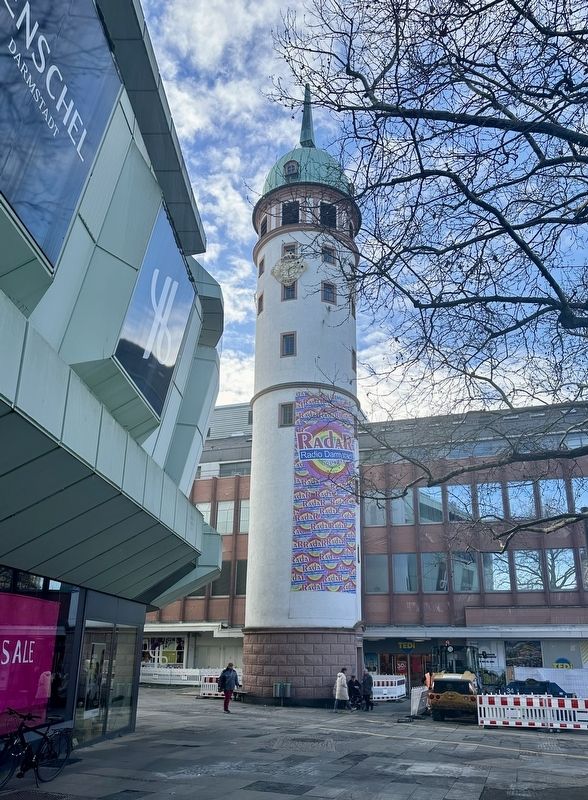
Photographed by Andrew Ruppenstein, January 30, 2025
2. Weißer Turm / White Tower and Marker
The marker is (barely) visible here by the group of three people by the tower entrance.
Also see . . .
1. Weißer Turm (Darmstadt) (Wikipedia, in German). Overview (in translation):
The White Tower is a former corner tower of the medieval city fortifications and a landmark of the city of Darmstadt. It was built as a defensive tower. After the city wall lost its value in defending the city, the tower was redesigned as a bell tower in 1704 and largely took on its current appearance. It was largely destroyed in an air raid on September 11, 1944 and has been rebuilt from the ruins since 1949. It is currently looked after by a group of friends who offer regular tours. Since 1997 it has also served as a gallery.(Submitted on February 26, 2025.)
The tower is 39.75 meters high to the top and the diameter of the tower is six meters. There are 125 steps leading from the entrance up to the bell tower.
2. Geschichte des Weißen Turms (Freundeskreis Weißer Turm e.V., in German).
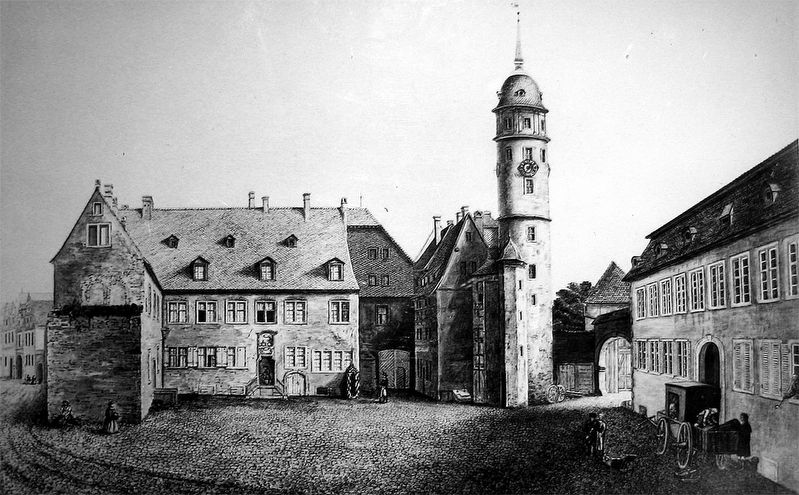
courtesy Wikimedia Commons, circa 1800
3. Weißer Turm (White Tower) and old post building
City wall and defensive towers: In the Middle Ages, the White Tower stood at a strategically important location on the southwest corner of the Darmstadt city wall, as the city wall, passing in a slight curve past the city church and the houses on the western market square, turned sharply towards the castle here. The year in which the tower was built is not known and cannot be researched, as there is no documentary or archaeological evidence.(Submitted on February 26, 2025.)
Credits. This page was last revised on February 26, 2025. It was originally submitted on February 26, 2025, by Andrew Ruppenstein of Lamorinda, California. This page has been viewed 315 times since then and 105 times this year. Photos: 1, 2, 3. submitted on February 26, 2025, by Andrew Ruppenstein of Lamorinda, California.
