East End in Boise in Ada County, Idaho — The American West (Mountains)
Bishops’ House
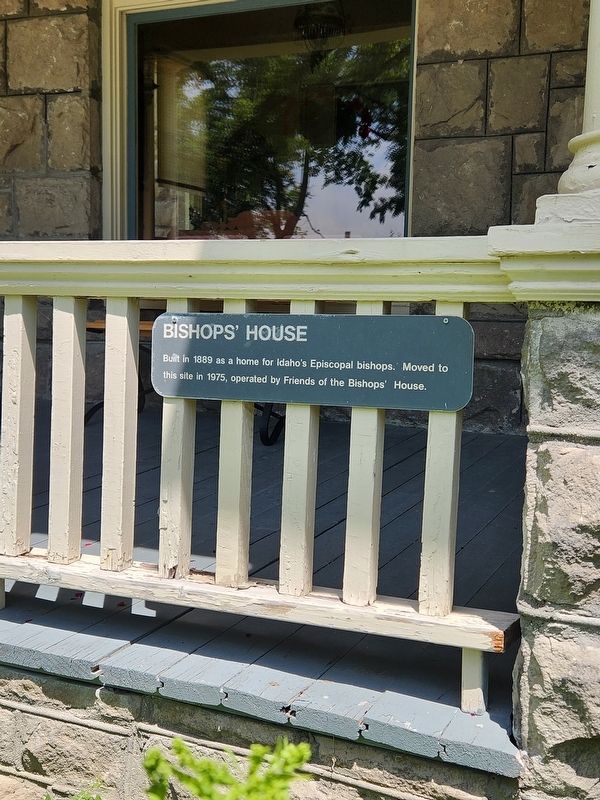
Photographed by Douglass Halvorsen, June 26, 2023
1. The Bishops House Marker
Erected by Friends of the Bishops’ House.
Topics and series. This historical marker is listed in this topic list: Religion & Religious Structures. In addition, it is included in the National Register of Historic Places (NRHP) series list. A significant historical year for this entry is 1889.
Location. 43° 36.189′ N, 116° 9.749′ W. Marker is in Boise, Idaho, in Ada County. It is in East End. It is on Old Penitentiary Road, on the left when traveling east. Touch for map. Marker is at or near this postal address: 2420 Old Penitentiary Rd, Boise ID 83712, United States of America. Touch for directions.

Regionally, this marker is on the Snake River Plain. It is also in the American Mountain West. Globally, it is in North America, the Western Hemisphere, the Western World, and the Anglosphere.
Other nearby markers. At least 8 other markers are within 2 miles of this marker, measured as the crow flies: Warden’s House (within shouting distance of this marker); Sally Port (within shouting distance
this page online
Regarding Bishops’ House. This former home resides on the property of the Old Idaho State Penitentiary, a former prison, which was listed in the National Register of Historic Places in 1974. The Bishops’ House was independently listed in the National Register of Historic Places in 1982.
Also see . . . National Register of Historic Places Inventory Form.
The Episcopal bishops' house, commissioned by Bishop James Funsten in 1900, is architecturally significant as a large-scale and successful example of the firm's imprinting of an existing building with a personal stylistic signature by means of remodeling. It is an early example of the movement of the Queen Anne style to a later, more academic,(Submitted on February 27, 2025, by Douglass Halvorsen of Klamath Falls, Oregon.)classicizing phase. The house is historically significant as evidence of the beginning of the firm's relationship with the Episcopal Church under Funsten, an institutional client exceeded in importance only by the Catholic Diocese and the State of Idaho.Photographed by Douglass Halvorsen, June 26, 20232. The Bishops House Marker
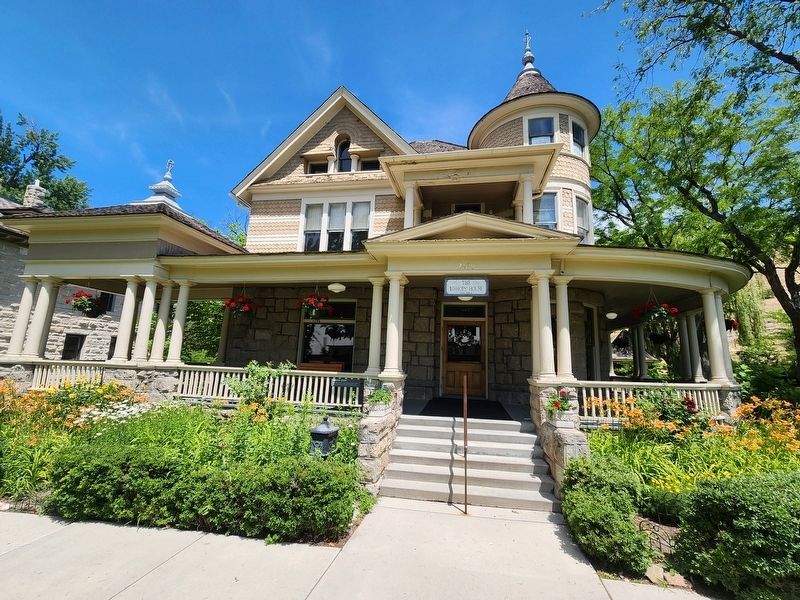
The original house, built for the Episcopal bishops in 1890, would also have been described as Queen Anne in style, but the decorative elements were modest in nature and were essentially applied to the margins of a simple and boxy, if ample, house. The remodeling of 1900 reportedly cost $3,000. Involving as it did one of the corner turrets for which Tourtellotte had developed an affection, and a big wraparound porch with an outset finialed gazebo, it made the house substantially more irregular in plan and profile. The surface veneering with Boise sandstone and shaped shingles, materials that these architects used consistently in their Queen Anne and colonial work, produced substantially more texture and contrast of surface. The result is thus more emphatically Queen Anne—and the sort of Queen Anne that had done much to make the senior partner's reputation. At the same time, the use of classicizing elements on the addition and revisions and the relatively stable and imposing appearance as compared to the fanciful Pierce-Borah House make this a fine example of the tendency to square up, solidify, and classicize the Queen Anne style. The Hester Spackman House [National Register, State Street Historic District, 1978], and the Sommercamp house (site 25) are other good examples of the Queen Anne-classical style, but on a less substantial scale. The Bishops' house was scaled to match its neighboring St. Margaret's School, for which Tourtellotte and Company designed an addition in 1907, and the slightly earlier Brady and Eoff houses in the next block, as well as the slightly later and also nearby Falk, Grunbaum, and Curran houses. Only the first of these Tourtellotte and Company commissions is still standing in a recognizable form.
The commission for the St. Margaret's School addition was one of several major ones the firm secured from the Episcopal Church during the first years of the century, in the early tenure of the Right Reverend James Bowen Funsten, a Virginia native who had been consecrated as First Missionary Bishop of Idaho in 1899. These commissions included St. Michael's Rectory and the supervision of construction of St. Michael's Episcopal Cathedral in 1900 and the St. Luke's Hospital building in 1903. Minor but important commissions during this period included small frame churches at Shoshone [National Register, Shoshone Historic District, 1975], Mackay (site 18), and St. Anthony, all in 1902; Ross Fork in 1904 (site 33); Gooding in 1909 (site 60); and Bruneau in 1911 (site 75).
The Bishop's house was moved to prevent its demolition in November, 1975. On its new site in east Boise, against a background of sagebrush-covered hills and with young trees planted around it, the house is unusually evocative of early Boise's oasls-like appearance. It has been fully restored, is being refurnished, and is open to the public as a gathering place, thanks to the non-profit group that saved it. The house is nominated on its new site because of its architectural signifi cance as an excellent example of the Queen Anne-classical Tourtellotte and Company house; its historical significance as the earliest of a series of important commis sions for an ambitious Idaho bishop; and its sensitive relocation, restoration, and complete accessibility to the public.
Credits. This page was last revised on March 3, 2025. It was originally submitted on February 27, 2025, by Douglass Halvorsen of Klamath Falls, Oregon. This page has been viewed 190 times since then and 30 times this year. Photos: 1, 2. submitted on February 27, 2025, by Douglass Halvorsen of Klamath Falls, Oregon. • J. Makali Bruton was the editor who published this page.
