Hanau in Main-Kinzig-Kreis, Hesse, Germany — Central Europe
Zum Gedenken an die Jüdischen Gemeinde Hanau
⎯⎯⎯
In Memory of the Jewish Community of Hanau I
Photographed by Andrew Ruppenstein, February 3, 2025
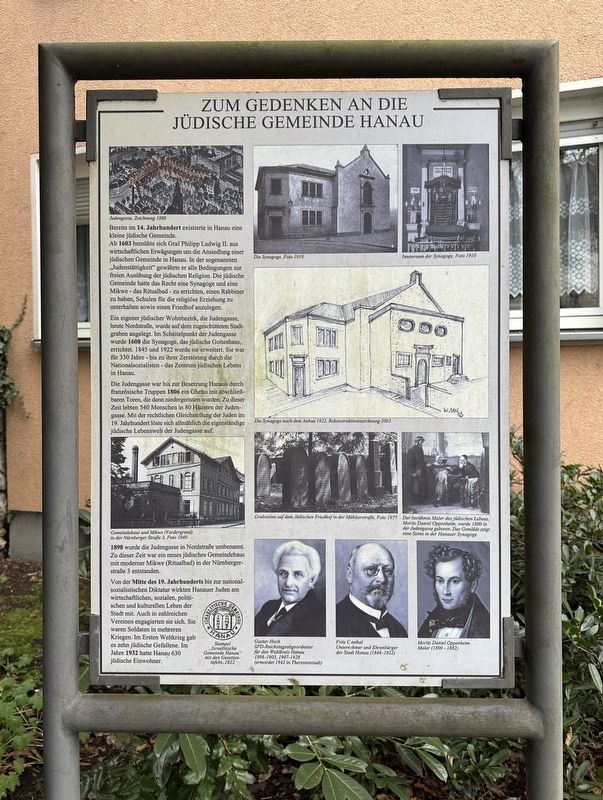
1. In Memory of the Jewish Community of Hanau I Marker

Ab 1603 bemühte sich Graf Philipp Ludwig II. aus wirtschaftlichen Erwägungen um die Ansiedlung einer jüdischen Gemeinde in Hanau. In der sogenannten ,,Judenstättigkeit" gewährte er alle Bedingungen zur freien Ausübung der jüdischen Religion. Die jüdische Gemeinde hatte das Recht eine Synagoge und eine Mikwe das Ritualbad - zu errichten, einen Rabbiner zu haben, Schulen für die religiöse Erziehung zu unterhalten sowie einen Friedhof anzulegen.
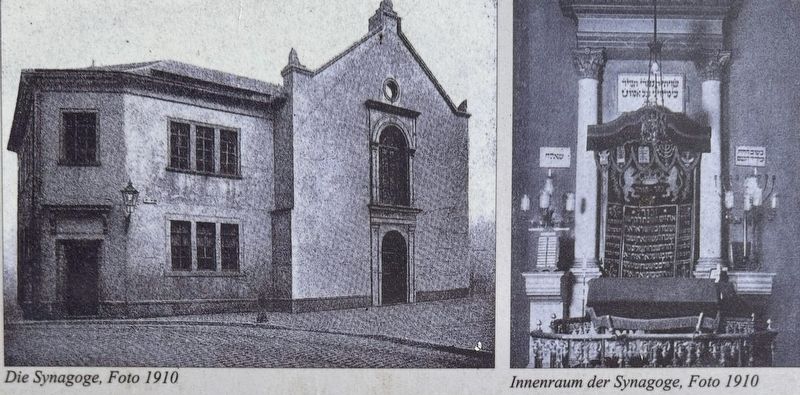
Ein eigener jüdischer Wohnbezirk, die Judengasse, heute Nordstraße, wurde auf dem zugeschütteten Stadtgraben angelegt. Im Scheitelpunkt der Judengasse wurde 1608 die Synagoge, das jüdische Gotteshaus, errichtet. 1845 und 1922 wurde sie erweitert. Sie war für 330 Jahre bis zu ihrer Zerstörung durch die Nationalsozialisten - das Zentrum jüdischen Lebens in Hanau.
Die Judengasse war bis zur Besetzung Hanaus durch französische Truppen 1806 ein Ghetto mit abschließbaren Toren, die dann niedergerissen wurden. Zu dieser Zeit lebten 540 Menschen in 80 Häusern der Judengasse. Mit
this page online
1898 wurde die Judengasse in Nordstraße umbenannt. Zu dieser Zeit war ein neues jüdisches Gemeindehaus mit moderner Mikwe (Ritualbad) in der Nürnbergerstraße 3 entstanden.
Von der Mitte des 19. Jahrhunderts bis zur nationalsozialistischen Diktatur wirkten Hanauer Juden am wirtschaftlichen, sozialen, politischen und kulturellen Leben der Stadt mit. Auch in zahlreichen Vereinen engagierten sie sich. Sie waren Soldaten in mehreren Kriegen. Im Ersten Weltkrieg gab es zehn jüdische Gefallene. Im Jahre 1932 hatte Hanau 630 jüdische Einwohner.
A small Jewish community already existed in Hanau in the 14th century.
From 1603 onwards, Count Philipp Ludwig II endeavoured to establish a Jewish community in Hanau for economic reasons. In the so-called "Judenstättigkeit" he granted all the conditions for the free practice of the Jewish religion. The Jewish community had the right to build a synagogue and a mikveh (the ritual bath), to have a rabbi, to maintain schools for
Photographed by Andrew Ruppenstein, February 3, 2025
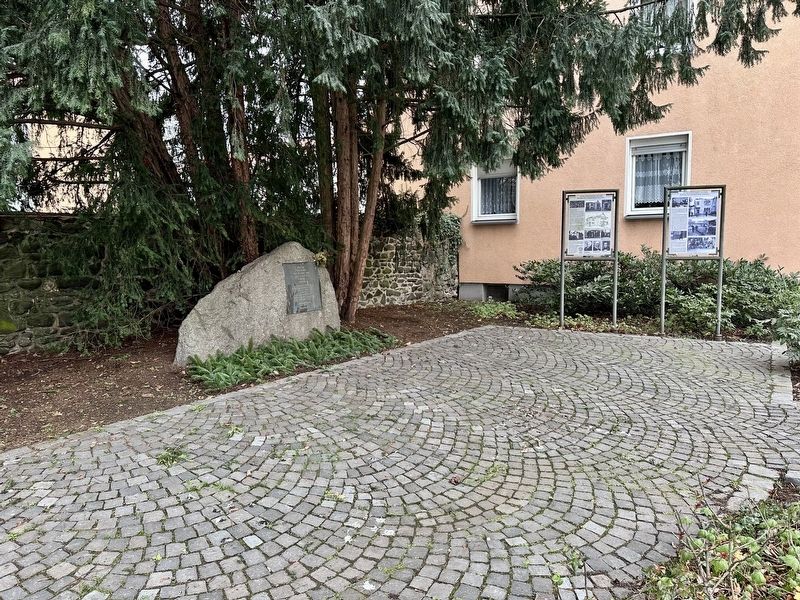
2. In Memory of the Jewish Community of Hanau I Marker - wide view
The marker is the leftmost panel of the two visible here. Also visible to the left is the rock with marker indicating the former location of the synagogue, which was destroyed on November 10, 1938.
A separate Jewish residential district, the Judengasse, today Nordstrasse, was built on the filled-in city moat. The synagogue, the Jewish house of worship, was built at the apex of the Judengasse in 1608. It was expanded in 1845 and 1922. It was the centre of Jewish life in Hanau for 330 years until it was destroyed by the National Socialists.
Until Hanau was occupied by French troops in 1806, the Judengasse was a ghetto with lockable gates, which were then torn down. At that time, 540 people lived in 80 houses in the Judengasse. With the legal equality of Jews in the 19th century, the independent Jewish life in the Judengasse gradually dissolved.
In 1898, Judengasse was renamed Nordstraße. At that time, a new Jewish community center with a modern mikveh (ritual bath) had been built at Nürnbergerstraße 3.
From the middle of the 19th century until the National Socialist dictatorship, Hanau's Jews were involved in the city's economic, social, political and cultural life. They were also involved in numerous clubs. They were soldiers in several wars. In the First World War, ten

circa 1880
3. Marker illustration: Judengasse
Topics and series. This historical marker is listed in these topic lists: Notable Places • Religion & Religious Structures. In addition, it is included in the Synagogues series list. A significant historical year for this entry is 1603.
Location. 50° 8.181′ N, 8° 55.202′ E. Marker is in Hanau, Hessen (Hesse), in Main-Kinzig-Kreis. It is on Nordstraße, on the left when traveling north. Touch for map. Marker is at or near this postal address: Nordstraße 11, Hanau HE 63450, Germany. Touch for directions.

Regionally, it is in Europe, the European Union, Atlantic Europe, Central Europe, the Schengen Area, Western Europe, and the Western World. Historically, it finds itself in what was once the Roman Empire, the Holy Roman Empire, and the former West Germany.
Other nearby markers. At least 8 other markers are within walking distance of this marker: Zum Gedenken an die Jüdischen Gemeinde Hanau / In memory of the Jewish Community of Hanau II (here, next to this marker); Hanau Synagogue Memorial (here, next to this marker); Die Ghettomauer / The Ghetto Wall
1910
4. Marker photos: Synagogue and its interior
1977
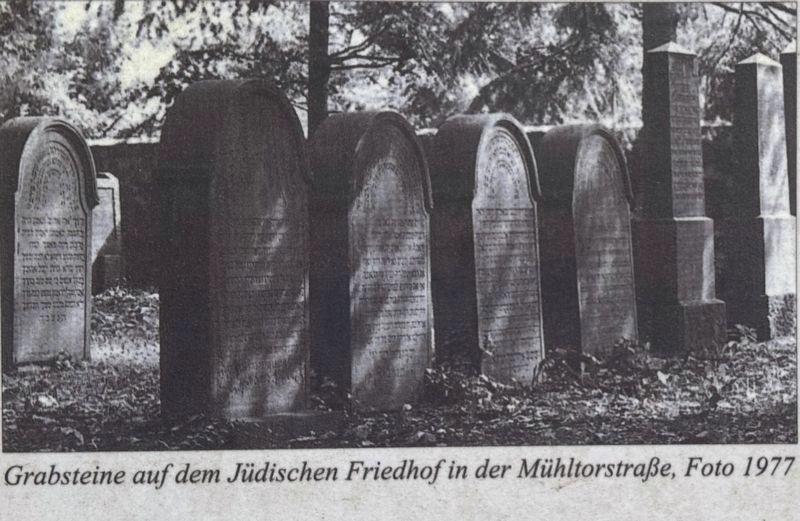
5. Marker photo: Gravestones in the Jewish Cemetery on Mühltorstrasse
Credits. This page was last revised on February 27, 2025. It was originally submitted on February 27, 2025, by Andrew Ruppenstein of Lamorinda, California. This page has been viewed 129 times since then and 24 times this year. Photos: 1, 2, 3, 4, 5. submitted on February 27, 2025, by Andrew Ruppenstein of Lamorinda, California.
