Downtown in Boise in Ada County, Idaho — The American West (Mountains)
Federal Building
Boise Capitol Area District
Photographed by Douglass Halvorsen, June 27, 2023
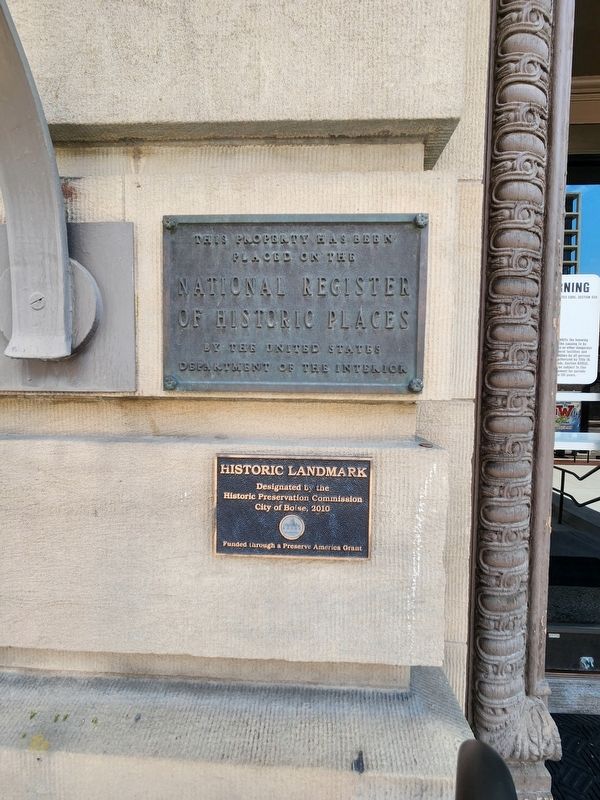
1. Federal Building Marker
This property has been placed on the National Register of Historic Places by the United States Department of the Interior
Erected by United States Department of the Interior.
Topics. This historical marker is listed in this topic list: Industry & Commerce.
Location. 43° 37.027′ N, 116° 12.088′ W. Marker is in Boise, Idaho, in Ada County. It is in Downtown. It is on West Bannock Street, on the right when traveling west. Touch for map. Marker is at or near this postal address: 750 W Bannock St, Boise ID 83702, United States of America. Touch for directions.

Regionally, this marker is on the Snake River Plain. It is also in the American Mountain West. Globally, it is in North America, the Western Hemisphere, the Western World, and the Anglosphere.
Other nearby markers. At least 8 other markers are within walking distance of this marker: The Idaho Building (within shouting distance of this marker); Abraham Lincoln and Idaho (within shouting distance of this marker); Frank Steunenberg (about 300 feet away, measured in a direct line); Lumberjack to Statesman
this page online
Regarding Federal Building. The Federal Building is not individually listed in the National Register of Historic Places but rather one of eight contributing buildings and structures that encompass the Boise Capitol Area District. The District was listed in the National Register of Historic Places in 1976.
Also see . . . National Register of Historic Places Nomination Form.
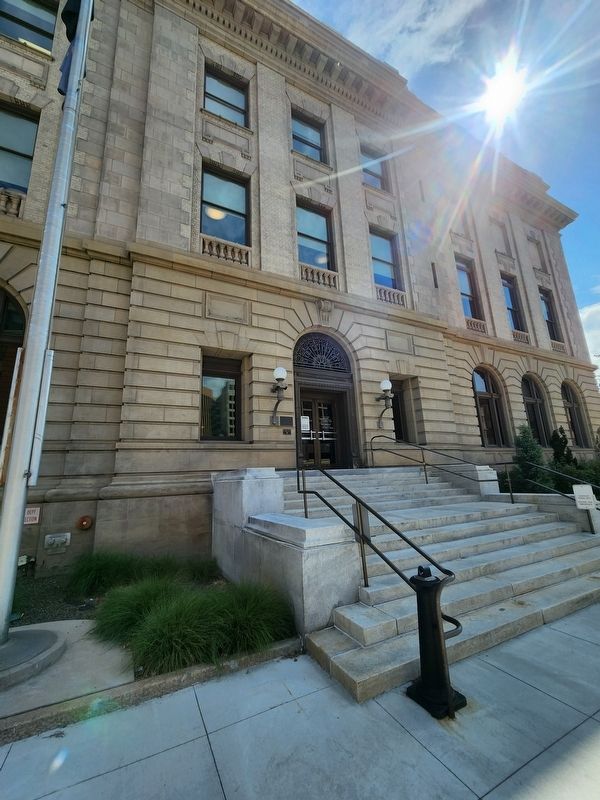
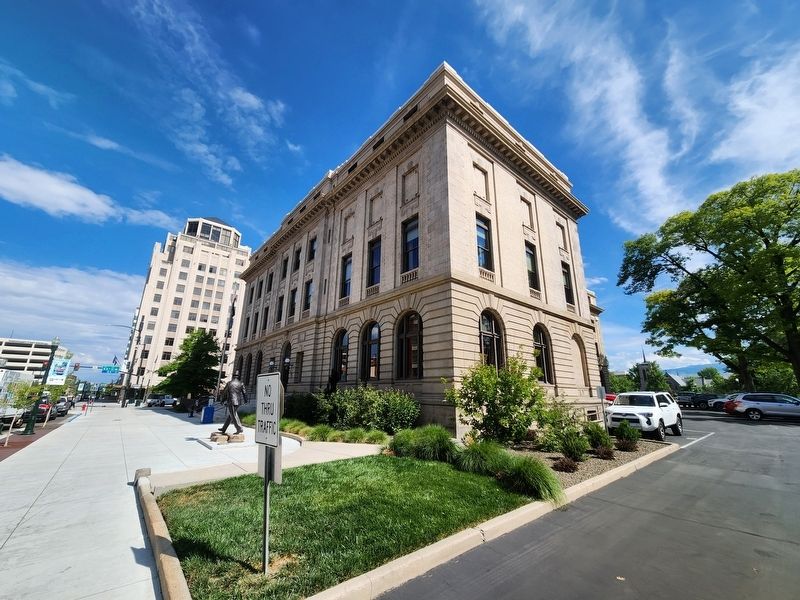
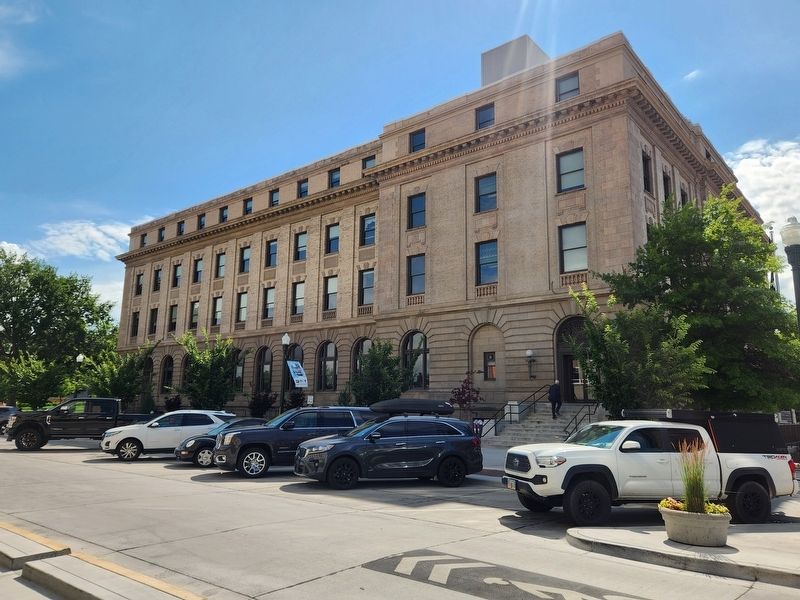
NRHP Nomination Form Statement of Significance: (3). To the west of the park area is the old Federal Building, which is on the northeast corner of Eighth and Bannock streets. The original portion, built in 1904, was designed by the United States Treasury Department while James Knox Taylor was supervising architect. The four-story stone and white brick building is one of the best examples of Beaux Arts architecture in the region. The first floor has round arch windows and a similar(Submitted on February 28, 2025, by Douglass Halvorsen of Klamath Falls, Oregon.)doorway with excellent wrought iron decorations in the tympanum. The third story is capped by a cornice supported by dentils, and the fourth story is abbreviated in a typical Renaissance manner to form a parapet. In 1930 a substantial addition was built from the northwest corner to form an abbreviated L. This addition is stylistically similar to the original structure.Photographed by Douglass Halvorsen, June 27, 20232. Federal Building Marker
Boise was designated permanent territorial capital of Idaho in December 1864, a year and a half after the community was founded. Capitol Square soon became an important feature of the townsite, although the territorial capital was not actually completed until 1886. As the center of Idaho's governmental complex, the varied buildings represented in this district have an importance and character of great interest. They are pleasingly bound together by some of the city's finest park areas, with large old trees in great variety. Two of these, on the Capitol grounds, were planted by visiting Presidents of the United States: Benjamin Harrison and Theodore Roosevelt.
The greatest value to Idaho of recognizing the Boise Capitol Area District as an architecturally significantcomplex lies in calling attention to the worth of Moderne structures as well as more traditional Classical revival ones. The district includes the State Capitol; the Federal Building; an important adjoining hotel which served as a major political center during the depression and for many years after that; a park and monument dedicated to Frank Steunenberg, a former governor whose assassination in 1905 led to the internationally famous conspiracy trial of William D. Haywood in 1907; and the Ada County Courthouse, located on the site of the trial. The Haywood Trial, along with some earlier significant labor cases, took place in Ada County's previous courthouse—an earlier structure in which officials of the Coeur d'Alene miners unions decided to organize the Western Federation of Miners (a minitant industrial union which provided the primary sponsorship for the Industrial Workers of the World in 1905) in 1893. The present Ada County Courthouse houses a representative collection of Works Projects Administration murals characteristic of the time it was constructed. While not a politically oriented structure. Saint Michael's Cathedral, immediatelyPhotographed by Douglass Halvorsen, June 27, 20233. Federal Buildingadjacent to the capitol, forms an important architectural component of this historic district.Photographed by Douglass Halvorsen, June 27, 20234. Federal Building
Credits. This page was last revised on March 1, 2025. It was originally submitted on February 28, 2025, by Douglass Halvorsen of Klamath Falls, Oregon. This page has been viewed 203 times since then and 55 times this year. Photos: 1, 2, 3, 4. submitted on February 28, 2025, by Douglass Halvorsen of Klamath Falls, Oregon. • J. Makali Bruton was the editor who published this page.
