Auburn in Lee County, Alabama — The American South (East South Central)
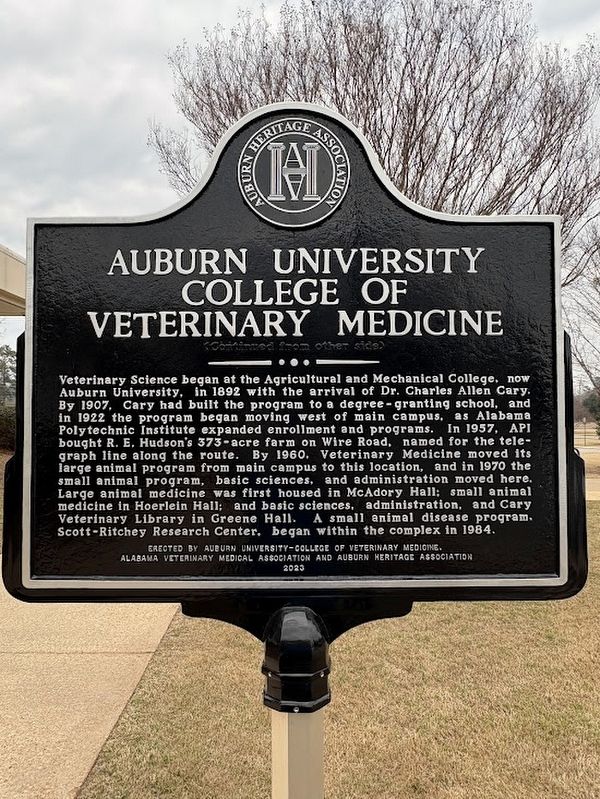
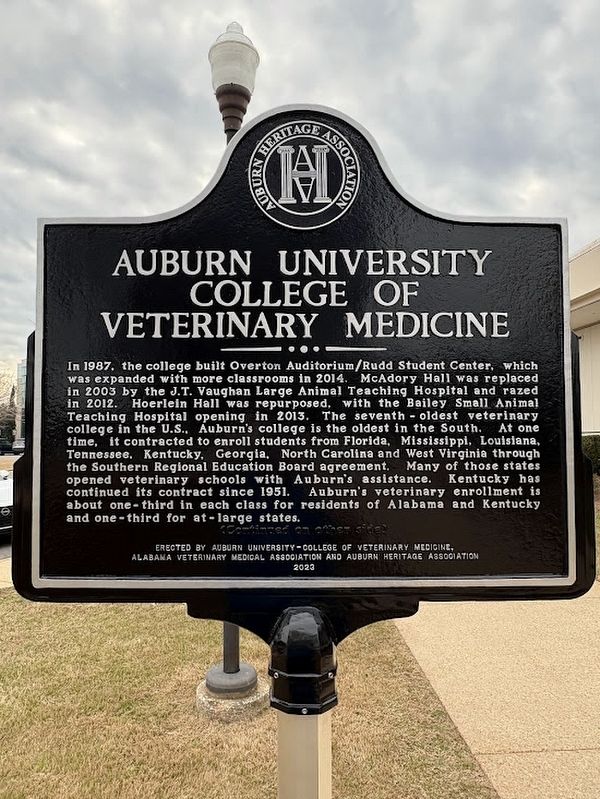
Auburn University College of Veterinary Medicine
Photographed by Darren Jefferson Clay, February 22, 2025
1. Auburn University College of Veterinary Medicine Marker
In 1987, the college built Overton Auditorium/Rudd Student Center, which was expanded with more classrooms in 2014. McAdory Hall was replaced in 2003 by the J.T. Vaughan Large Animal Teaching Hospital and razed in 2012. Hoerlein
this page online
Erected 2023 by Auburn University-College of Veterinary Medicine, Alabama Veterinary Medical Association and Auburn Heritage Association.
Topics. This historical marker is listed in these topic lists: Animals • Education.
Location. 32° 35.434′ N, 85° 30.615′ W. Marker is in Auburn, Alabama, in Lee County. It is on Wire Road 0.1 miles east of Shug Jordan Pkwy (Alabama Route 147), on the right when traveling west. Touch for map. Marker is at
Photographed by Darren Jefferson Clay, February 22, 2025
2. Auburn University College of Veterinary Medicine Marker

Regionally, this marker is in East Alabama and in Greater Columbus. It is also in the American South and specifically in the Deep South. Globally, it is in North America, a Gulf of Mexico state, the Western Hemisphere, the Western World, and the Anglosphere. Historically, it finds itself in what was once the territory of the Mississippian Culture, one of the Confederate States of America, and the Antebellum South.
Other nearby markers. At least 8 other markers are within 2 miles of this marker, measured as the crow flies: The USDA Regional Laboratory for Animal Disease Research (approx. 1.1 miles away); Auburn University and the Alabama Farmers Federation (approx. 1.2 miles away); The Old Rotation (approx. 1.4 miles away); Max Adams Morris / Max Adams Morris Drill Field (approx. 1½ miles away); Sigma Alpha Epsilon (approx. 1½ miles away); Cary Hall (approx. 1½ miles away); Advancing American Art Collection (approx. 1½ miles away); The Cullars Rotation / The Alvis Field and Cotton Rust (approx. 1.6 miles away).
Photographed by Darren Jefferson Clay, February 22, 2025
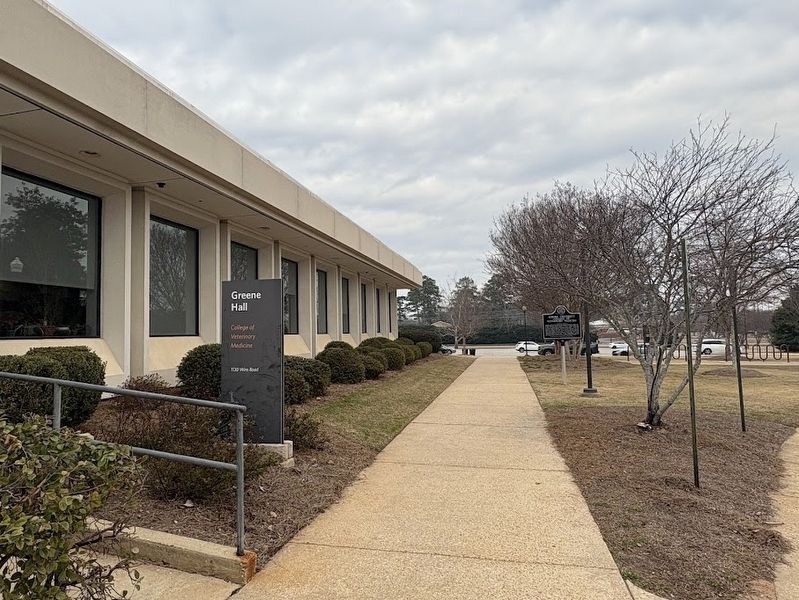
3. Auburn University College of Veterinary Medicine Marker
Credits. This page was last revised on March 3, 2025. It was originally submitted on March 2, 2025, by Darren Jefferson Clay of Duluth, Georgia. This page has been viewed 293 times since then and 86 times this year. Photos: 1, 2, 3. submitted on March 2, 2025, by Darren Jefferson Clay of Duluth, Georgia. • James Hulse was the editor who published this page.
