South Loop in Chicago in Cook County, Illinois — The American Midwest (Great Lakes)
Second Presbyterian Church of Chicago
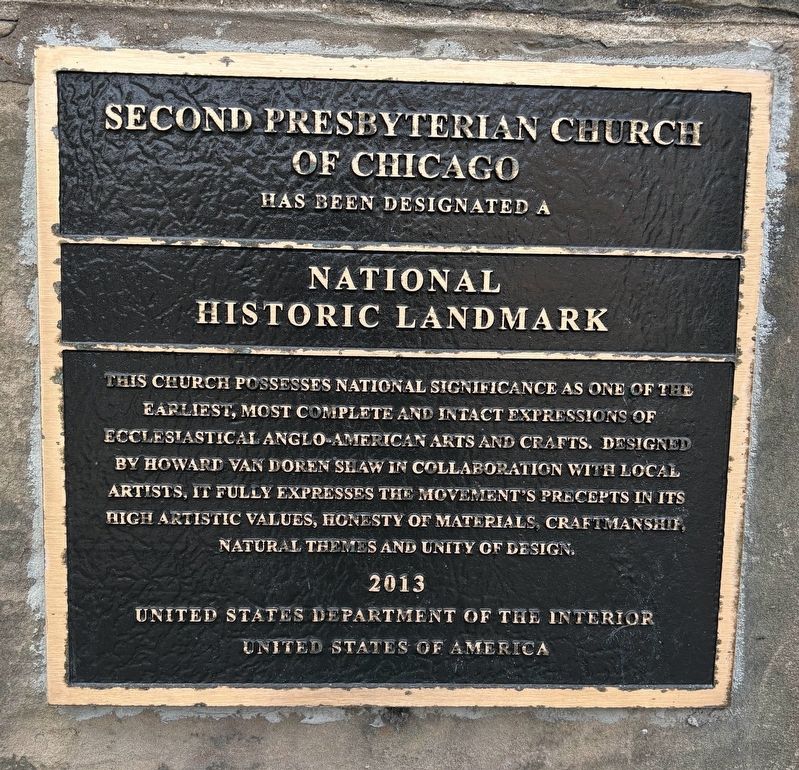
National Historic Landmark
Photographed by Sean P. Flynn, February 28, 2025
1. Second Presbyterian Church of Chicago Marker
This church possesses national significance as one of the earliest, most complete and intact expressions of ecclesiastical Anglo-American arts and crafts. Designed by Howard Van Doren Shaw in collaboration with local artists, it fully expresses the movement's precepts in its high artistic values, honesty of materials, craftmanship, natural themes and unity of design.
Erected by United States Department of the Interior.
Topics and series. This historical marker is listed in these topic lists: Architecture • Religion & Religious Structures. In addition, it is included in the American Presbyterian and Reformed Historic Sites, and the National Historic Landmarks series lists.
Location. 41° 51.339′ N, 87° 37.444′ W. Marker is in Chicago, Illinois, in Cook County. It is in South Loop. It is on Michigan Avenue north of Cullerton Avenue, on the right when traveling south. The marker is to the left of the Michigan Avenue entrance into the church. Touch for map. Marker is at or near
this page online

Regionally, this marker is in Chicago’s Loop. It is also in the American Midwest. Globally, it is in North America, on the Great Lakes, in the Western Hemisphere, in the Western World, and in the Anglosphere. Historically, it finds itself in what was once the Viceroyalty of New France, the territory of the Mississippian Culture, and the Northwest Territory.
Other nearby markers. At least 8 other markers are within walking distance of this marker: South Michigan Ave. Motor Row (here, next to this marker); 1936 South Michigan: Second Presbyterian Church (here, next to this marker); Second Presbyterian Church (a few steps from this marker); Chess Records Office and Studio (about 700 feet away, measured in a direct line); Chess Records Recording Studio (about 800 feet away); South Michigan Avenue Motor Row (about 800 feet away); Henry B. Clarke House (about 800 feet away); Visionary (approx. 0.2 miles away). Touch for a list and map of all markers in Chicago.
More about this marker. A Chicago Landmark plaque
Photographed by Sean P. Flynn, February 28, 2025
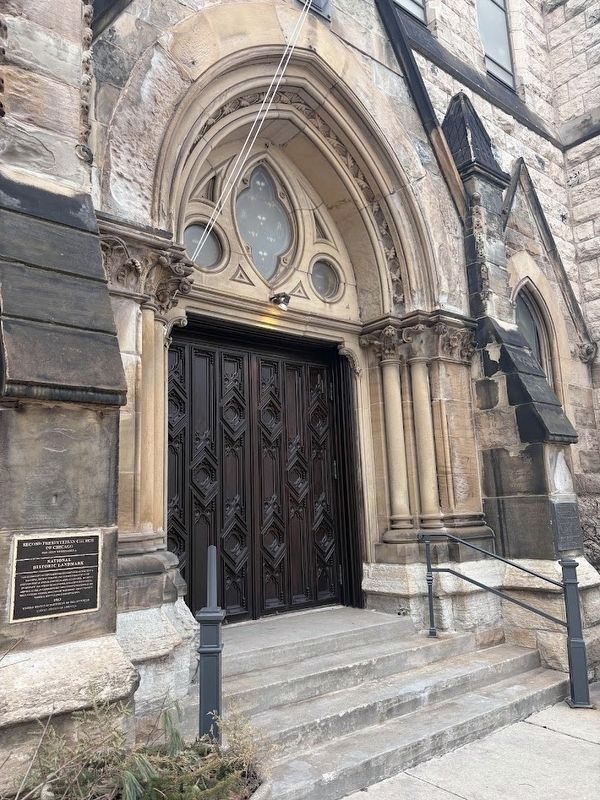
2. Second Presbyterian Church of Chicago
A Chicago Landmark plaque is to the right of the door; this National Historic Landmark plaque is to the left.
Regarding Second Presbyterian Church of Chicago. The original Second Presbyterian Church was organized in 1842 in what is today the Loop area of downtown, at Randolph and Lake. A few years later, it enlisted James Renwick, best known for Washington's Smithsonian building and New York's St. Patrick's Cathedral, to build a new Gothic-style structure, which opened in 1851. That building was destroyed in the Great Chicago Fire of 1871. Soon thereafter the church merged with another Presbyterian congregation and, once again, enlisted Renwick to build this new church about 2½ miles south of its old one. After fire in 1901 destroyed the roof and the sanctuary, the church was rebuilt using a design by Howard Van Doren Shaw, a notable architect and a member of this church. During the late 1800s and early 1900s, the church's members included many notable Chicagoans, including the Armour, Pullman and Blackstone families, and Robert Todd Lincoln, son of Abraham Lincoln.
October 19, 2013
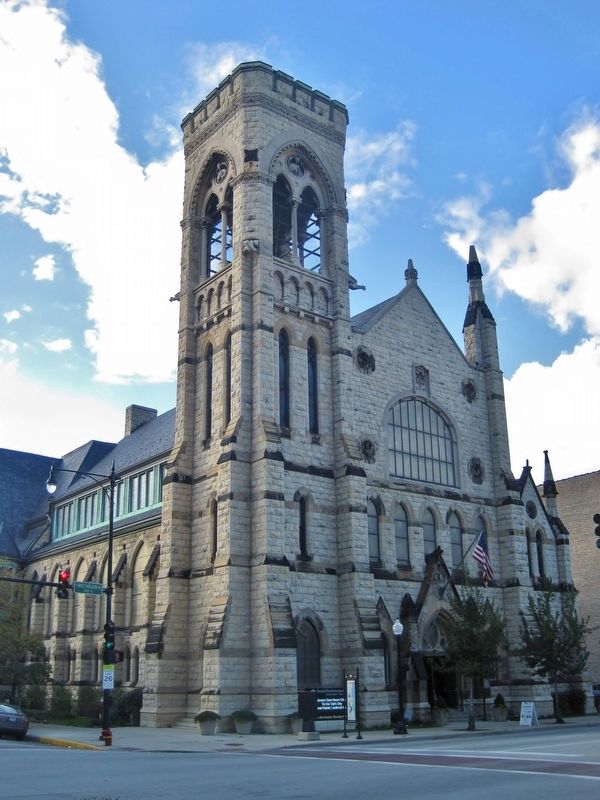
3. Second Presbyterian Church
The church was named a National Historic Landmark in 2013
October 19, 2013
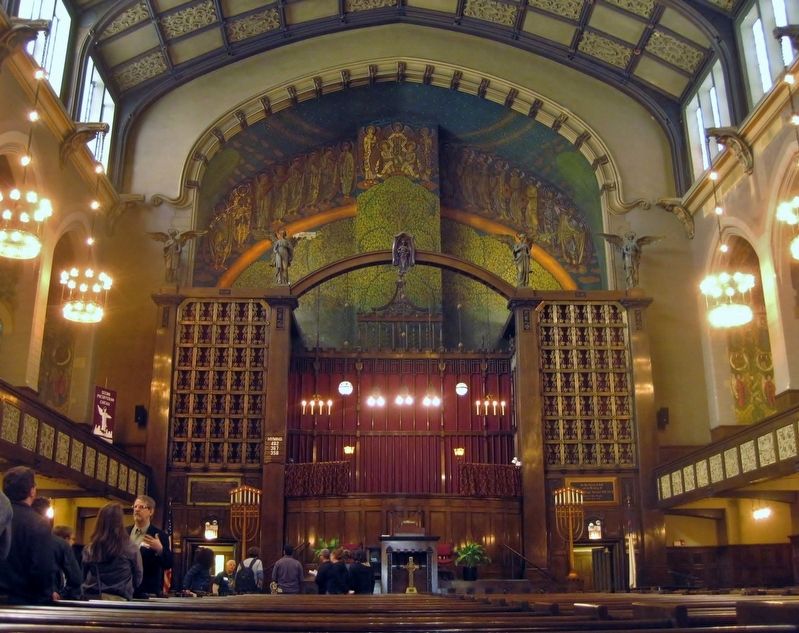
4. Second Presbyterian Church Interior
Howard Van Doren Shaw remodeled the interior, which is now considered a masterpiece of Arts & Crafts design
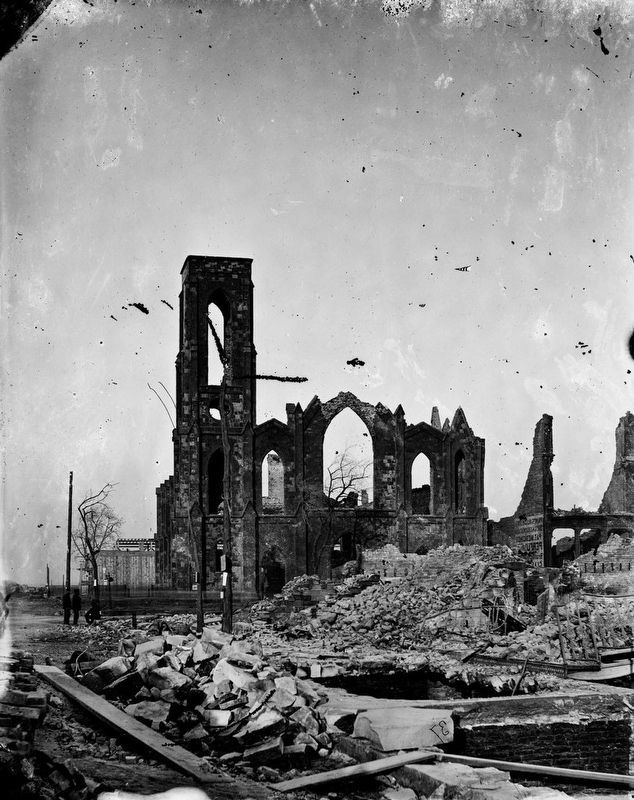
Jex Bardwell; courtesy of Chicago History Museum (ICHi-177254)
5. The ruins of Second Presbyterian Church after the Great Chicago Fire
The original Second Presbyterian was in downtown Chicago and burned down in the Great Chicago Fire of 1871. It was rebuilt in 1874 in its current location, about 2½ miles south.
Credits. This page was last revised on March 4, 2025. It was originally submitted on March 3, 2025, by Sean P. Flynn of Oak Park, Illinois. This page has been viewed 281 times since then and 31 times this year. Photos: 1, 2. submitted on March 3, 2025, by Sean P. Flynn of Oak Park, Illinois. 3, 4. submitted on October 21, 2013. 5. submitted on March 3, 2025, by Sean P. Flynn of Oak Park, Illinois.
