Boise in Ada County, Idaho — The American West (Mountains)
Fort Boise
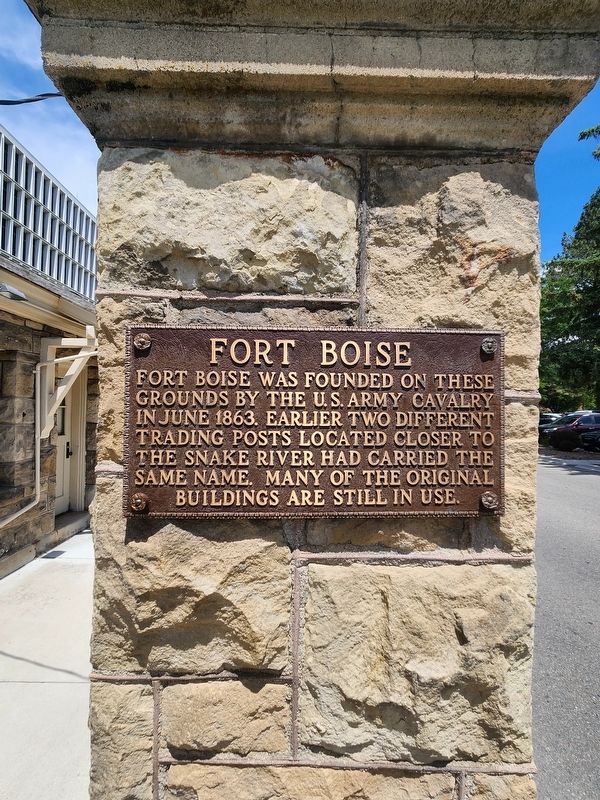
Photographed by Douglass Halvorsen, June 26, 2023
1. Fort Boise Marker
Topics and series. This historical marker is listed in this topic list: Forts and Castles. In addition, it is included in the National Register of Historic Places (NRHP) series list. A significant historical year for this entry is 1863.
Location. 43° 37.188′ N, 116° 11.656′ W. Marker is in Boise, Idaho, in Ada County. It is on N 5th Street, on the left when traveling north. Touch for map. Marker is at or near this postal address: 550 W Fort Street, Boise ID 83702, United States of America. Touch for directions.

Regionally, this marker is on the Snake River Plain. It is also in the American Mountain West. Globally, it is in North America, the Western Hemisphere, the Western World, and the Anglosphere.
Other nearby markers. At least 8 other markers are within walking distance of this marker: The O’Farrell Cabin (about 300 feet away, measured in a direct line); a different marker also named The O'Farrell Cabin
this page online
Regarding Fort Boise. The Fort Boise property was listed in the National Register of Historic Places in 1972.
Also see . . .
1. Fort Boise - Idaho State Historical Society.
Indian hostility against immigrants moving westward over the Oregon Trail prompted the United States Army to authorize the establishment of Fort Boise. Massacre of the Ward party in Boise valley in 1854 brought military retaliation against the local Indians. Increased native restlessness which naturally followed these incidents forced the Hudson’s Bay Company to abandon Fort Boise, a fur trade post located where Boise River discharges into the Snake. Army escort units came out for several seasons to meet the annual immigrant parties and to protect them through the dangerous Snake country. Yet(Submitted on March 4, 2025, by Douglass Halvorsen of Klamath Falls, Oregon.)the need still was felt for a permanent military post in the vicinity of the fur traders’ earlier Fort Boise. Numerous attacks in 1858 and 1859 made the situation worse. Finally, after hearing of the Otter massacre (which certainly showed the futility of the Army escort system), General George Wright formally recommended, October 10, 1860, that the United States Army erect another Fort Boise. Before his proposal could be acted upon, though, the Army got involved in the Civil War. During that conflict, national concern with the Indians of the Snake country diminished somewhat. With the gold rush to Boise Basin underway late in 1862, however, solution of the Boise Indian problem could be deferred no longer. General Benjamin Alvord suggested, October 14, 1862, that the need for Fort Boise had increased tenfold since 1860. The Governor of Washington, whose territory included all of later Idaho, firmly endorsed the request, and General Wright continued to urge immediate action. Finally, on January 14, 1863, the Secretary of War authorized the new post. General Alvord decided upon a site about forty miles up the river from the Hudson’s Bay Company’s earlier Fort Boise, and Major Pickney Lugenbeel left Fort Vancouver, June 1, to put the orders in effect.Photographed by Douglass Halvorsen, June 26, 20232. Fort Boise Marker
Arriving in the vicinity of the new post, June 28, Lugenbeel spent several days choosing an exact site. Then he celebrated July 4 by formally locating Fort Boise. While a detachment of Oregon cavalry was working on the original log structures of Fort Boise, a town sprang up next to the post. Both the Fort and the town were intended to be permanent; aside from some settler’s 1863 log cabins preserved as relics, the oldest buildings in Boise are some of those constructed for the Fort. A sandstone quartermaster’s building erected September 1, 1864, still is in use as an office building more than a century later, and at least one of the other really early Fort buildings has survived.
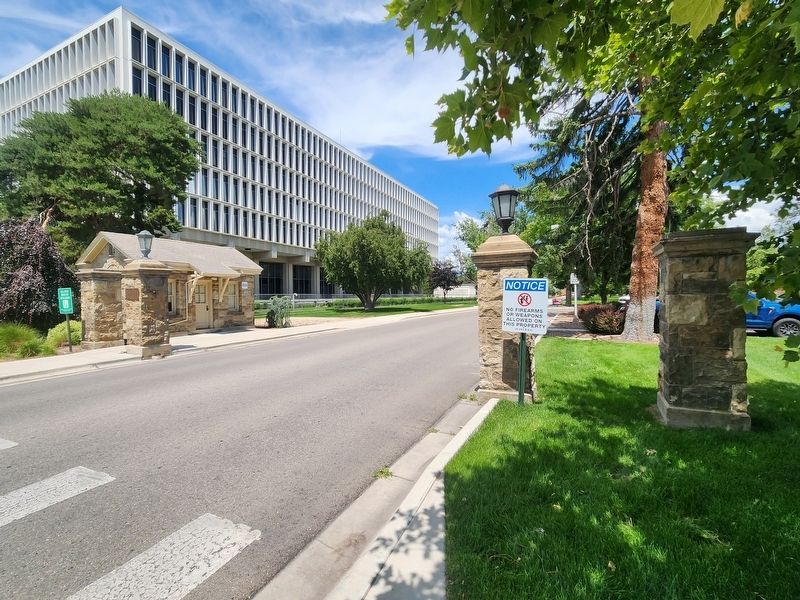
2. Fort Boise NRHP Nomination Form.
Some of the early buildings of 1864 still stand, and at least one is still in use. A number of later buildings of the military post also are in use, and although a Veteran's Hospital has been built next to them, enough of the old fort still can be seen to make this a site of unusual interest.(Submitted on March 4, 2025, by Douglass Halvorsen of Klamath Falls, Oregon.)
The site has architectural interest, especially due to the early date of the U.S. Quartermaster's building and the one remaining house of the original "officers' row", both constructed of native sandstone quarried nearby. These two 1864 structures are massive in character; they afford an unusually good opportunity to observe stone construction of the period. Early photographs extant allow study of later alterations, although these are minor.
Credits. This page was last revised on March 4, 2025. It was originally submitted on March 4, 2025, by Douglass Halvorsen of Klamath Falls, Oregon. This page has been viewed 274 times since then and 136 times this year. Photos: 1, 2. submitted on March 4, 2025, by Douglass Halvorsen of Klamath Falls, Oregon. • Andrew Ruppenstein was the editor who published this page.
