Near Damloup in Meuse, Alsace, Lorraine, Champagne-Ardenne, France — Western Europe
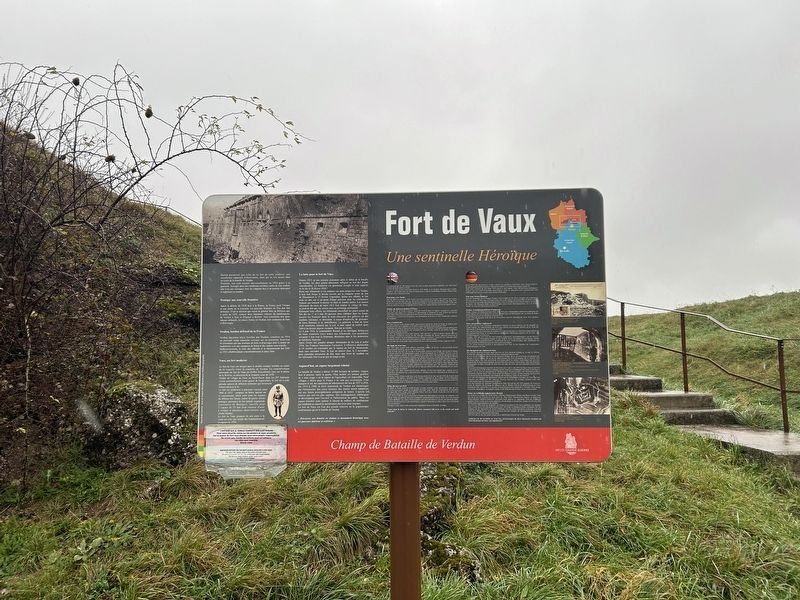
Fort de Vaux
Une sentinelle Héroïque

Photographed by Steve Stoessel, November 18, 2024
1. Fort de Vaux Marker

Destin paradoxal que celui de ce fort de taille modeste, aux excellentes capacités d'observation, mais qui me tire aucun obus au cours de la bataille de Verdun. Pourtant, son nom retentit universellement en 1916 grâce à sa garnison. Assiégée dans des conditions terribles, isolée de tout renfort, elle livre une résistance hors du commun face à un ennemi déterminé el supérieur en nombre.
Protéger une nouvelle frontière
Après la défaite de 1870 face à la Prusse, la France perd l’Alsace et une partie de la Lorraine. La nouvelle frontière de l’Est doit être défendue. C’est la mission que reçoit le général Séré de Rivières qui, à partir de 1874, conçoit deux immenses rideaux de fortifications. de Verdun à Toul et d'Epinal à Belfort. Aux extrémités des deux rideaux défensifs, les places fortes, tel Verdun, sont ceinturées de forts ci d'ouvrages.
Verdun, bastion défensif de la France
Verdun, ancienne place fortifiée par Vauban, constitue en 1914 un puissant camp retranché ceinturé sur un périmètre d'environ 45 kilomètres par une trentaine de forts et d'ouvrages dont la moitié cot modernisée avec des carapaces de
this page online
Vaux, un fort moderne
Le fort de Vaux est intégré dans la double ceinture fortifiée su centre de la laquelle trône la citadelle de Verdun. La caractéristique principale du fort de Vaux est d'offrir d'excellentes vues sur la plaine de la Woëvre, en direction de la frontière issue de 1870.
Visible du village de Vaux au Nord-Ouest, dont les 287 habitants vivent essentiellement avant-guerre de l’agriculture, le fort est à cette période entouré de déboisés militaires qui favorisent l'observation et le tir.
Le fort est modernisé à plusieurs reprises entre 1888 et 1912 : carapace de béton spécial sur le casernement, béton armé pour les organes de défense des fossés, entrée de guerre mieux protégée, puissance de feu latérale augmentée (casemates de Bourges), tourelle pour 2 canons de 75 mm sous cuirasse d'acier a éclipse et plusieurs observatoires sous cloche blindée
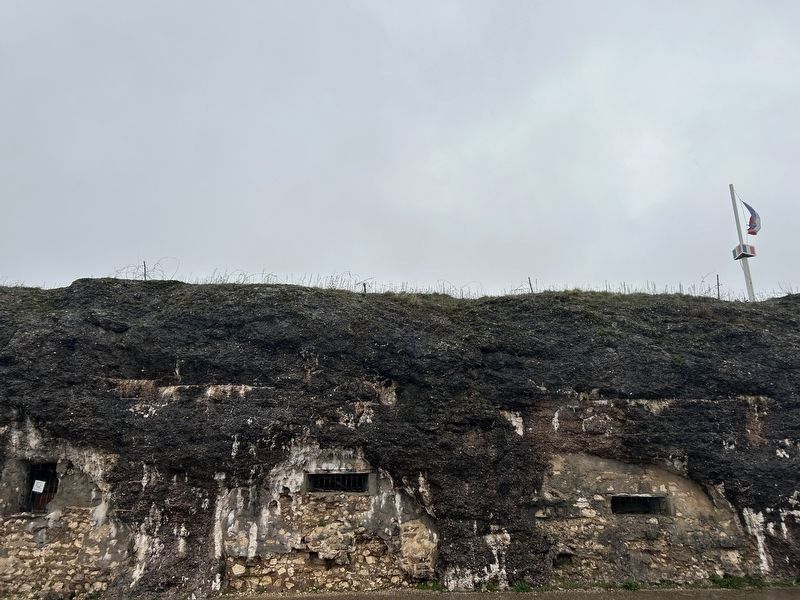
Le fort de Vaux proposé de nos jours à la visite est celui qui résulte des bombardements ravageurs de 1916.
La lutte pour le fort de Vaux
Depuis
Photographed by Steve Stoessel, November 18, 2024
2. Fort de Vaux Marker
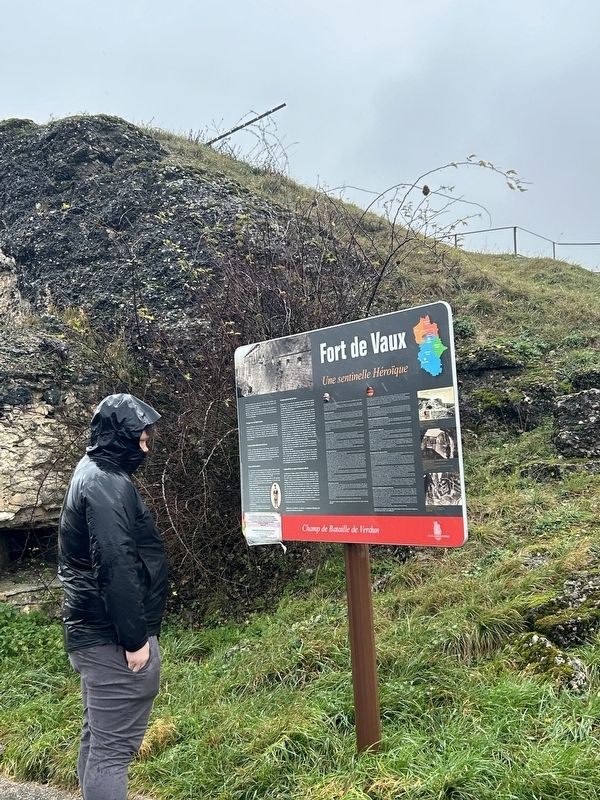
Reste aux Allemands à s'en emparer car, pour progresser vers Verdun, il leur faut élargir la brèche ouverte par la conquête éclair du fort de Douaumont le 25 février. Cependant, même très affaibli, le fort reste un abri sûr et un point d'appui précieux pour les combattants français qui tiennent le secteur en dépit de lourdes pertes. Les assauts allemands du mois de mars 1916 fort tomber le village de Vaux, au pied da fort qui, las, résiste sous un pilonnage permanent.
Relançant leurs efforts, les Allemands encerclent les glacis autour du fort des les e et 2 juin. Ils peuvent alors s'infiltrer dans les fossés, acculer les Français dans la semi-obscurité des galeries où des combats infernaux se déroulent, à coups d'explosifs, de grenades, de lance-flammes et de mitrailleuses. La garnison, à bout de force et de munitions, torturée par la soif, et sans espoir de renfort après l’envoi du dernier pigeon voyageur, finit
Photographed by Steve Stoessel, November 18, 2024
3. Fort de Vaux Marker
Le 3 juin 1916, le commandant Raynal et les héroïques défenseurs de Vaux remettent leurs armes aux Allemands. Les assaillants occupent à leur tour la forteresse, désormais sous le feu destructeur de l’artillerie française.
Après l’échec des grandes attaques allemandes de fin juin et juillet 1916, les Français reprennent l'initiative. L'offensive déclenchée le 24 octobre est couronnée par la reprise du fort de Douaumont, mais sans atteindre Vaux. Il faut un nouvel élan, le 2 novembre, pour reprendre possession du fort, mais sans livrer de combats car les Allemands l'ont évacué peu de temps avant.
Aujourd'hui, un espace largement reboisé
La bataille de Verdun a détruit 10 000 hectares de cultures, vergers, bois et praines. Après la guerre, l’État rachète ces terrains qualifiés de « zone rouge » où la reprise de l'agriculture est impossible. Neuf villages & Morts pour la France » ne sont pas reconstruits. Pour masquer le sol, des opérations de reboisement ont lieu de 1927 à 1934. De 1974 à 1990, la forêt domaniale de Verdun est réaménagée par l'élimination des vieux résineux des années trente remplacés par une futaie
Photographed by Steve Stoessel, November 18, 2024
4. Fort Vaux
Le fort de Vaux est l'un des grands témoins de la gigantesque confrontation qu'est la bataille de Verdun.
« Découvrez son histoire en visitant ce monument historique ave ses parcours intérieur et extérieur. »
The paradoxical fate of this modest-sized fort, with excellent observation capabilities, but which fired no shells during the Battle of Verdun.
And yet its name resounded universally in 1916 thanks to its garrison. Besieged in terrible conditions, isolated from any reinforcements, it delivered extraordinary resistance despite being outnumbered by a determined enemy.
Protecting a new frontier
After the defeat of 1870 by Prussia, France lost Alsace and part of Lorraine. The new eastern border must be defended. This was the mission given to General Séré de Rivières who, from 1874, designed two vast lines of

Photographed by Steve Stoessel, November 18, 2024
5. Fort de Vaux MInterior
Verdun, defensive bastion of France
In 1914, the city of Verdun, a historic bastion fortified by Vauban, constitutes in 1914 a powerful entrenched camp surrounded on a perimeter of about 45 kilometers by about thirty forts and works, half of which were modernized with concrete shells and cannons under turrets. Unfortunately, the crisis of the personnel and the disarmament of the forts in 1915 considerably weakened the stronghold.
Vaux, a modern fort
Fort Vaux was part of the double fortified ring positioned around the citadel of Verdun. Its primary asset was the excellent view of the Woëvre plain, towards the border erected in 1870.
Visible from the village of Vaux to the northwest, whose 287 inhabitants lived mainly from agriculture prior to the war, the fort was at this time surrounded by forest clearings created by the military to facilitate observation and firing artillery.
The fort was modernized several times between 1888 and 1912: a shell of special concrete laid over the barracks, reinforced concrete for the structures defending the ditches, improved protection of the wartime entrance, increased flanking firepower (Bourges casemates), turret for two 75 mm cannons under retractable steel armor and several observational posts under armored domes.
The Fort Vaux, open to the public today, still bears the scars of the devastating shelling it suffered in 1916.
The battle for Fort de Vaux
Since 1915, and only a week after the start of the Battle of Verdun, giant German shells had inflicted considerable damage on the fort. The fortress was almost blind and without firing capacity from 26 February 1916!
All the Germans had to do now was take it, because if they wanted to reach Verdun, they had to enlarge the breach opened by the lightning fast capture of Fort Douaumont on 25 February. However, even in its highly weakened condition, the fort continued to be a safe shelter and a valuable operations post for the French fighters who managed to hold the sector despite heavy losses. German assaults of March 1916 led to the fall of the village of Vaux, at the foot of the fort, but the latter continued to resist despite relentless shelling.
Relaunching their efforts, the Germans encircled the ramparts around the fort on the 1st and 2nd of June. They were then able to infiltrate the ditches, and drove the French back in the semi-darkness of the galleries where hellish fighting was taking place, with explosives, grenades, flamethrowers and machine guns. The garrison, exhausted and lacking ammunition, tortured by thirst, and with no hope of reinforcement after dispatching the last carrier pigeon, eventually surrendered.
On June 3, 1916, Major Raynal and the heroic defenders of Fort Vaux handed their weapons over to the Germans. The attackers in turn occupied the fortress, and they , in turn, were subjected to the destructive fire of French artillery.
Following a series of unsuccessful large-scale German attacks in late June and July 1916, the French regained the initiative. The offensive launched on 24 October culminated in the recapture of Fort Douaumont, but Vaux remained out of reach. A new attempt on 2 November was needed to regain possession of the fort, but without fighting because the Germans had evacuated it a few days earlier.
Today, the trees are back
The Battle of Verdun destroyed 10,000 hectares of crops, orchards, woods and meadows. After the war, the French government bought up designated "red zone" areas where the resumption of agriculture was impossible. Nine villages , which “died for France" were never rebuilt. To provide cover for the soil, the area was reforested from 1927 to 1934.
From 1974 to 1990, the state-owned forest of Verdun was redeveloped by removing the old conifers from the 1930s, and replacing them with a plantation consisting mainly of beeches. Spruce was reserved for soils with higher clay content. Tourist facilities have been developed to welcome and inform the public. However, this forested area is first and foremost a shroud to thousands of combatants whose lives will sanctify these woods forever.
Fort Vaux is key witness of the monumental confrontation known as the Battle of Verdun.
"Discover its history by visiting this historic monument with its indoor and outdoor paths."
[German translation was not transcribed]
Topics. This historical marker is listed in these topic lists: Forts and Castles • War, World I. A significant historical date for this entry is February 26, 1916.
Location. 49° 11.998′ N, 5° 28.227′ E. Marker is near Damloup, Grand Est (Alsace, Lorraine, Champagne-Ardenne), in Meuse. It is on Grand Est Route 913a 3.2 kilometers north of Route 913. Marker is in the parking area for the fort at the end of D913a. Touch for map. Marker is in this post office area: Damloup, Grand Est 55400, France. Touch for directions.

Regionally, it is in the North Atlantic Region, Europe, the European Union, Atlantic Europe, the Schengen Area, Western Europe, a coastal Mediterranean country, and the Western World. Historically, it finds itself in what was once a French colony, the Roman Empire, and specifically the Holy Roman Empire.
Other nearby markers. At least 8 other markers are within walking distance of this marker: Pigeon de Verdun (a few steps from this marker); De sa construction à la bataille de Verdun (within shouting distance of this marker); Dans la bataille de Verdun (within shouting distance of this marker); a different marker also named Dans la bataille de Verdun (within shouting distance of this marker); a different marker also named Dans la bataille de Verdun (within shouting distance of this marker); Les Défenseurs du Fort de Vaux (within shouting distance of this marker); a different marker also named De sa construction à la bataille de Verdun (within shouting distance of this marker); a different marker also named De sa construction à la bataille de Verdun (within shouting distance of this marker). Touch for a list and map of all markers in Damloup.
Credits. This page was last revised on March 5, 2025. It was originally submitted on March 5, 2025, by Steve Stoessel of Niskayuna, New York. This page has been viewed 195 times since then and 45 times this year. Photos: 1, 2, 3, 4, 5. submitted on March 5, 2025, by Steve Stoessel of Niskayuna, New York.
