Punda in Willemstad, Curaçao, Dutch Caribbean — Caribbean (Dutch Caribbean)
Timeline
Approaching 4 centuries of Jewish Life in Curacao

Photographed by Pete Skillman, February 25, 2025
1. Timeline Marker

The first Jewish settlers of Curacao came in 1651. They were descendants of the families who had fled the Inquisition in Spain and Portugal five generations or so earlier. In Curacao they found a safe haven where they were able to settle in peace and prosper.
From the onset, Curacao became an epicenter for Jewish life in the Americas. At its height at the beginning of the 19th century, Curacao was nick-named the mother congregation of the Americas as it supported new communities and synagogues throughout the Americas. Many also moved to the new communities and traded with family left behind in Curacao.
Today after 12 to 14 generations on the island, the Curacao Jewish community is facing an uncertain future as their numbers dwindle. Will the past be able to inspire the future?
Jewish history of Curacao
- 1492
End of an era
Spanish Jews once consituted one of the largest and most prosperous Jewish communities in the world. Facing persecution, the ancestors of the people who would eventually settle in Curacao had fled or were planning to do so. - 1634
First Jew in Curacao
Samuel Cohen was servingas interpreter on Johan van Walbeeck's ship and because he spoke Spanish, he stayed behind on the island as 'overseer of the Indians' on behalf of the Dutch. He did not stay very long.Click or scan to see
this page online - 1651
First group of Jews arrives
Joao d'Yllan brought the first group of Jewish settlers from the Dutch to Curacao, some 10-12 souls. They named the land they had been allotted 'De Hoop,' and probably used an existing building as a makeshift synagogue. It was the beginning of the Mikve Israel [Hope of Israel] congregation. - 1654
Second group arrives
David Nassy was also given a contract to escort a group of 50 Jewish settlers from Amsterdam to Curacao. There is however no record of this group ever arriving in Curacao, perhaps because of the war that was reigning between Holland and England. It is however widely accepted that in these years some (individual) Jewish settlers must have arrived (directly) from Brazil. - 1659
More Jewish settlers
A group of some 70 settlers arrived from Amsterdam under the patronage of Isaac da Costa. Many had formerly been in Dutch Brazil. They, too, went to live and tend the land at De Hoop and in additionwere assigned more land to the west. They brought with them our first Torah bought from 'Esnoga' in Amsterdam. Soon there after, a cemetery was consecrated at Bleinheim near plantation.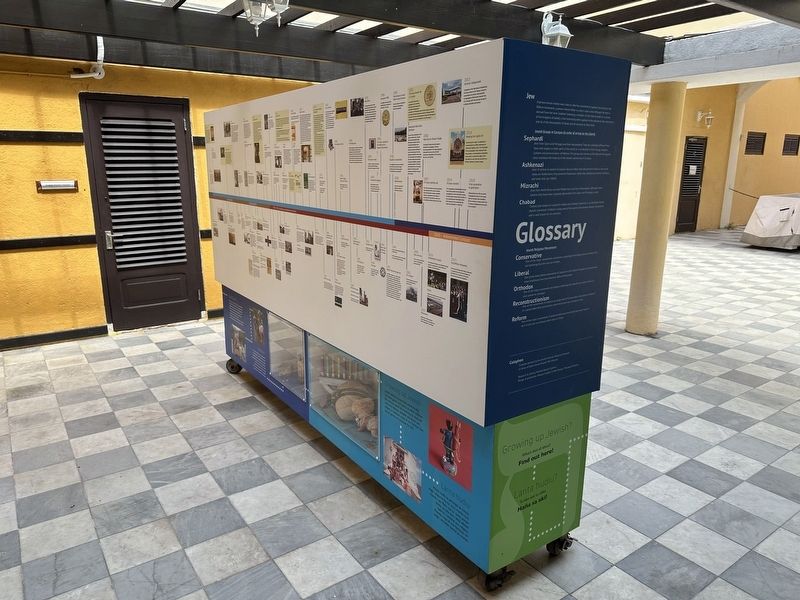 Photographed by Pete Skillman, February 25, 20252. Timeline Marker - full rear view
 - 1660
Move to town
Agriculture turned out not to be a viable means of making a living and the Curacao Jews started to move to town, exploring other opportunities. In 1660 Jeosuah Henriquez was owner of 2 buildings in town on what was presumably later known as Jodenstraat. - 1662
Forging a living
Many Jews became involved in building, operating, hiring and sailing ships. With shipping came a need for the Jewish firms to branch out into insurance, financing and banking. Today's Curacao Jews are still (successfully) involved in these sectors, albeit in smaller numbers. - 1668
First Grave
Death of Judith Nunes da Fonseca, whose tombstone carried the oldest legible inscription in Beth Haim Bleinheim. Meanwhile the elements of time have rendered it illegible. The da Fonseca family hailed from Portugal. - 1674
First Synagogue in Punda
The Jews converted a house to their first Synagogue in town and the first Rabbi (Chacham) arrives in Curacao,Josiau Pardo of Amsterdam. Photographed by Pete Skillman, February 25, 20253. Timeline Marker - first section
 - 1681
De Hoop still going strong
The original Synagogue at 'De Hoop' was replaced with a larger one, attesting to the still vibrant community living 'den kunuku.' - 1690
Community grows
The first non-military doctor arrives in Curacao; he is Ysaac Gomes Casseres. Many other Curacao Jewish doctors followed. The Synagogue in town was moved to a larger space, which happened again 6 years later. - 1703
First Synagogue built
The Synagogue in town was once again replaced, this time a new building was erected on the exact same site as our Snoa currently stands. Some of the furniture and fixtures of this building are still in use in the current House of Worship. - 1732
Oldest Synagogue in the Americas
Again the building was deemed too small to house the growing Congregation. The Mikve Israel community once again constructed a new House of Worship, our current Snoa. It was consecrated on the eve of Passover in 1732. This makes Synagogue Mikve Israel-Emanuel the oldest synagogue building in continuous use in the New World. - 1746
Jewish life in Otrobanda
When living within the walled city becametoo expensive, Jews moved to the suburbs of Willemstad, such as Pietermaai, Scharloo and Otrobanda. Religious observances prohibited those in Otrobanda to cross the bay by skiff on Shabbat, so the Otrobanda members of Mikve Israel built a new synagogue there: Neve Shalom (Dwelling of Peace). At first they continued to fall fully under the jurisdiction of Mikve Israel, which caused disputes. Later in 1750, Prince Willem IV settled the dispute by giving Otrobandistas more autonomy. Photographed by Pete Skillman, February 25, 20254. Timeline Marker - second section
 - 1765
Only local Rabbi
Jacob Lopez de Fonseca becomes Chief Rabbi of Curacao. He is the only Chief Rabbi ever born locally. - 1775
Love letter
The Jews came to Curacao speaking and corresponding in Portuguese, but it is believed that they soon adapted to speaking Papiamentu in daily life and enriched the language to a great extent. In fact, the oldest extant document written in Papiamentu is a love letter written by a Sephardic Jew to his beloved. - 1776
End of the Boom
Jewish firms in St. Eustatius and Curacao had been main suppliers of goods and ammunition for the army of rebels commanded by George Washington. The end of the war also meantthe end of the economic boom for those shipping and commercial houses. Photographed by Pete Skillman, February 25, 20255. Timeline Marker - third section
 - 1790
Largest Community in the Americas
The Curacao Jewish Community was one of the largest most important and wealthiest congregations in the New World. We contributed royally to consecrate new synagogues and cemeteries throughout the Americas. Because of economic malaise however, a significant number of Curacao Jews migrate to St. Thomas, Danish Virgin Islands over the next 4 decades. - 1811
Support for Simon Bolivar
The Jews of Curacao were also involved in the South American revolution: Jewish firms supplied goods and war materials to the Libertador; two Jewish men were officers in his army (Isaac de Sola & Benjamin Henriquez); and Mordechay Ricardo offered Bolivar's sisters refuge in Curacao when they went into exile in 1814. They resided at the Octagon, an estate that belonged to Ricardo's mother-in-law. - 1817
Dutch Herritage
Congregation Mikve Israel added the word 'Netherlands' to its name and from that time on is officially called 'Netherlands Portuguese Israelite Congregation Mikve Israel.' - 1818
Neve Shalom Closes
By 1815 there werevery few Jews left in Otrobanda, they had moved to Pietermaai, Pen and Scharloo. The Synagogue in Otrobanda was closed in 1818 and the plot sold in 1864. Photographed by Pete Skillman, February 25, 20256. Timeline Marker - fourth section
 - 1825
Jewish Legal Status
Although the Jews of Curacao had been offered all rights and protection, it was not until this year that they were legally emancipated, and became eligible to hold functions in government. - 1829
Jewish leaders
Curacao chamber of commerce is founded and her first three elected presidents are Jewish: Jesurun, Penha, and Cohen Henriquez. In total 17 Jews were presidents of the Chamber in its first 100 years. - 1830
Emigration
Curacao's Jews move to Venezuela (especially Coro), Colombia, Santo Domingo and Central America. - 1837
S.E.L. Maduro & Sons founded
In 1837 Salomon Elias Levy Maduro started his own ship's bunkering company in the port of Curacao. At the time the primary income came from supplying vessels calling the port with coal. During the years that followed, the sons entered into the business and it evolved into a conglomerate of companies servicing travel and tourism markets. - 1844
Jewish Representation
Curacao Jews gainthe right to serve in the Colonial Council of Curacao. This body, in conjunction with the Dutch Government, would decide upon the general administration of Curacao and the other Dutch islands. The Crown appointed its members. Photographed by Pete Skillman, February 25, 20257. Timeline Marker - fifth section
 - 1850
Naar Theater
Jacob Jeosuah Naar was a theater enthusiast who would put on plays with the young and old in the Jewish Community. He would eventually build a theater, which became the place where famous actors and artists from around the world would come to perform. - 1863
Temple Emanuel
A group of Mikve Israel members had been appealing for quite some years to modernize and liberalize the religious rites, which was against the will of the Rabbi and Direktiva. Finally about a third of the members left to start their own liberal congregation and consecrated the magnificient Tempel Emanu-el (God with us). - 1866
Organ installed in Snoa
The pipe organ in our Snoa is inaugurated on a new balcony with choir area.
Curacao Hebrew Ladies' Benevolent Society
The Society was founded in 1866 and numbered 46 members. In its Constitution its official name is stated as 'Curacaosche Israelitische DamesWeldadigheids Vereniging.' Its purpose 'to render financial aid to needy Jewish women and Jewish children.' It still functions to date. Photographed by Pete Skillman, February 25, 20258. Timeline Marker - sixth section
 - 1875
Last Sermon in Portuguese
Chief Rabbi Chaham Aaron Mendes Chumaceiro pronounced the last sermon in Portuguese in Mikve Israel. - 1876
Emigration to Panama
Another emigration of Jews from Curacao, this time to Panama where the digging of the Canal brought about a boom. By 1876 the found Kol Shearith Israel. - 1880
New Cemetery
The original cemetery at Bleinheim was filling up and had become inconvenient to visit as Jewish life in Curacao now centered on Punda. Thus a new cemetery was consecrated at Berg Altena, closer to town with easier access. This burial ground is still used today. - 1895
The Pamphleteer
Attorney Abraham Mendes Chumaceiro (1841-1902) publishes "Zal het kiesrecht Curacao tot het kannibalisme voeren?" (Will suffrage lead Curacao to cannibalism?). Born in Amsterdam in 1841, he moved to Curacao in 1856, where he studied law, and was admitted to the bar in 1872. He soon acquired great prominence in his profession. Among his literary works are "Is Curacao to Koop?"(Is Curacao for Sale?) and "Het Kiesrecht in de Kolonie Curacao" (Suffrage in the Curacao Colony). Photographed by Pete Skillman, February 25, 20259. Timeline Marker - seventh section
 - 1896
Curacao Liqueur
One of Curacao's best-known exports is its very own native liqueur; one flavored using the aromatic dried-up peels of the lahara fruit (and often dyed a blue worthy of the Caribbean deeps). This island citrus evolves from Valencia oranges planted long ago by the Spanish, then abandoned when Curacao's dry and demanding climate wreaked havoc on their sweetness. Thankfully, Edgar Senior and Haim Mendes Chumaceiro ultimately discovered that the lahara, while not particularly edible, has a plenty worthy alternate use. - 1899
Wilhelminapark
The Ladies' Club Entre Nous, a benevolent society that had been founded in 1895 by a group of Jewish women, transforms the empty lot (Fo'i Porta) into Wilhelminapark under the presidency of Rebecca Cohen Henriquez. In 1933 they erect a majestic statue of Queen Wilhelmina in the park. - 1906
New Industry
Haim J. Cohen Henriquez starts a school for locals to learn how to plait straw hats, starting as such a new industry allowing many local women to earn a living while workingat home. Photographed by Pete Skillman, February 25, 202510. Timeline Marker - eighth section
 - 1916
Maduro's Bank Established
By the early 20th century increasing industrialization following the discovery of oil in nearby Venezuela ushered in a demand for modern banking services. Local financier Joseph Alvarez Correa established Madura's Bank with the financial backing of his inlaws. It was the island's first commercial bank. In 1932 it merged with Curiel's Bank to form Maduro & Curiel's Bank. A century later descendants of both original Jewish families are still involved. - 1926
Arrival Ashkenazi Jews
Ashkenazi Jews fleeing from the pogroms all over Eastern Europe started to arrive in Curacao. Very few of those who ended up here had ever heard of Curacao. They had been on their way to other destinations in Latin America, Curacao was a port of call. Some of them stayed on when they learned that the country of their destination was in political turmoil and realized that there was of opportunity in Curacao. Some left after a while, but those who remained sent for relatives. A majority of the refugees hailed from the former Bessarabia, a border area between Romania and Russia. A few came from Poland. - 1932
Club Union
A social club by and for the Ashkenazi Jewish community of Curacao was established. It became a center for Jewish life, where celebrations, plays, parties and such took place. - 1940
Curacao Jews detained
Following Curacao's declaration of war almost 500 persons, who were of German, Austrian or Italian nationality or descent, were taken from Curacao and Aruba to be interned in a camp in Bonaire as they were considered enemies of the State. Among those detained were even several German and Austrian Jews. in time Rabbi Cardoze negotiated their release from the internment camp, they were ordered however to remain in Bonaire for the duration of the war.
Newsletter
The Mikve Israel congregation starts publishing a monthly newsletter. - 1941
Jewish Relief Committee
The Spanish ship Cabo de Hornos, with 86 Jewish refugees onboard had been refused entry by several countries. Curacao's Jews successfully petitioned for the refugees to be allowed to land and guaranteed to cover their needs while on the island. - 1945
George Maduro dies
George Maduro had been studying Law in Holland when the Germans invaded the Netherlands in 1940. As a reserve officer in the Dutch Army, he led the successful charge to capture Villa Dorrepaal, on the river Maas, from the Germans. He later became active in the resistance movement, helping downed pilots flee via Spain. He was eventually captured and died in 1945 of typhus in a concentration camp in Dachau. After his death the Queen awarded his the Militaire Willemsorde. His parents helped found Madurodam in The Hague in his memory. The Government of Curacao named a street in his honor. - 1949
Scharloo Shaarei Tsedek
The Ashkenazi established their own Congregation Shaarei Tsedek (Gates of Righteousness) and rent a house on Scharlooweg to hold services; they follow rituals according to Ashkenazi traditions and customs. - 1950
Hebrew School Moria Founded
The Ashkenazi community held Hebrew classes for their children after school, Cantor Cardozo of Mikve Israel was their first teacher. - 1957
Precious Stones
Rabbi Isaac S. Emmanuel publishes his pioneering research of the tombstones of the Jews of Curacao, recording 3 centuries of Jewish life on the island. - 1958
Walls start crumbling
Wall at Berg Altena cemetery separating the Temple section from that of Mikve Israel is demolished. - 1959
Curacao has a shul
Consecration of the synagogue of Conregation 'Shaarei Tsedek' in Scharloo where it remained until the mid eighties. - 1962
More Jewish life
Rabbi Simeon Maslin was hired by Temple Emanu-El; besides his work as spiritual leader of the congregation, he will always be remembered for his successful efforts in reuniting the two Sephardic communities and creating a platform for more and better interactions between the different groups of Jews on the island.
B'nai B'rith Curacao was founded.
The current Community Hebrew School was established and enrolls 50 students from all three Jewish congregations on the island. Just a few years later, the enrollment doubled. Regretfully today enrollment is down to a handful.
Otto Senior, who was president of Mikve Israel at the time of the merger with Tempel Emanu-El, establishes the Ritz Ice Cream Factory. - 1963
Changing times
Mikve Israel, Temple Emanu-El, and Shaarei Tsedek conduct their first joint service.
On August 9th, the final service is conducted at Temple Emanu-El. - 1964
Merger
The two Sephardic Congregations on the island merge into the new United Congregation Mikve Israel-Emanuel. Services would be held at the 'Snoa' and will follow Reconstructionist rites - being somewhere between orthodox and reform - allowing them to maintain some of the historical and traditional customs of both congregations. - 1965
Cuban Refugees
More than 90 percent of the Jews in Cuba left after Castro and his revolutionaries marched into Havana on January 1, 1959. By 1965 many were settled back on their ancestral Curacao. - 1968
Female Bonding
The ladies of Mikve Israel establish the Sisterhood to nourish the community.
First bat mitzvah took place at Mikve Israel-Emanuel. - 1969
BBYO
A local chapter of B'nai B'rith Youth Organization was founded and was named after George Maduro. Its weekly meetings for Jewish teenagers fostered leadership and organizational skills, and promoted active involvement in educational and charitable events. - 1970
Jewish museum
In 1965, Stichting Monumentenzorg bought the two buildings next to the Synagogue, which presumably had housed the Rabbi's residence and an original Mikvah, They proposed that after restoration they house a Museum of Jewish life in Curacao. In 1969, the Jewish Cultural Historical Museum was founded as a separate Foundation with Isaac Haim Capriles serving as its first President. On April 15th, 1970, the buildings were turned over to the Foundation and soon thereafter the Museum opened its doors. Dr. Jessy Jesurun, together with Miriam Capriles, the Museum's first curator, worked tirelessly to set up those first exhibits and as such provide visitors with a more in depth view into the history and daily life of the Jewish community of Curacao. - 1971
Extensive Research
History of the Jews of the Netherlands Antilles by Isaac and Suzanne Emmanuel was published in two large volumes detailing the rich heritage of Sephardic Jews of our islands. - 1974
S.A.L (Mongui) Maduro Foundation
On March 5th, a foundation named after Salomon (Mongui) Abraham Levy Maduro is established by his widow Mrs. Rachel Louise (Lou) L. Maduro and their daughter Mrs. Ena Dankmeijer-Maduro. The Foundation would hold the Rooi Catootje plantation house, its antique furniture and its priceless library, containing unique collections of Antilliana and Judaica. It was Mr. Maduro's desire to make his valuable collection available to the public. His heirs, upon recommendation of Mrs. Daphne van Schendel-Labega, took it upon themselves to ensure the continuation of the collection. The resulting library, now housed in the Ena Dankmeijer-Maduro Pavilion, allows the public to share its contents as a reference collection, while Rooi Catootje is preserved as a museum and historical monument. - 1976
Girl power
Women were admitted as members of B'nai B'rith Curacao.
First local Bat Mitzvah took place at Mikve Israel-Emanuel. - 1982
Snoa 250 years
The Mikve Israel-Emanuel Synagogue commemorates 250 years of its consecration in 1732. The Government of Curacao honores our unique anniversary with the 'restoration' of the name for the street on the south side. The street becomes: "Hanchi di Snoa" after its original name (Joden)Kerkstraat. - 1985
First computer at Snoa - 1986
Shaarei Tsedek moves out of town
Shaarei Tsedek converted a house in Mahaai to a house of worship. - 1989
The Temple sold
When the upkeep and rental of the old Temple Emanu-El weighted too heavily upon the congregation, it was decided to sell the building. Part of the proceeds of the sale went toward renovating other properties owned by the community, but a large part was invested with the intent to use the derived interest to help support the daily operations at the Snoa. - 1992
Royal firsts
The Royal family joins the Mikve Israel-Emanuel community in prayer with Queen Beatrix, Prince Claus, Crown Prince Willem-Alexander, and Princes Johan Friso and Constantijn in attendance. HM Queen Beatrix is the first female to sit on the Banca, the Directors' seating area. - 1993
Our Snoa in Israel
A replica in miniature of the Snoa is unveiled at the Beih Hatfutsot Museum of the Diaspora in Tel Aviv. - 1994
Towards full equality
Dolly Devalle is the first woman called to open the doors of the heychal during a Friday evening services. - 1995
The Snoa is placed on the official list of National Monuments - 1996
Jerusalem 3000
The 3000th anniversary of the establishment of Jerusalem is celebrated in the Snoa. - 1998
Equality in Governance
The synagogue's by-laws are amended for the first time since the merger, granting women statutory equality. The Sisterhood is also dissolved. - 1999
First female on board Mikve Israel-Emanuel
The first women are installed on the Board of Congregation Mikve Israel-Emanuel. - 2000
Egalitarianism
Women are granted full equality in rituals of Mikve Isreal-Emanuel. - 2001
350 years Jewish life in Curacao
At the time Curacao had a population of no more than 500 Jews, of which about 350 were direct descendants of the Spanish and Portuguese Jews that five centuries earlier had had to flee the Iberian peninsula in search of religious freedom. The other 150 souls were descendants of those who fled pogroms in Eastern Europe and the Holocaust in the 20th century.
Restoration Beth Haim Bleinheim
As part of the celebrations of 350 years of Jewish Life in Curacao, the old cemetery, Beth Haim Bleinheim, was given new life. Firstly, the buildings on the premises were renovated and added a permanent exhibition in one of the structures. Full scale detailed reproductions we made of 25 gravestones and mounted on top of the original ones, forming an outdoor exhibition. Lastly, the community planted a 120-meter long hedge of trees on the border between the refinery and the cemetery to help filter the smoke of the refinery. - 2006
New Shul for Shaarei Tsedek
The Shaarei Tsedek community builds a beautiful new synagogue in Mahaai. One amazing feature is the huge transparent dome, which serves as the roof of the sanctuary, the magnificence of the stirking blue sky is awe inspiring. - 2007
275 years standing tall
The 275th anniversary of the Snoa building was celebrated with a service of thanks and commemorative prayers, a beautiful concert, a symposium on the future of small Jewish Communities, as well as an art exhibition entitled Inspired by the Snoa. - 2014
50 years reunited
The Congregation commemorated the fact that 50 years before the two Sephardic congregations on the island had reunited. For this occasion several older members of the community were interviewed about their memories of the merger and the result was presented in a short film. - 2015
Archives Safeguarded
Completion of the final phase of transferring the Snoa archives to the Maduro Library for conservation. All archival documentation of Congregation Mikve Israel-Emanuel from 1711 through 2007 will evermore be kept in a climate-controlled environment. - 2016
Keeping the Lights On
"Connecting the Lights" is published to commemorate the 300th anniversary of continuous lighting of the 1716 Chanukiah of the congregation. More important than being simply a commemorative publication, it also seeks to connect the lights of the Chanukiah to much that has occurred in its 300 year 'lifetime' in Jewish Curacao. - 2018
From generation to generation
Although there are still two Jewish Congregations active on the island, both our numbers have dwindled. Yet we continue to sustain Jewish life in Curacao, strengthened by the spirit of our ancestors.
History of Curacao and the World
- Since 500 BC
Native inhabitants
The Calquetios from Venezuela, a group from the Arawakan language family, apparently came to Curacao. They were an agricultural people. - 1392
Persecution in Spain
There was a long history of persecution of Jews in Spain before the establishment of the Inquisition. During the anti-Jewish riots of 1392, for example, over 50,000 Jews were murdered by mobs. Jews were told to convert to Catholicism or die. Forced Jewish converts were known as Marranos (swine), Conversos or "New Christians"; many continued to practice Judaism in secret. - 1478
Spanish Inquisition
Pope Sixtus IV issued a bull authorizing King Ferdinand and Queen Isabella of Spain to appoint an inquisitorial board for the express purpose of rooting out false Christians and heretics. - 1492
Jews Expelled from Spain
On August 2nd, all Jews of Spain were forced to abandon their possessions and leave. It is estimated that at that time about 50,000 Jews 'accepted' conversion and 100,000 - 200,000 left Spain going mostly north to Portugal and east all the way to the Ottoman Empire. - 1499
Discovery of Curacao
Alonso de Ojeda claimed the island for Spain. For 135 year the Spanish would rule Curacao. Early on most of the Indian residents were hauled off to Hispaniola to work the plantations as slaves. The islands were soon however deemed useless by the Spanish, as there were apparently no resources of significance. - 1531
Portugal introduces the Inquisition
Many of the Jewish families who had fled Spain in or before 1492, had sought refuge in Portugal. In some cases they had lived there in relative peace for 3 generations, but they were forced to once again flee the Inquisitors. - 1614
Dutch in the west
The Dutch lay claim to the territories of New Netherlands and establish New Amsterdam, later New York, in 1626. - 1634
Dutch rule in Curacao
Johan van Walbeeck took possession of the island and established a Dutch settlement. - 1648
Dutch Independence
The Dutch Republic, at the time Republiek der Verenigde Provincien, won its independence from Spain after 80 years of war. - 1654
Fall of Recife, Brazil
in 1630 the Dutch conquered Pernambuco from the Portuguese. Under Dutch rule for 24 years, the Jews of Recife experienced religious freedom and were allowed to establish a community. Its members were mainly Jews from Holland and Conversos who had already been in Pernambuco. When the Portuguese recaptured the land in 1654, most of the Recife Jews left Brazil together with the Dutch. - 1660
Statian Jews
Jews were starting to settle in St. Eustatius and were often drawn to (contraband) trade, given the advantage of the enviable geographic location of St. Eustatius near the English, French and Spanish islands. - 1662
Slave Depot
Curacao was established one of the centers in the Atlantic slave trade. Slaves arrived regularly from Africa and were bought and sold on the docks in Willemstad. Most continued on to their ultimate destination in the new South American republics or the Caribbean. Some slaves were sold locally to work on the plantations around the island. - 1674
Dutch leave New York
Dutch formally ceded New Netherlands (New York) to the English. - 1675
Esnoga opens
The Portuguese-Jewish synagogue opens its doors in Amsterdam. The interior of the Mikve Israel in Curacao is modeled after this great building. - 1703
Fortifying of Curacao
Fort Beekenburg was built at Caracasbaai to strengthen protection of Curacao. It was the first object visible from the sea when approaching the bay. - 1729
Building Shearith Israel
The Curacao Jews financially support the building of a synagogue for the oldest Spanish-Portuguese Congregation in New York. - 1750
Revolt of the slaves of Curacao
The slaves endured harsh treatment and inhumane living conditions on Curacao. From 1750 to 1751, the slaves at Hato Plantation established an uprising against their masters. - 1753
Jews settle in Aruba
The first Jew to settle in Aruba was a Portuguese-Jewish worker for the Dutch West Indies Company named Moses Solomon Levie Maduro, who arrived in Aruba with his family in 1754. - 1763
Touro Synagogue
Construction was completed on this house of worship in Rhode Island, with the Amsterdam and Willemstad buildings serving as models for its design. The Curacao Jewish community gave a generous financial support for the new building. It is today the oldest Jewish house of worship in North America still standing. - 1773
Boston Tea Party
The colonists in Boston protested the Tea Tax that had been imposed by the British government. Boston patriots dressed as Mohawk Indians, raided three British ships in Boston harbor and dumped 342 containers of tea into the harbor. - 1776
US Declaration of Independence
In 1775 the 13 American colonies rebelled against the British. The following year the Declaration of Independence was signed and the United States of America was born. - 1789
French revolution - Storming of the Bastille
The French Revolution was a period of time in France when people overthrew the monarchy and took control of the government. It started in 1789 and ended ten years later with the storming of the Bastille prison. - 1795
Slave Revolt
Island's largest slave uprising took place at Kenepa Plantation led by slaves Tula Rigaud, Louis Mercier, Bastiaan Karpata and Pedro Wakao. Up to 4000 slaves on the northwest section of the island revolted. More than one thousand slaves took part in extended gunfights. After a month, the authorities and Colonial armed forces suppressed the revolt. - 1800
Curacao came under British protectorate - 1802
Curacao returned to Dutch control - 1811
Simon Bolivar
Venezuela and Paraguay declare independence from Spain which starts a war. The people of Curacao greatly supported the struggle for independence of Venezuela and Colombia under the leadership of Libertador Simon Bolivar. The Curacaoans Pedro Luis Brion and Manuel Carel Piar received the great honor to be heralded as Venezuelan national heroes for their courageous acts. - 1814
Netherlands bans slave trading - 1815
Definitely Dutch
During the 18th and 19th centuries, the island changed hands among the British, the French, and the Dutch several times. Stable Dutch rule returned for good in 1815 at the end of the Napoleonic Wars, when the island was incorporated into the colony of Curacao and Dependencies. - 1819
Bolivar triumphs
Colombian and Venezuelan independence under the name 'Gran Colombia.' - 1821
Portugal officially ends the Inquisition - 1830
Latin sovereignty
Gran Colombia splits into the separate countries of Colombia, Venezuela, and Ecuador. - 1834
Spanish Inquisition Abolished
The Inquisition was definitively abolished in Spain on July 15, 1834, by a Royal Decree signed by regent Maria Cristina de Borbon, during the minority of Isabel II and with the approval of the President of the Cabinet Francisco Martinez de la Rosa. - 1859
Evolution
Charles Darwin published On the Origin of Species. - 1861
Civil War in the USA
In the USA, The North and South fought the Civil War over slavery and other issues. Fighting lasts for four years. - 1863
Abolition of Slavery
The Dutch abolished slavery bringing a change in the economy with the shift to wage labor. Some inhabitants of Curacao emigrated to other islands, such as Cuba, to work in the sugar cane plantations. Other former slaves had nowhere to go and remained working for the plantation owner in the tenent farmer system.
This was an instituted order in which the former slave leased land from his former master. In exchange the tenant promised to give up for rent most of his harvest to the former slave master. This system lasted until the beginning of the 20th century.
In 1863, the Emancipation Proclamation frees slaves in Confederate states in North America. - 1865
Punda Grows
The city wall of Willemstad is demolished to accommodate the growing commercial center of Curacao. - 1877
Curacao hit by hurricane
A terrible hurricane hit the island, causes much damage and destroys amongst others the Naar Theater. - 1888
Floating Bridge
Curacao's famous 'swinging old lady,' a floating pontoon bridge named for Queen Emma is built. - 1890
Young Queen
HRH Wilhelmina became Queen when her father King Willem III died; she was ten years old at the time. Her mother served as Regent until she turned 18 in 1898 and she was then inaugurated.
Daniel de Leon
The Curacao Jew Daniel de Leon leads the struggle for labor rights in New York; he co-founded the Socialist Labor Party in the States, and was for many years the editor of their New York Daily People. - 1898
Spanish-Cuban-American War
Cuban gains independence from Spain; United States takes control of Puerto Rico, Guam, and the Phillippines. - 1913
Panama Canal
After nearly a decade of construction, President Woodrow Wilson sent a signal from the White House to blow up the Gamboa Dike, causing water to flow into the Panama Canal and joining Atlantic and Pacific oceans for the first time. - 1914
Oil Found in Venezuela
On 15 April 1914, upon the completion of the Zumaque-I (now called MG-1) oil well, the first Venezuelan oilfield of importance, Mene Grande, was discovered by Caribbean Petroleum in the Maracaibo Basin. - 1916
Oil refining on Curacao
Royal Dutch Shell Company forms its subsidiary, Curacaose Petroleum Industrie Maatschappij (C.P.I.M.) and starts building a refinery in the Anna Bay to refine heavy crude oil from the Lake of Maracaibo in Venezuela. - 1929
Stock market crash US
The Wall Street stock market, crashes. Fortunes are lost, and the Great Depression begins. - 1933
Hitler
Adolf Hitler became Chancellor in Germany. Following his rise to power, Germany implements the persecution of Jews and other undesirables in stages, and starts building a network of concentration camps. - 1937
Parlimentary Democracy on Curacao
Curacao elects its own legislature for the first time, amongst others a Jew, Isaac Heim Capriles, was elected a member of Parliament. - 1940
Curacao declares war
Following the German invasion of the Netherlands, Curacao's Governor Wouters proclaims state of war and censor ship regulations laws are put in place. 200 German and 41 Dutch citizens are captured and interned in a camp in Bonaire. 800 British military men are stationed on Curacao and St. Maarten and the Schutterij (local militia) is founded and grows to 3000 members. - 1941
Pivotal Moments
The Holocaust starts. This is the genocide during World War II in which Adolf Hitler's Nazi Germany systematically murdered some six million European Jews between 1941 and 1945. Many other groups were also targeted, albeit in smaller numbers.
When Japan bombs the U.S. fleet at Pearl Harbor, in Hawaii, the United States enters World War II.
The Atlantic Charter is signed; the Allied forces commit to pursue a world of sovereign states and self-governing territories, with the right to self-determination and representative government. Eventually this will lead to new political structures for Curacao and the others in the Dutch Kingdom. - 1942
Americans arrive
1400 American troops arrive in Curacao to protect the island and her refinery, which together with the one in Aruba provide the vast majority of the aviation fuel for the Allied forces. - 1944
Visiting Dignitaries
H.R.H. Princess Juliana and H.R.H. Prince Bernhard visit Curacao amongst other worldly dignitaries; also US First Lady Eleanor Roosevelt visits Curacao and Aruba.
D-Day
D-Day landing in Normandy by Allied and French forces and American troops liberate Paris. - 1945
End of World War Two
Nazi dictator Adolf Hitler kills himself. The Netherlands is liberated. Germany surrenders.
Hiroshima & Nagasaki
US drops atomic bombs on Hiroshima and Nagasaki. - 1948
Universal Sufferage
As Holland ushered in a new monarch, Queen Juliana, Curacao gave voting rights to all citizens over the age of 23.
Establishment of the State of Israel. - 1954
Autonomous Rule
The Statuut or the Charter for the Kingdom of the Netherlands, is enacted, giving the former Dutch Caribbean colonies a new status. Thus the autonomous country the Netherlands Antilles is born. - 1957
Sputnik 1
USSR launched the first artificial Earth satellite Sputnik 1 into space. - 1959
Fidel Castro
Triumph of the Cuban Revolution, the rebel leader Fidel Castro became the Prime Minister, and elections were set up to elect other officials. - 1962
Crisis
Missile Crisis with the US, Cuba, and the USSR. - 1963
Civil Rights in US
Martin Luther King Jr., leader of the civil rights movement in the US, delivered his 'I Have a Dream' speech. - 1969
May 30th strike in Curacao
Local workers at the oil refinery had been on strike for a few weeks, demanding equal pay for equal work. On this fateful day the strike turns riot and many properties are damaged, looted and destroyed, and two people lose their lives.
Moon Walk
Astronaut Neil Armstrong became the first person to walk on the moon. - 1973
Black Power
In Curacao, the first afro-Curacaoan prime minister is elected, while in government and the private sector positions are opening up for Curacaoans of non-European lineage. - 1978
Anthem for Curacao
Curacao adopts a national anthem. The Jewish author May Henriquez formed part of the committee appointed by the government to write the anthem's lyrics. - 1980
Coronation of HM Queen Beatrix
On April 30th, HRH Princess Beatrix becomes Queen of the Netherlands. - 1984
Flag of Curacao
Curacao gets its own flag with blue and yellow stripes representing the sun and the blue skies and waters. The white stars point to the five continents where our population came from. - 1985
SHELL leaves Curacao
In 1983, SHELL's concession with Venezuela ended and it had to negotiate a new price for crude. Negotiations did not pan out, so the company decides to close down operations. The Curacao government bought the installations and leased to the Venezuelan PDVSA. - 1986
Autonomous Aruba
Aruba became a separate country within the Kingdom of the Netherlands. - 1989
Worldwide change
The Berlin Wall was demolished.
Poland overthrew communism.
Tim Berners-Lee of Great Britain created the World Wide Web. - 1990
Pope John Paul II visits Curacao - 1991
End of Cold War
USSR collapsed, Cold War ended. The U.S. battles Iraq in the Persian Gulf War after the Iraq invasion of Kuwait. - 1992
European Union
Maastricht treaty created the European Union. - 1994
Fair trade
U.S., Mexico, and Canada signed NAFTA, the North American Free Trade Agreement. - 1996
Anne Frank exhibition in Curacao - 1997
UNESCO World Heritage Site
The UNESCO recognizes our unique capital and its rich history as world heritage city. In 1634 the Dutch established Willemstad, a trading settlement, at a fine natural harbor on Curacao. The town developed continuously over the following centuries. Today it consists of several distinct historic districts where the architecture reflects not only European urban planning concepts but also styles from the Netherlands and from the Spanish and Portuguese colonial towns with which the merchants of Willemstad had engaged in trade. - 1999
Curacao commemorated 500 years of written history.
The U.S. transfers control of the Panama Canal and Canal Zone to Panama. - 2001
9/11 attacks
Terrorists hijack four planes for a string of deadly attacks against the U.S. - 2003
Start war Iraq
The U.S. and its allies went to war in Iraq. Fighting lasted until 2011. - 2007
Papiamentu
Netherlands Antilles declared Dutch, Papiamentu, and English the official languages on the islands. - 2010
Autonomous Curacao
The Netherlands Antilles was dissolved; Curacao became an autonomous country within the Kingdom of the Netherlands.
Tomas
Tropical Storm Tomas struck Curacao, caused widespread flooding and damage. - 2013
King Willem-Alexander
The Prince of Orange, HRH Willem Alexander, is crowned King of the Dutch Kingdom on April 30th. He is married to HM Queen Maxima; they have three daughters.
Glossary
Jew
A person whose mother was a Jew or who has converted to Judaism. According to the Reform movement, a person whose father is a Jew is also a Jew. Although the term is derived from the term 'Judahite' (meaning a member of the tribe of Judah or a citizen of the kingdom of Judah), it has historically been applied to the patriarchs, the matriarchs and all of the descendants of Jacob and all converts to their faith.
Jewish Groups in Curacao (in order of arrival on the island)
Sephardi
Jews from Spain and Portugal and their descendants. They are culturally different from Jews with origins in other parts of the world as is evidenced in their liturgy, religious customs and pronunciation of Hebrew. This group, also known as the Spanish-Portuguese Jews constitute the majority of the Jewish community in Curacao.
Ashkenazi
Jews of central or eastern European descent. More than 80 percent of Jews in the world today are Ashkenazim; they preserve Palestinian rather than Babylonian Jewish traditions, and some still use Yiddish.
Mizrachi
Jews from North Africa and the Middle East and their descendants. Although many believe that these Jews originally descended from Spain and Portugal as well.
Chabad
Chabad, also known as Lubavitch, Habad, and Chabad-Lubavitch, is an Orthodox Jewish, Hasidic movement. Chabad is today one of the world's best-known Hasidic movements and is well known for its outreach.
Jewish Religious Movements
Conservative
One of the major movements of Judaism, accepting the binding nature of Jewish law but believing that the law can change.
Liberal
One of the most liberal movements of Judaism in the United Kingdom, but somewhat more traditional than the American Reform Movement.
Orthodox
One of the major movements of Judaism, believing that Jewish law comes from G-d and cannot be changed.
Reconstructionism
One of the movements of Judaism, and outgrowth of Conservative that does not believe in a personified deity and believes that Jewish law was created by men.
Reform
One of the major movements of Judaism, believing that Jewish law was inspired by G-d and one can choose which laws to follow.
Colophon Timeline donated to the Jewish Cultural Historical Museum in honor of Dylan Kenan Russel's Bar Mitzvah.
Research & editing: Michele Russel-Caprites
Design & production: Passaat Graphic & Web Design | Monique Rosalina
(English):
What's that all about?
Find out here!
The Torah
The Torah is at the heart of our religion. It is a long scroll written by hand in Hebrew containing the five books of Moses. The Torah contains God's teachings and guidance in many stories we all know and love.
The Shabbat
Shabbat is the most important day of the week for us for on that day we remember that God created the world and everything in it. On the seventh day, the Shabbat, God rested, and, like God, we also rest on Shabbat. We light candles to welcome Shabbat, hold services, say prayers and eat and drink together.
The Lord bless you and keep you.
The Lord make his face shine upon you.
And be gracious to you.
The Lord lift up his countenance upon you
And give you peace.
Doing Good
There are a total of 613 laws or commandments (mitzvoth) in the Torah. They are about foods, holidays and prayers, but also about honesty, how to treat other people and lots more. They help make you a better person and make the world a better place. We grow up with the notion that it is good to lend a helping hand and give good causes.
Growing up Jewish
Jewish children around the world do play the same games and sports as other children. But we also spend time learning to read and write the Hebrew alphabet and about our religion. In addition, many of our holidays have special games and activities for kids. (Papiamento):
Ta kiko esei ta nifika
Hana sa aki!
Nos Tora
Nos Tora ta kurason di nos religion. Ta trata di un rol di perkament largu, na hebreo skibi na man, ku ta kontene testament bieu. Nos Tora ta yen di historia ku nos tur konose i stima. Den nan tin Dios su sabiduria i guia.
Shabat
Shabat ta e dia mas importante di siman pa nos, riba e dia aki nos ta korda ku Dios a krea mundu i tur kos den i riba dje. Riba e di shete dia, e shabat, Dios a sosega, i manera Dios, nos tambe ta para ketu riba Shabat. Nos to sende bela pa yama Shabat bon bini, tene servisio, hasi rezo i ta kome i bebe huntu.
Dios bendishona i kuida bo.
Ku presensia di
Dios bria riba bo i dunabo grasia.
Dios kompanabo i dunabo pas.
Hasi Bon
En total tin 613 lei of mandamentu (mitzvot) den nos Tora. Nan ta trata kuminda, fiesta i orashon, pero tambe honestidat, kon pa trata otro i hopi mas. Nan ta yuda hasi abo un miho hendei hasi mundu un miho luga. Nos ta krese ku e noshon ku mester duna un man i aporta na bon kousa.
Lanta hudiu
Mucha hudiu ta partisipa na mesun wega i deporte ku tur otro mucha ront mundu i aki. Pero nos ta tuma tempu tambe pa sina lesa i skibi alfabet hebreo i tokante nos religion. Ademas, hopi di nos fiestanan tin wega i aktividat spesial pa mucha.
Topics. This historical marker is listed in these topic lists: Industry & Commerce • Religion & Religious Structures • Settlements & Settlers.
Location. 12° 6.318′ N, 68° 55.968′ W. Marker is in Willemstad, Curaçao (Curaçao). It is in Punda. It can be reached from Hanchi Snoa. Marker is located in the courtyard of the Mikve Israel-Emanuel Synagogue. Touch for map. Marker is at or near this postal address: Hanchi Snoa 8b, Willemstad, Curaçao, Dutch Caribbean. Touch for directions.

Regionally, it is one of the Lesser Antilles on the Caribbean Sea, on in the Atlantic Ocean, and in North America.
Other nearby markers. At least 8 other markers are within walking distance of this marker: Jewish Cemetery Beth Haim at Bleinheim, Curacao (here, next to this marker); Historical centuries old Mikvah (here, next to this marker); Beth Haim Berg Altena (here, next to this marker); Royal Visit Memorial (a few steps from this marker); Mikve Israel - Emanuel (a few steps from this marker); Mr. Dr. Moises Frumencio Da Costa Gomez (about 120 meters away, measured in a direct line); This sculpture is called Chichi® (about 120 meters away); Wilhelmina (about 150 meters away). Touch for a list and map of all markers in Willemstad.
Credits. This page was last revised on March 15, 2026. It was originally submitted on March 5, 2025, by Pete Skillman of Wilmington, Delaware. This page has been viewed 467 times since then and 130 times this year. Photos: 1, 2, 3, 4, 5, 6. submitted on March 5, 2025, by Pete Skillman of Wilmington, Delaware. 7, 8, 9, 10. submitted on March 7, 2025, by Pete Skillman of Wilmington, Delaware.
