Vaux-devant-Damloup near Douaumont-Vaux in Meuse, Alsace, Lorraine, Champagne-Ardenne, France — Western Europe
Dans la Bataille de Verdun
Le fort de Vaux dans la bataille de Verdun
Photographed by Steve Stoessel, November 18, 2024
1. Dans la Bataille de Verdun Marker

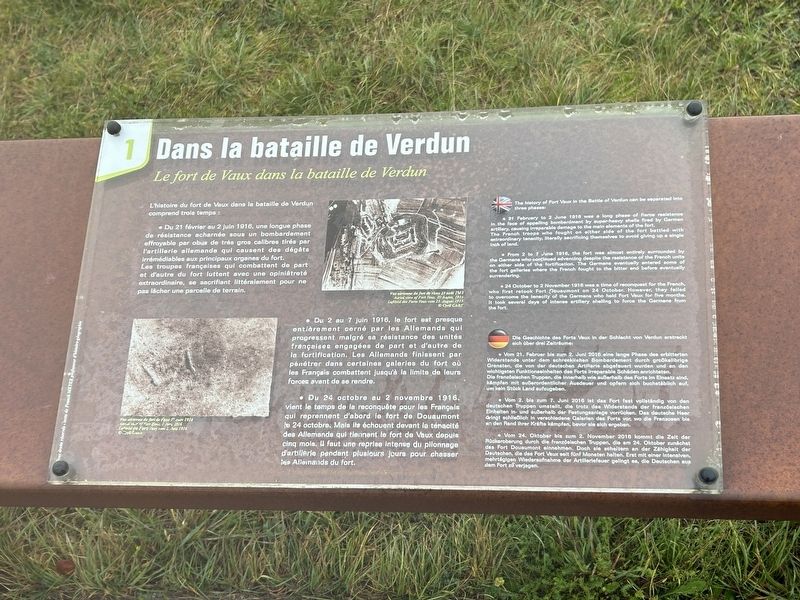
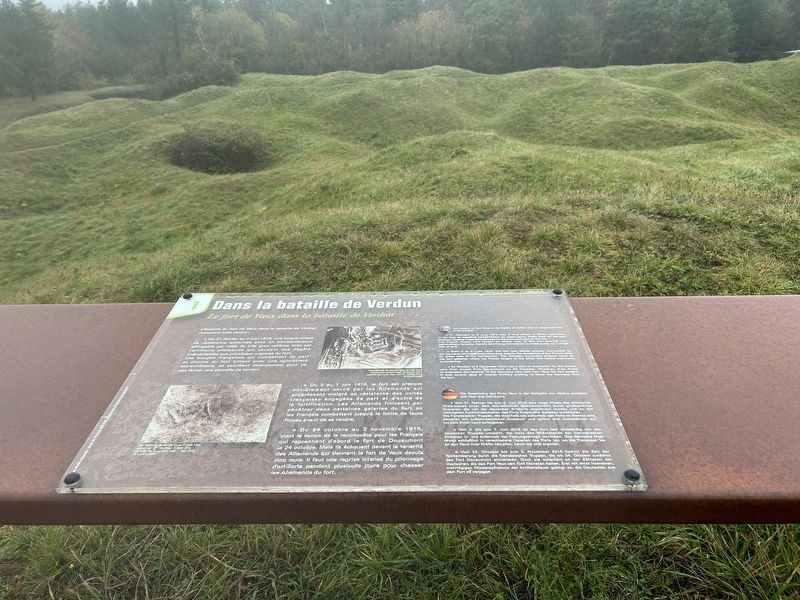
L'histoire du fort de Vaux dans la bataille de Verdun comprend trois temps :
• Du 21 février au 2 juin 1916, une longue phase de résistance acharnée sous un bombardement effroyable par obus de très gros calibres tirés par l'artillerie allemande qui causent des dégâts irrémédiables aux principaux organes du fort. Les troupes françaises qui combattent de part et d'autre du fort luttent avec une opiniâtreté extraordinaire, se sacrifiant littéralement pour ne pas lâcher une parcelle de terrain.
◦ Du 2 au 7 juin 1916, le fort est presque entièrement cerné par les Allemands qui progressent malgré sa résistance des unités françaises engagées de part et d'autre de la fortification. Les Allemands finissent par pénétrer dans certaines galeries du fort ou les Français combattent jusqu'à la limite de leurs forces avant de se rendre.
◦ Du 24 octobre au 2 novembre 1916 vient le temps de la reconquête pour les Français qui reprennent d'abord le fort de Douaumont le 24 octobre. Mais lis échouent devant la ténacité des Allemands qui tiennent le fort de Vaux depuis cinq mois. Il faut une reprise intense du pilonnage
this page online
• 21 February to 2 June 1916 was a long phase of fierce resistance In the face of appalling bombardment by super-heavy shells fired by German artillery, causing Irreparable damage to the main elements of the fort. The French troops who fought on either side of the fort battled with extraordinary tenacity, literally sacrificing themselves to avoid giving up a single inch of land.
• From 2 to 7 June 1916, the fort was almost entirely surrounded by the Germans who continued advancing despite the resistance of the French units on either side of the fortification. The Germans eventually entered some of the fort galleries where the French fought to the bitter end before eventually surrendering.
• 24 October to 2 November 1916 was a time of reconquest for the French. who first retook Fort Douaumont on 24 October. However, they failed to overcome the tenacity of the Germans who held Fort Vaux for five months. It took several days of intense artillery shelling to force the Germans
Photographed by Steve Stoessel, November 18, 2024
2. Dans la Bataille de Verdun Marker
• Vom 21. Februar bis zum 2. Juni 2016 eine lange Phase des erbitterten Widerstands unter dem schrecklichen Bombardement durch großkalibrige Granaten, die von der deutschen Artillerie abgefeuert wurden und an den wichtigsten Funktionseinheiten des Forts Irreparable Schäden anrichteten. Die französischen Truppen, die innerhalb wie außerhalb des Forts im Einsatz sind, kämpfen mit außerordentlicher Ausdauer und opfern sich buchstäblich auf, um kein Stück Land aufzugeben.
• Vom 2. bis zum 7. Juni 2016 ist das Fort fast vollständig von den deutschen Truppen umstellt, die trotz des Widerstands der französischen Einheiten in- und außerhalb der Festungsanlage vorrücken. Das deutsche Heer dringt schließlich in verschiedene Galerien des Forts vor, wo die Franzosen bis an den Rand Ihrer Kräfte kämpfen, bevor sie sich ergeben.
• Vom 24. Oktober bis zum 2. November 2016 kommt die Zeit der Rückeroberung durch die französischen Truppen, die am 24. Oktober zunächst das Fort Douaumont einnehmen. Doch sie scheitern an der Zähigkeit der Deutschen,
Photographed by Steve Stoessel, November 18, 2024
3. Dans la Bataille de Verdun Marker
Topics. This historical marker is listed in these topic lists: Forts and Castles • War, World I. A significant historical date for this entry is June 2, 1916.
Location. 49° 12.027′ N, 5° 28.178′ E. Marker is near Douaumont-Vaux, Grand Est (Alsace, Lorraine, Champagne-Ardenne), in Meuse. It is in Vaux-devant-Damloup. It can be reached from Grand Est Route 913a 3.2 kilometers north of Route 913. The fort is at the end of D913a. Touch for map. Marker is at or near this postal address: D913a, Douaumont-Vaux, Grand Est 55400, France. Touch for directions.

Regionally, it is in the North Atlantic Region, Europe, the European Union, Atlantic Europe, the Schengen Area, Western Europe, a coastal Mediterranean country, and the Western World. Historically, it finds itself in what was once a French colony, the Roman Empire, and specifically the Holy Roman Empire.
Other nearby markers. At least 8 other markers are within walking distance of this marker: De sa construction à la bataille de Verdun (here, next to this marker); a different marker also named De sa construction à la bataille de Verdun (a few steps from this marker); Dans la bataille de Verdun (a few steps from this marker); a different marker also named Dans la Bataille de Verdun (a few steps from this marker); a different marker also named De sa construction à la bataille de Verdun (a few steps from this marker); a different marker also named Dans la bataille de Verdun (a few steps from this marker); a different marker also named De sa construction à la bataille de Verdun (within shouting distance of this marker); a different marker also named De sa construction à la bataille de Verdun (within shouting distance of this marker). Touch for a list and map of all markers in Douaumont-Vaux.
Credits. This page was last revised on March 5, 2025. It was originally submitted on March 5, 2025, by Steve Stoessel of Niskayuna, New York. This page has been viewed 92 times since then and 13 times this year. Photos: 1, 2, 3. submitted on March 5, 2025, by Steve Stoessel of Niskayuna, New York.
