Hanau in Main-Kinzig-Kreis, Hesse, Germany — Central Europe
Altstädter Rathaus
⎯⎯⎯
Old Town City Hall
Photographed by Andrew Ruppenstein, February 3, 2025
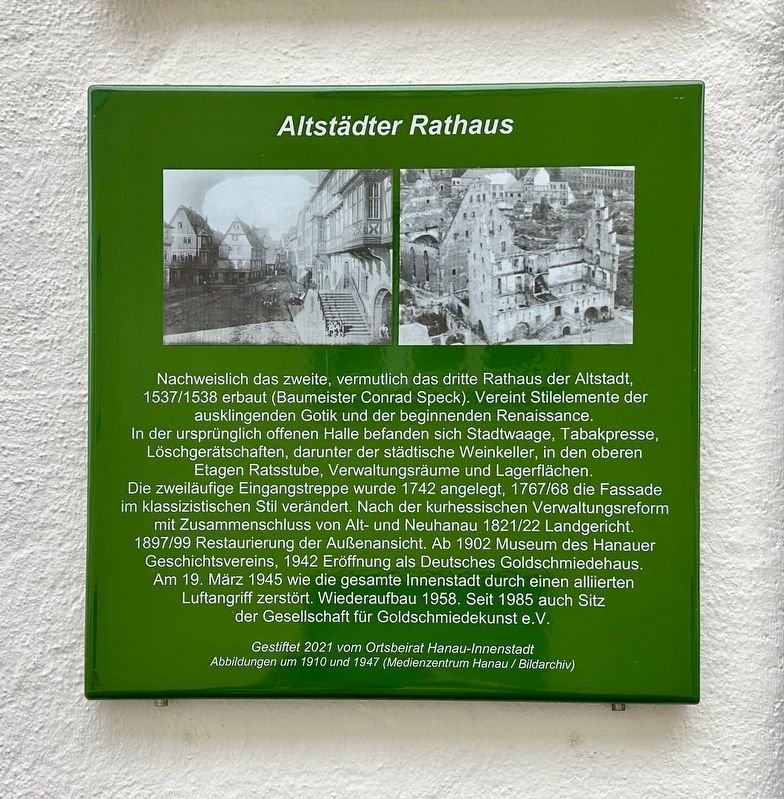
1. Altstädter Rathaus / Old Town City Hall Marker

Gestiftet 2021 vom Ortsbeirat Hanau-Innenstadt
Abbildungen um 1910 und 1947 (Medienzentrum Hanau / Bildarchiv)
Probably the second, possibly the third town hall in the old town,
this page online
Donated in 2021 by the Hanau-Innenstadt local council
Images from around 1910 and 1947 (Medienzentrum Hanau / Bildarchiv)
Erected 2021.
Topics. This historical marker is listed
Photographed by Andrew Ruppenstein, May 26, 2024
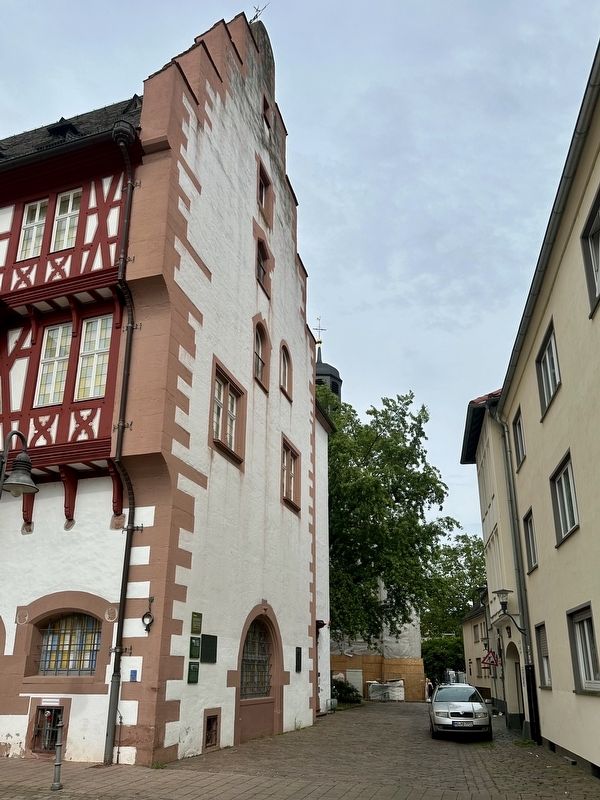
2. Altstädter Rathaus / Old Town City Hall Marker - wide view
Location. 50° 8.193′ N, 8° 55.068′ E. Marker is in Hanau, Hessen (Hesse), in Main-Kinzig-Kreis. It is on Altstädter Markt. Touch for map. Marker is at or near this postal address: Altstädter Markt 2A, Hanau HE 63, Germany. Touch for directions.

Regionally, it is in Europe, the European Union, Atlantic Europe, Central Europe, the Schengen Area, Western Europe, and the Western World. Historically, it finds itself in what was once the Roman Empire, the Holy Roman Empire, and the former West Germany.
Other nearby markers. At least 8 other markers are within walking distance of this marker: Pranger / Pillory (here, next to this marker); Hanauer Elle und Gerechtigkeitsbrunnen / The Hanau “Foot” and Fountain of Justice (here, next to this marker); Wilhelm Ziegler (here, next to this marker); Firma Jean Wunderlich (a few steps from this marker); „Männchen mit den großen Ohren“ / “Little Man with the Big Ears” (within shouting distance of this marker); Dietrich Bonhoeffer (within shouting distance of this marker); Pumpenstock / Water Pumping Station
Photographed by Andrew Ruppenstein, May 26, 2024
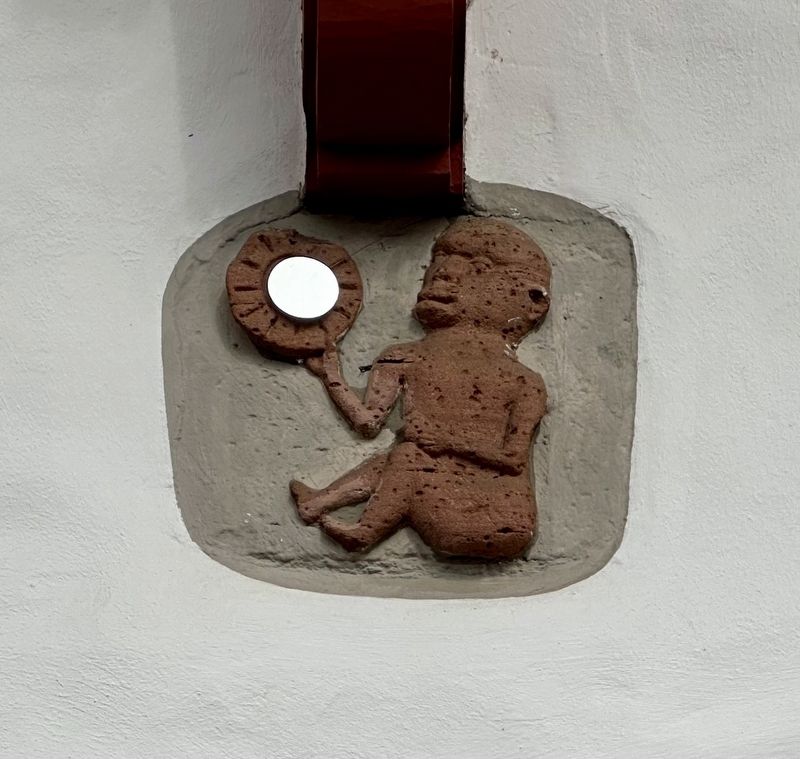
3. Old Town City Hall sandstone decorative relief
A relief on the fasssade depicts a monkey with a mirror, a popular medieval motif for self-regard or narcissism.
Also see . . . Deutsches Goldschmiedehaus (Wikipedia, in German). Excerpt (in translation):
The German Goldsmiths' House was built as a half-timbered building on the long side of the Old Town Market between two stone gable walls and on a stone base floor. With its stepped gable and high saddle roof, the solitary monumental building was visible from afar. It dates from the late Gothic and early Renaissance periods and is dated to 1538 by a building inscription. Its functional predecessor, the town hall from the 15th century, stood on the opposite side of the market square (so-called playhouse). A memorial plaque on the house "Altstädter Markt 1" commemorates this. Konrad Speck is known as the master builder, as are the stonemasons Hans von Gießen, Peter von Aschaffenburg and Hans von Lich.(Submitted on March 6, 2025.)
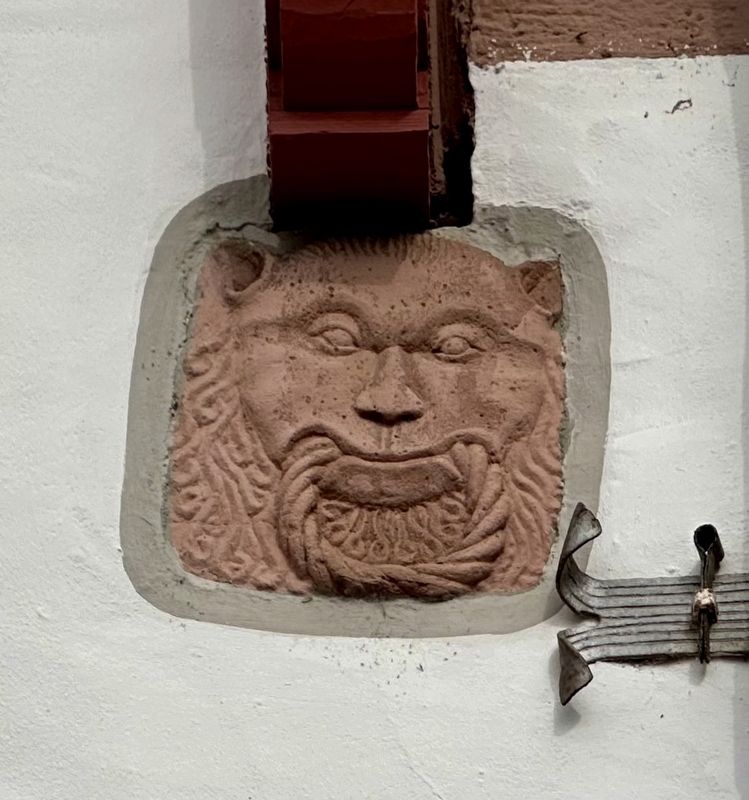
The two-flight open staircase at the German Goldsmiths' House was added based on a design by Christian Ludwig Hermann from 1742. Numerous sandstone reliefs from the14th to 16th centuries embedded in the facade show allusions to foolishness and self-love as well as depictions of mythical creatures or the clever bourgeoisie - a pictorial program that still owes its origins to the Middle Ages. Originally, the ground floor contained arbor-like sales halls, the first floor the council chamber, living room and hallway, and the upper floor a warehouse. A Hanau yardstick, which was used for the market, is embedded in the facade as an iron rod.Photographed by Andrew Ruppenstein, May 26, 20244. Old Town City Hall sandstone decorative relief

Photographed by Andrew Ruppenstein, May 26, 2024
5. Altstädter Rathaus / Old Town City Hall
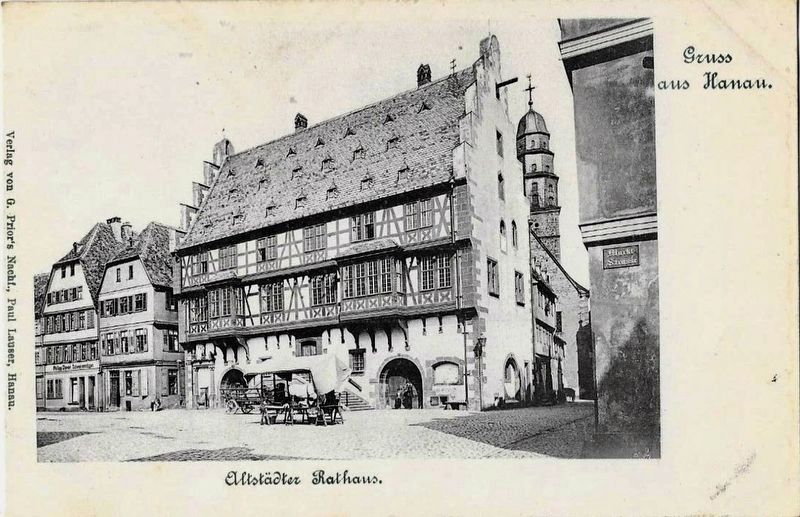
Photographed by Verlag von G. Prior’s Nachf., Paul Lauser, circa 1910
6. Altstädter Rathaus / Old Town City Hall
Credits. This page was last revised on March 6, 2025. It was originally submitted on March 5, 2025, by Andrew Ruppenstein of Lamorinda, California. This page has been viewed 118 times since then and 11 times this year. Photos: 1. submitted on March 5, 2025, by Andrew Ruppenstein of Lamorinda, California. 2, 3, 4, 5, 6. submitted on March 6, 2025, by Andrew Ruppenstein of Lamorinda, California.
