Near Mesen in West-Vlaanderen, Flanders, Belgium — Northwestern Europe
Iers Vredespark
2014-18
| — | 100 jaar Groote Oorlog | — |

Photographed by Steve Stoessel, November 13, 2024
1. Iers Vredespark Marker

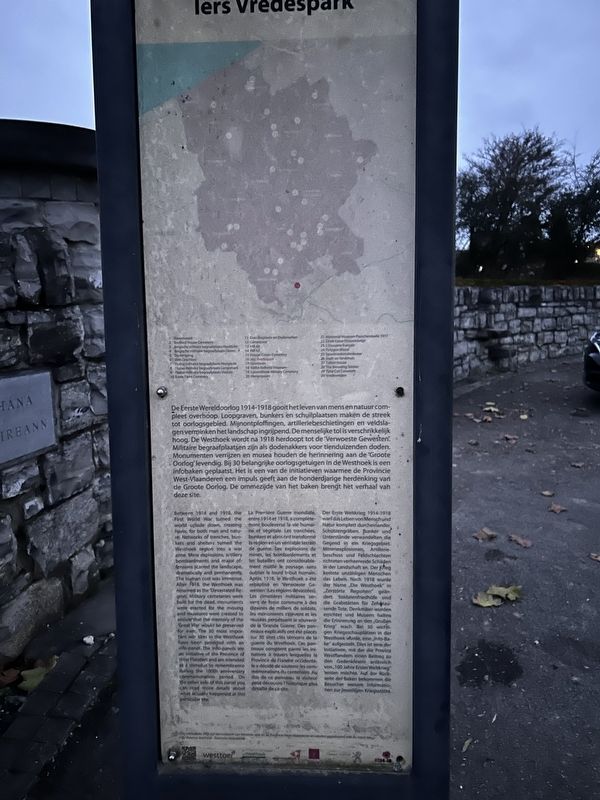
De Eerste Wereldoorlog 1914-1918 gooit het leven van mens en natuur compleet overhoop. Loopgraven, bunkers en schuilplaatsen maken de streek tot oorlogsgebied. Mijnontploffingen, artilleriebeschietingen en veldslagen verminken het landschap ingrijpend. De menselijke tol is verschrikkelijk hoog. De Westhoek wordt na 1918 herdoopt tot de 'Verwoeste Gewesten. Militaire begraafplaatsen zijn als dodenakkers voor tienduizenden doden. Monumenten verrijzen en musea houden de herinnering aan de 'Groote Oorlog' levendig. Bij 30 belangrijke oorlogsgetuigen in de Westhoek is een infobaken geplaatst. Het is een van de initiatieven waarmee de Provincie West-Vlaanderen een impuls geeft aan de honderdjarige herdenking van de Groote Oorlog. De ommezijde van het baken brengt het verhaal van deze site.
this page online
Photographed by Steve Stoessel, November 13, 2024
2. Front Side Iers Vredespark Marker
[Side 2]
In juni 1917 en in een week tijd, verjagen Britse eenheden alle Duitsers uit Mesen. Ierland is dan nog Brits, maar katholieke soldaten van de 16de Ierse Divisie vechten zij aan zij met protestantse soldaten van de 36ste Ulster Divisie. De Ierse Vredestoren gedenkt die gebeurtenis en symboliseert zo de hoop op verzoening tussen beide gemeenschappen. De Vredestoren heeft de vorm van een traditionele “round tower”, en is gedeeltelijk gebouwd met stenen van een Iers armenhuis in Mullingar. De toren ligt te midden

Photographed by Steve Stoessel, November 13, 2024
3. Iers Vredespark Marker and Round Tower in Background
Irish Peace Park
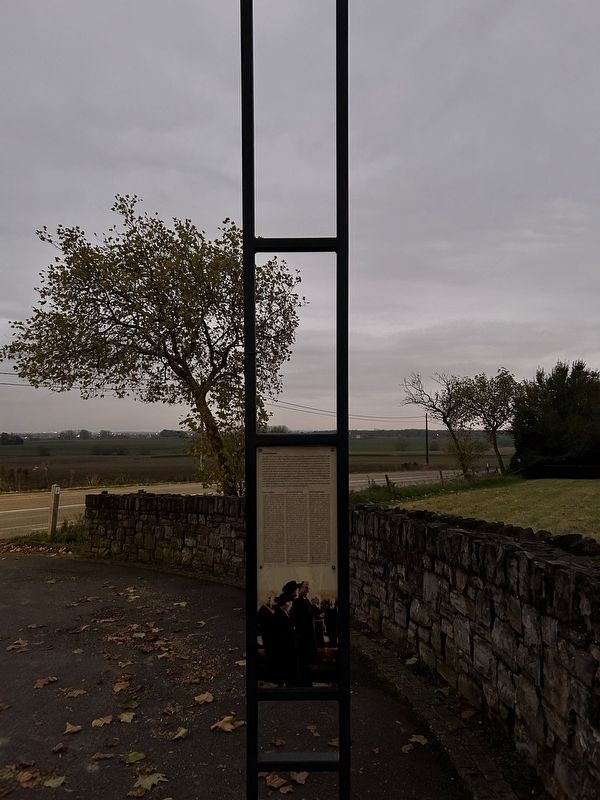
In June 1917, the British Army drove the Germans out of the town of Mesen in just over a week. At this time, Ireland was still part of Great Britain, but Catholic soldiers of the 16th Irish Division fought side by side with Protestant troops of the 36th Ulster Division, The Irish Peace Tower commemorates this event and symbolizes the desire for reconciliation between the two communities. The Peace Tower was built in the form of a traditional round tower and was constructed in part with stone from a demolished workhouse in the Irish town of Mullingar. The tower is the focal point of the Irish Peace Park, which also contains other memorials honoring all the soldiers from the Island of Ireland

Photographed by Steve Stoessel, November 13, 2024
4. Iers Vredespark Marker
Parc Irlandais de la Paix
En juin, 1917 et en l’espace d’une séeraine, des unités britanniques chassent tous les Allemands l’erriands de Messines. À cette époque, bien que l’Irlande fût toujours britannique, des soldats catholiques de la 16e Division Irlandise et des soldats protestants de la 36e Ulster Division combattait côte â côte. La Tour Irlandaise de la Paix commémoré cet événement et symbolise ainsi l’espoir d’une réconciliation entre ces deux communautés. La Tour de la Paix, a la forme d'une ‘round tower’ traditionnelle et est partiellement construite avec des pierres provenant d'une maison de pauvres à Mullingar en Irlande. La tour est implantée au centre du Parc irlandais de la Paix, où des mémoriaux rappellent le souvenir de tous les
Photographed by Steve Stoessel, November 13, 2024
5. Iers Vredespark Marker
Im Juni 1917 vertrieb britische Einheiten binnen einer Woche alle Deutschen aus Mesen. Obschen Irland zu diesem Zeitpunkt nach britisch est kämpfen katholische Soldaten der 16.Irischen Division Seite an Seite mit protestantischen Truppen von der 36. Ulster-Division. Der Irische Friedensturm gederiecht dieser Eintracht und symbolisiert damit auch de Hoffnung auf Aussöhnung zwischen den beiden Glaubensgemeinschaften. Der Friedensturm hat die Form eines traditionellen "round tower" und wurde teilweise aus Steinen errichiet, die von einen irischen Armenhauses in Mullingar starnenen. Der Turm befindet sich mitten im Irishen Friedensparks, wo Denkmäler an alle hier gefallen Soldaten von der Grünen Insel erinnern. Der Turm wurde am 11. November 1998 in Aniversenheit der irischen Präsidentin Mary McAleese, der britischen Königin Elizabeth II. und dem belgischen König Albert II eingeweiht. Seitdem wird hier jedes Jahr am 11. November der Toten gedacht. Mehr über den Ersten Weltkrieg in Mesen erfahren Sie in der Touristeninformation am Markt 1.
Topics. This memorial is listed in this topic list: War, World I.
Location. 50° 45.588′ N, 2° 53.738′ E. Memorial is near Mesen, Vlaanderen (Flanders), in West-Vlaanderen. It is on Armentierssteenweg (National Route 365) south of Nieuw Zealanderstraat, on the left when traveling north. Touch for map. Memorial is at or near this postal address: Armentierssteenweg 8, Mesen, Vlaanderen 8957, Belgium. Touch for directions.

Regionally, it is in Europe, the European Union, Atlantic Europe, the Benelux Low Countries, the Schengen Area, Western Europe, and the Western World. Historically, it finds itself in what was once the Roman Empire and specifically also the Holy Roman Empire.
Other nearby markers. At least 8 other markers are within 3 kilometers of this marker, measured as the crow flies: Prowes Point (approx. 1.8 kilometers away in Région Wallonne); Christmas Truce 1914 / Trêve de Noël 1914 (approx. 1.8 kilometers away in Région Wallonne); Monument UEFA (approx. 1.8 kilometers away in Région Wallonne); Mud Lane at the Crossroads at Hyde Park Corner (approx. 2.4 kilometers away in Région Wallonne); Les Catacombes près de Hyde Park Corner (approx. 2.4 kilometers away in Région Wallonne); Le Memorial (approx. 2.6 kilometers away in Région Wallonne); Le Last Post (approx. 2.6 kilometers away in Région Wallonne); Hyde Park Corner (Royal Berks) Cemetery (approx. 2.6 kilometers away in Région Wallonne).
Also see . . .
1. Good Friday Agreement (Wikipedia).
The Good Friday Agreement (GFA) or Belfast Agreement is a pair of agreements signed on 10 April (Good Friday) 1998 that ended most of the violence of the Troubles, an ethno-nationalist conflict in Northern Ireland since the late 1960s. It was a major development in the Northern Ireland peace process of the 1990s.(Submitted on March 8, 2025, by Steve Stoessel of Niskayuna, New York.)
2. Easter Rebellion (Wikipedia).
The Easter Rising,also known as the Easter Rebellion, was an armed insurrection in Ireland during Easter Week in April 1916. The Rising was launched by Irish republicans against British rule in Ireland with the aim of establishing an independent Irish Republic while the United Kingdom was fighting the First World War. It was the most significant uprising in Ireland since the rebellion of 1798 and the first armed conflict of the Irish revolutionary period.(Submitted on March 8, 2025, by Steve Stoessel of Niskayuna, New York.)
Credits. This page was last revised on March 8, 2025. It was originally submitted on March 6, 2025, by Steve Stoessel of Niskayuna, New York. This page has been viewed 105 times since then and 19 times this year. Photos: 1. submitted on March 6, 2025, by Steve Stoessel of Niskayuna, New York. 2, 3, 4, 5. submitted on March 8, 2025, by Steve Stoessel of Niskayuna, New York.
