Valdese in Burke County, North Carolina — The American South (South Atlantic)
The Waldensians
A Story of Faith and Courage
| — | Town of Valdese 125th Anniversary Mural by Tom and Casey Kilgore | — |

Photographed by Mark Parker, March 2, 2025
1. The Waldensians Mural (panel 1)
(Panel 1)
Where and How the Story Began.
In May of 1893 Burke County was buzzing with rumors about Waldensians coming to establish a colony between Morganton and Connelly Springs. Truth is, most of the people who would be their neighbors knew little about these "furriners," who the gossips said had been "run out of Europe because they were heretics!"
Some might ask today the same questions Burke County folks were asking back then: "Who are these Waldensians, and why did they come to North Carolina?"
Theirs is a story of faith
this page online
During the Dark Ages, from a remote valley high in the Cottian Alps between Italy and France, men disguised as merchants and tradesmen set out to carry the light of the Gospel throughout Europe. These were the Waldensians, the oldest known Protestant group in the world today.
Quite possibly, the light of their faith was kindled by the Apostles themselves, who may have traversed the Alpine valleys on their way to evangelize France and other parts of Europe. Most records of Waldensian

Photographed by Mark Parker, March 2, 2025
2. The Waldensian mural (panel 2)
When asked how old is their faith, for generations Waldensian parents have told their children, "From time immemorial."
Go, ye, therefore and teach all nations...Teaching them to observe all things whatsoever I have commanded you: and, lo, I am with you always, even unto the end of the world. (Matthew 28:19-20)
(Panel

Photographed by Mark Parker, March 2, 2025
3. The Waldensians Mural (panel 3) - Peter Waldo
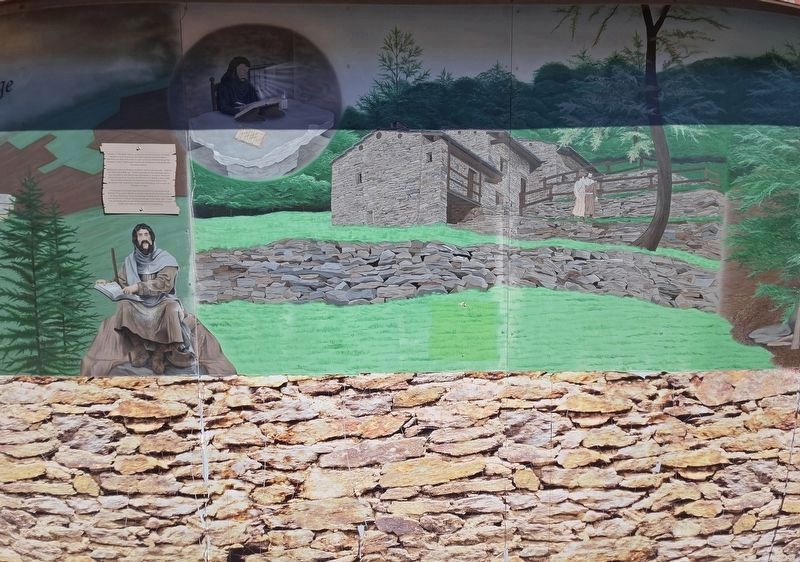
Virtually unknown to the world, Waldensians for centuries quietly lived out the Christian faith in their daily life as farmers in the obscurity of their remote and virtually inaccessible Alpine valleys. The name "Waldensian" ("Valdesi" in Italian) means "people of the valley." There they lived peacefully in small isolated hamlets, with houses tightly clustered so that every available foot of land could be used for farming.
Their lives, however, would change dramatically in the Twelfth Century, when a charismatic leader—expelled from France
Photographed by Mark Parker, March 2, 2025
4. The Waldensians Marker - wide view of panel 3
Peter Waldo and the Waldensian settlement in the Alps
(Panel 3)
Around 1173 Peter Waldo, a wealthy merchant of Lyon (France), sought a more authentic Christian experience. All copies of Scripture at that time were in Latin, and only ordained alergy had access to them. Waldo paid a priest to translate the Gospels into his native dialect.
Deeply convicted by Christ's words to the rich young ruler—"Sell all you have and

Photographed by Mark Parker, March 2, 2025
5. The Waldensians Mural (panel 4)
In that day only those ordained by the Church had authority to preach. Thus, when Waldo, a layman, ingored the Church's orders to stop preaching, he and his followers were excommunicated and exiled from France. Some took refuge in the
Photographed by Mark Parker, March 2, 2025
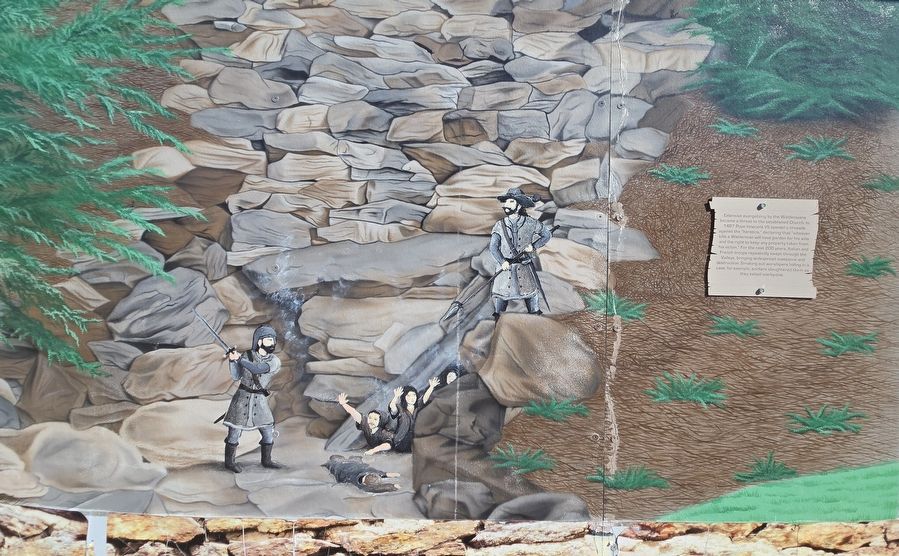
6. Wide view of panel 4 The Waldensians Marker
Depiction of the soldiers attacking Waldensian worshippers at a cave.
(Panel 4)
Extensive evangelizing by the Waldensians became a threat to the established Church. In 1487 Pope Innocent VIl opened a crusade against the "heretics," declaring that "whoever kills a Waldensian will have pardon for his sins and the right to keep any property taken from his victim." For the next 200 years, Italian and French troops repeatedly swept through the Valleys, bringing widespread massacre and

Photographed by Mark Parker, March 2, 2025
7. The Waldensians Mural (panel 5)
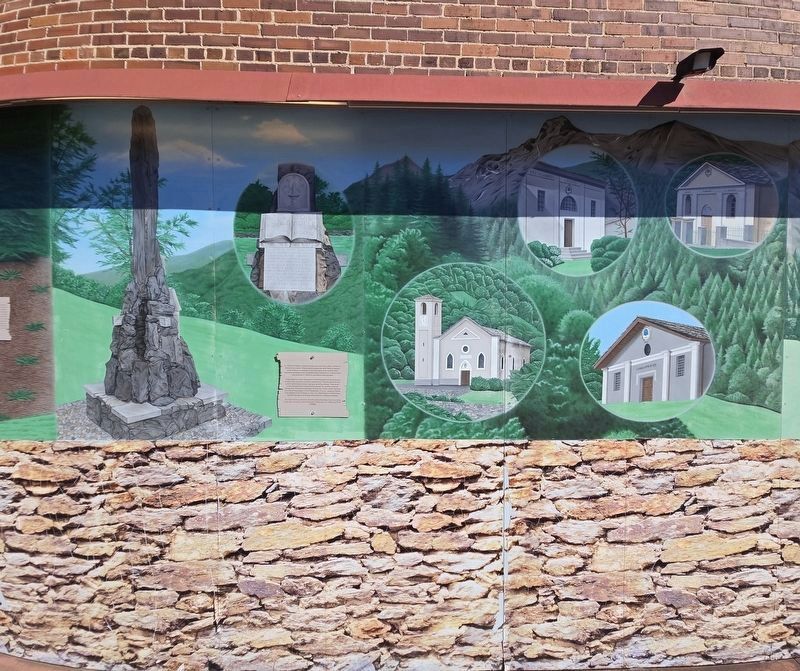
(Panel 5) In 1532 an historic milestone was reached when, after months of debate and prayer, Waldlensian barbas met with Reform leaders at Chanforan, a meadow in the Angrogna area, and formally aligned themselves with the Reformation Movement. A monument was erected in 1932 to commemorate the spot.
That alliance meant change for the Waldensians in the practice of their faith. Secrecy would be abandoned. They would worship
Photographed by Mark Parker, March 2, 2025
8. The Waldensians Marker - wide view of panel 5
Monument at Chanforan: top left shows the Waldensian emblem (candle and 7 stars and Bible). Four Waldensian temples built (clockwise from top right)
were San Lorenzo (1555); Ciabas (1555); Serre [1555); and Prali
(1556).
(At right) Among the first temples built (clockwise from top right) were San Lorenzo (1555); Ciabas (1555); Serre [1555); and Prali (1556).
(Panel 6)
In 1689

Photographed by Mark Parker, March 2, 2025
9. The Waldensians Mural (panel 6)
Among their brave pastor / commanders in the "Glorious Return" was Henri Arnaud (left).
Camped at Sibaud, near the village of Bobbio in the Pallice Valley,

Photographed by Mark Parker, March 2, 2025
10. The Waldensians Marker - wide view of panel 6
Included are scenes from the "Glorious Return" as Waldensians battled French and Italian soldiers in returning to their homeland. Leader Henri Arnaud is next to the text. The monument at Sibaud commemorates the events.
Two hundred years later a monument (above) would mark the exact spot where that oath was made, with the name of each parish chiseled into the stones.
(Panel 7)
Severe restrictions on Waldensians would ebb and flow over the years as control shifted between Italy and France. At any time, Protestants not born in the Valleys might be banished, worshìp services banned,

Photographed by Mark Parker, March 2, 2025
11. The Waldensians Marker (panel 7) - Charles Beckwith
During the years of persecution, Waldensian children were denied the privilege of attending schools and colleges. An Englishman would come to their rescue.
After Napoleon's defeat at Waterloo, General Charles Beckwith, who fought with the British in that battle, learned of the Waldensians and wanted to help them. He moved to the Valleys and, over the next 30 years, built

Photographed by Mark Parker, March 2, 2025
12. The Waldensians Marker - wide view of panel 7
Charles Backwwith and one of the Beckwith Schools built for the Waldensians
(Panel 8)
In 1844 King Charles Albert visited the Valleys and was warmly welcomed despite warnings that the Waldensians would be hostile. In appreciation for their gracious reception of him, the King ordered that a fountain be set in Torre Pellice in honor of the Waldensians. Rarely does a monarch honor his people with a monument. Usually it's the other way around!
Even more magnanimous

Photographed by Mark Parker, March 2, 2025
13. The Waldensians Marker (panel 8)
That event is one of two celebrated even today by Waldensians here and abroad, the other one being the Glorious Return to their Valleys in August of 1689.
(Panel 9)
The Waldenses are admitted to the enjoyment of all the civil and political rights of our other subjects and freely to attend our schools both within and without the university and to obtain the academic

Photographed by Mark Parker, March 2, 2025
14. The Waldensians Marker (panel 9) - Edict of Emancipation signed by King Carlo Alberto
Carlo Alberto
King of Sardina
Duke of Savoy
(Panel 10)
When the Valleys were no longer plagued by the horrendous purgings of the past, another dire problem arose overpopulation. Soon small farms had been divided among children and children's children until the land could be divided no more. With starvation imminent, the only option for survival was emigration.
Word of land available in America offered hope. Two men traveled to North Carolina

Photographed by Mark Parker, March 2, 2025
15. The Waldensians Marker - wide view panels 8 & 9
Fountain given to the Waldensians by King Carlos Alberto
Erected 2018.
Topics. This historical marker is listed in these topic lists: Religion & Religious Structures

Photographed by Mark Parker, March 2, 2025
16. The Waldensians Marker (panel 10)
Location. 35° 44.615′ N, 81° 33.822′ W. Marker is in Valdese, North Carolina, in Burke County. It is on Main Street West (U.S. 70) east of Faet Street Southwest, on the right when traveling east. The mural is at Jacumin Park. Touch for map. Marker is at or near this postal address: 137 Main St W, Valdese NC 28690, United States of America. Touch for directions.

Regionally, this marker is in North Carolina’s Mountains. It is also in the American South, specifically

Photographed by Mark Parker, March 2, 2025
17. The Waldensians Marker - wide view of panel 10
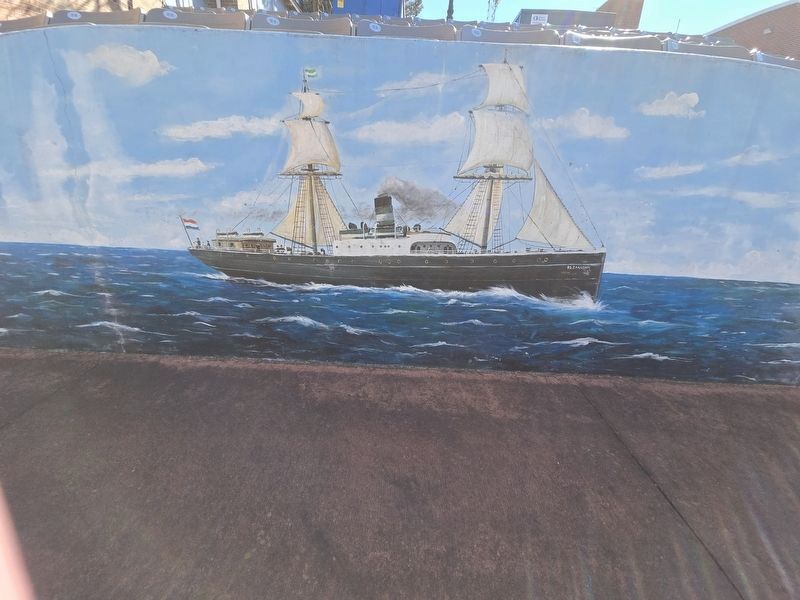
Waldensians meeting to decide who would move to Burke County in North Carolina
Other nearby markers. At least 8 other markers are within walking distance of this marker: James Madison (within shouting distance of this marker); Benjamin Franklin (within
Photographed by Mark Parker, March 2, 2025
18. The Waldensians Marker - ship sailing to the US
Also see . . . The Waldensians of Valdese, North Carolina. 2020 essay by Bethany Mace in The Clio. Excerpt:
They decided(Submitted on March 16, 2025.)to land in North Carolina because a man named Marvin Scaife had 10,000 acres of land for sale and they decided to buy it since it reminded them of their land in Italy. They came to the land they named “Valdese” on the No. 11 train. The first settlers came in May 1893 and in August, 25 more emigrants came. By November, 178 more emigrants came to Valdese to create a permanent settlement.Photographed by Mark Parker, March 2, 202519. East side of the Waldensian Mural, focusing on history in Europe up to 1893
The settlers encountered many problems in Valdese. Since the soil was mostly infertile, it was hard to farm. Also, there was a language barrier between the Waldensiansand the residents of Burke County that were there to help them. Some progress was made in farming but the most notable contributions to Valdese was industrial achievements. (2) Established in 1901, the Waldensian Hosiery Mill started the industry boom resulting in Valdese being “one of the nation’s leading hosiery manufacturing centers”.Photographed by Mark Parker, March 2, 202520. West side of the Waldensian mural, focusing on the history in Valdese, NC 1893-present


Photographed by Mark Parker, March 2, 2025
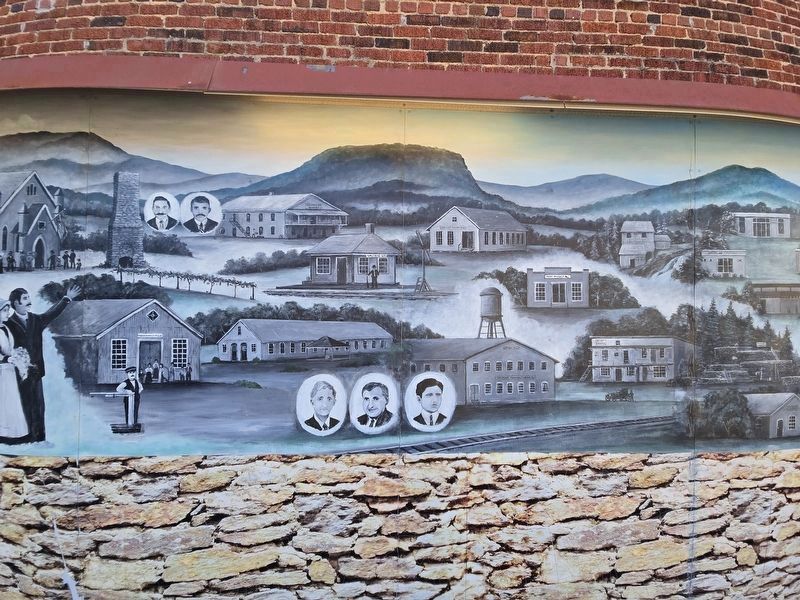
21. The Waldensians Mural West side (panel 1) village of Valdese
Scenes in the painting include initials settlers, railroad, community oven, Tron House, farming, Waldensian Presbyterian Church, first Christmas and a wedding
Photographed by Mark Parker, March 2, 2025
22. West side of Waldensians mural (panel 2)- development of businesses
Included are Waldensian Bakery, Valdese Train Depot, Valdese Manufacturing, Meat Market, Martinat Hosiery Mill, Crestline Furniture and Burke Mill

Photographed by Mark Parker, March 2, 2025
23. West side of Waldensians Mural (panel 3)
Further expansion of the town. Note the appearance of "The Twilight Zone" and Life Magazine on the right side, both of which featured an incident in which machines in the town ran backwards.

Photographed by Mark Parker, March 2, 2025
24. West side of the Waldensian mural (panel 4) government officials and buildings

Photographed by Mark Parker, March 2, 2025
25. West side of the Waldensian mural (panel 5) - Schools and educators
Schools included in the mural are Francis Garrou School (demolished in 2012), Valdese High, The Old Rock School, Valdese Public School, Valdese Elementary, Heritage Middle School, East Burke High and Draughn High

Photographed by Mark Parker, March 2, 2025
26. West side of the Waldensian mural (panel 6)
Included are various civic organizations, art groups, WSVM AM radio, Valdese News and the Valdese Public Library
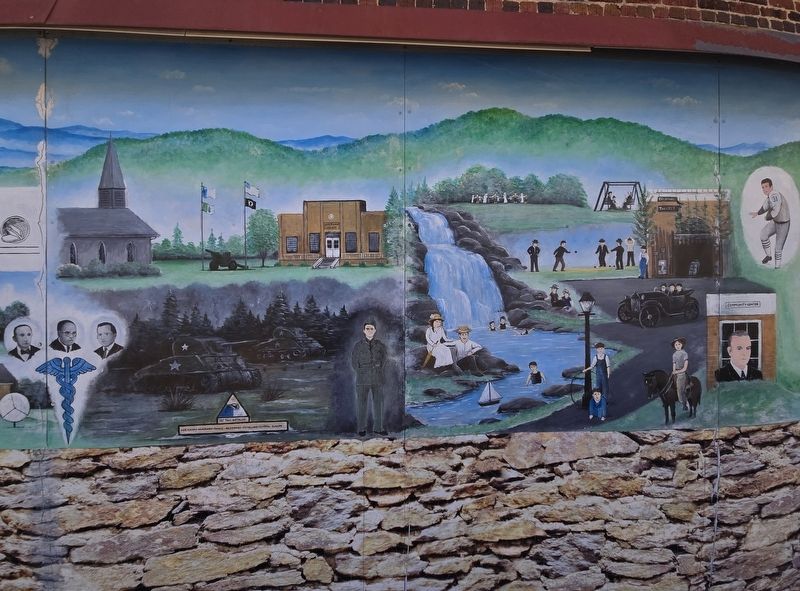
Photographed by Mark Parker, March 2, 2025
27. West side of the Waldensian mural (panel 7), militiary, physicians and recreation
Included in the panel is the local American Legion Post, a commemoration of those that served in the 737th Tank Battalion during WWII, and recreation opportunities such as McGalliard Falls and the Colonial Theater.

Photographed by Mark Parker, March 2, 2025
28. West side of the Waldensian mural (panel 8) remembering the past
Included in the panel are Waldensian Presbyterian Church and Waldensian Heritage Museum, the fountain at Centennial Park, "From This Day Forward" an annual summer play that re-creates the story of the Waldensians and The Trail of Faith.
Credits. This page was last revised on March 16, 2025. It was originally submitted on March 7, 2025, by Mark Parker of Hickory, North Carolina. This page has been viewed 250 times since then and 45 times this year. Photos: 1, 2. submitted on March 7, 2025, by Mark Parker of Hickory, North Carolina. 3. submitted on March 8, 2025, by Mark Parker of Hickory, North Carolina. 4. submitted on March 11, 2025, by Mark Parker of Hickory, North Carolina. 5. submitted on March 8, 2025, by Mark Parker of Hickory, North Carolina. 6. submitted on March 11, 2025, by Mark Parker of Hickory, North Carolina. 7. submitted on March 8, 2025, by Mark Parker of Hickory, North Carolina. 8. submitted on March 14, 2025, by Mark Parker of Hickory, North Carolina. 9. submitted on March 8, 2025, by Mark Parker of Hickory, North Carolina. 10. submitted on March 14, 2025, by Mark Parker of Hickory, North Carolina. 11. submitted on March 11, 2025, by Mark Parker of Hickory, North Carolina. 12. submitted on March 14, 2025, by Mark Parker of Hickory, North Carolina. 13, 14. submitted on March 11, 2025, by Mark Parker of Hickory, North Carolina. 15. submitted on March 14, 2025, by Mark Parker of Hickory, North Carolina. 16. submitted on March 11, 2025, by Mark Parker of Hickory, North Carolina. 17, 18, 19, 20, 21, 22, 23, 24. submitted on March 14, 2025, by Mark Parker of Hickory, North Carolina. 25, 26, 27, 28. submitted on March 15, 2025, by Mark Parker of Hickory, North Carolina. • J. J. Prats was the editor who published this page.
