South Loop in Chicago in Cook County, Illinois — The American Midwest (Great Lakes)
1936 South Michigan: Second Presbyterian Church
Photographed by Sean P. Flynn, February 28, 2025
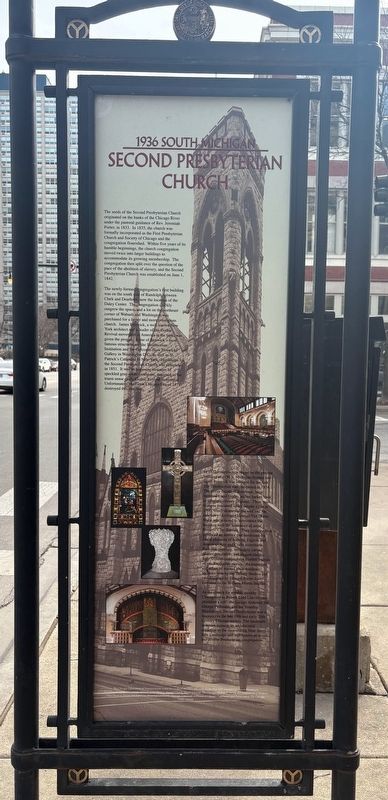
1. 1936 South Michigan: Second Presbyterian Church Marker
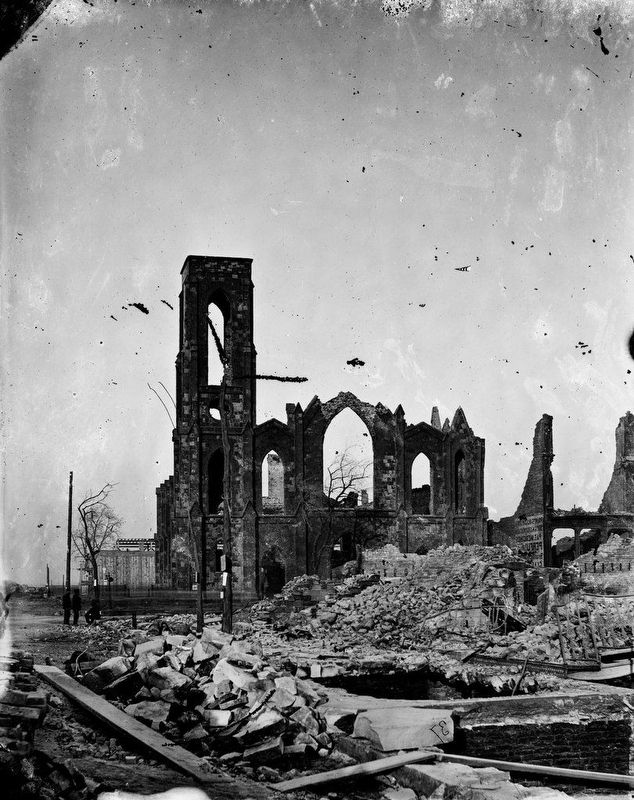
The newly-formed congregation's first building was on the south side of Randolph between Clark and Dearborn, now the location of the Daley Center. The congregation quickly outgrew the space, and a lot on the northeast corner of Wabash and Washington was purchased for a larger and more prestigious church. James Renwick, a well-known New York architect and a leader of the Gothic Revival movement in America at the time, was given the project. Some of Renwick's most famous structures are the Smithsonian Institution and the Corcoran (now Renwick) Gallery in Washington D.C., as well as St. Patrick's Cathedral in New York. His design for the Second Presbyterian Church was completed in 1851. It was an imposing structure of speckled gray-white limestone, designed in the truest sense of the Gothic Revival movement. Unfortunately, the Great Chicago Fire of 1871 destroyed this structure.
In 1872, construction began on the present building at 1936 S. Michigan Avenue and again Renwick was selected for the task. The construction was completed in 1874. The heavy façade of limestone, huge buttresses, and Gothic arches harken back to fifteenth-century England. These main features remained intact despite a fire in 1900, which destroyed the roof and
this page online
As the church for notable wealthy Chicagoans as Robert Todd Lincoln (the president's son), the George Armours, the George Pullmans, and the Timothy Blackstones, Second Presbyterian was a mainstay in the late 19th and early 20th Century Chicago society. The landmark structure remains an architectural attraction in the surrounding Near South Side Landscape and still houses an active and diverse Presbyterian congregation.
Erected by Chicago Department of Transportation.
Topics and series. This historical marker is listed in these topic lists:
Photographed by Sean P. Flynn, February 28, 2025
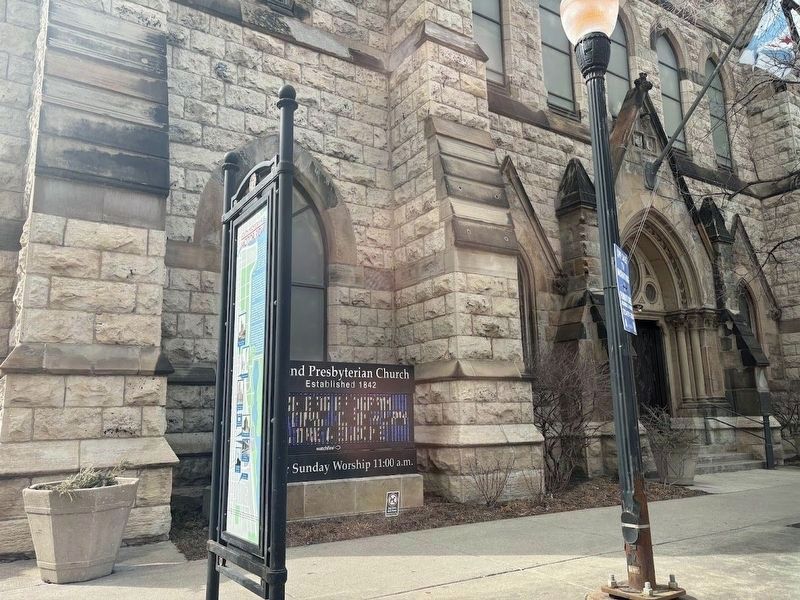
2. Marker in front of Second Presbyterian Church
Location. 41° 51.339′ N, 87° 37.439′ W. Marker is in Chicago, Illinois, in Cook County. It is in South Loop. It is at the intersection of South Michigan Avenue and Cullerton Aveue on South Michigan Avenue. The marker is in front of Second Presbyterian Church. Touch for map. Marker is at or near this postal address: 1936 South Michigan Avenue, Chicago IL 60616, United States of America. Touch for directions.

Regionally, this marker is in the American Midwest. Globally, it is in North America, on the Great Lakes, in the Western Hemisphere, in the Western World, and in the Anglosphere. Historically, it finds itself in what was once the Viceroyalty of New France, the territory of the Mississippian Culture, and the Northwest Territory.
Other nearby markers. At least 8 other markers are within walking distance of this marker: South Michigan Ave. Motor Row (here, next to
October 19, 2013
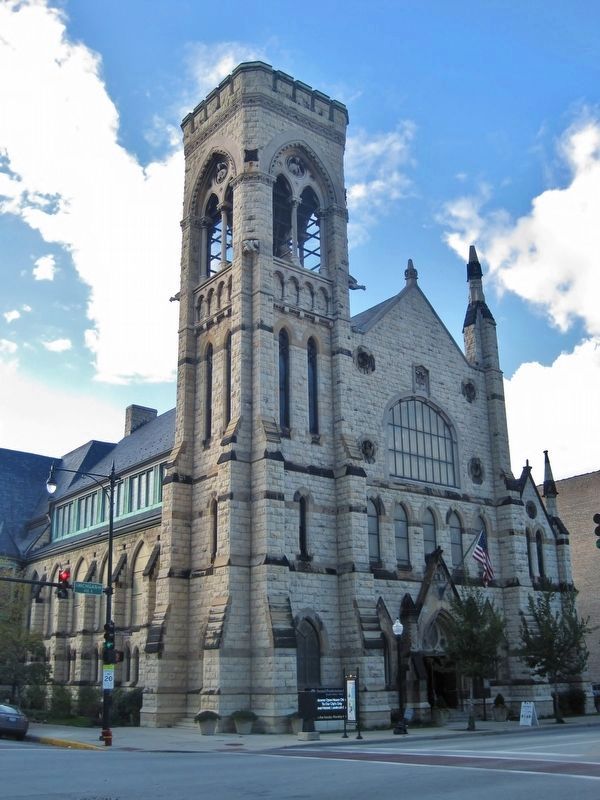
3. Second Presbyterian Church
The church was named a National Historic Landmark in 2013. This marker can be seen near the corner of the building.
More about this marker. Second Presbyterian has two markers affixed to the church itself, a few steps from this marker: one noting its designation as a National Historic Landmark, and another about its status as a Chicago Landmark.
Also see . . .
1. James Renwick, Jr., Architect of Smithsonian Buildings. From the Smithsonian Institution
Excerpt: "Renwick's prominent career also included the design of Saint Bartholomew's Church (1871–1872) in New York City, Second Presbyterian Church in Chicago, Illinois (1872–1874), and All Saints' Roman Catholic Church (1882–1893) in Harlem. These buildings, along with other Renwick structures, display Renwick's reputation as(Submitted on March 10, 2025, by Sean P. Flynn of Oak Park, Illinois.)a brave and experimental designer, who combined many different architectural traditions in order to create a new American style."Jex Bardwell; courtesy of Chicago History Museum (ICHi-177254), circa 18714. The ruins of Second Presbyterian Church after the Great Chicago FireThe original Second Presbyterian was in downtown Chicago and burned down in the Great Chicago Fire of 1871. It was rebuilt in 1874 in its current location, about 2½ miles south.
2. Second Presbyterian Church of Chicago official site. (Submitted on March 10, 2025, by Sean P. Flynn of Oak Park, Illinois.)
Credits. This page was last revised on March 10, 2025. It was originally submitted on March 10, 2025, by Sean P. Flynn of Oak Park, Illinois. This page has been viewed 153 times since then and 18 times this year. Photos: 1. submitted on March 10, 2025, by Sean P. Flynn of Oak Park, Illinois. 2. submitted on March 4, 2025, by Sean P. Flynn of Oak Park, Illinois. 3. submitted on October 21, 2013. 4. submitted on March 3, 2025, by Sean P. Flynn of Oak Park, Illinois.
