Rione X Campitelli in Roma in Città metropolitana di Roma Capitale, Latium, Rome, Italy — Central Italy (Tyrrhenian Coast)
Monumento a Vittorio Emanuele II
⎯⎯⎯
Monument to Victor Emmanuel II
Photographed by James Hulse, June 24, 2023
1. Monumento a Vittorio Emanuele II / Monument to Victor Emmanuel II Marker

Architetti: G. Sacconi, P. Piacentini, G. Koch, M. Manfredi
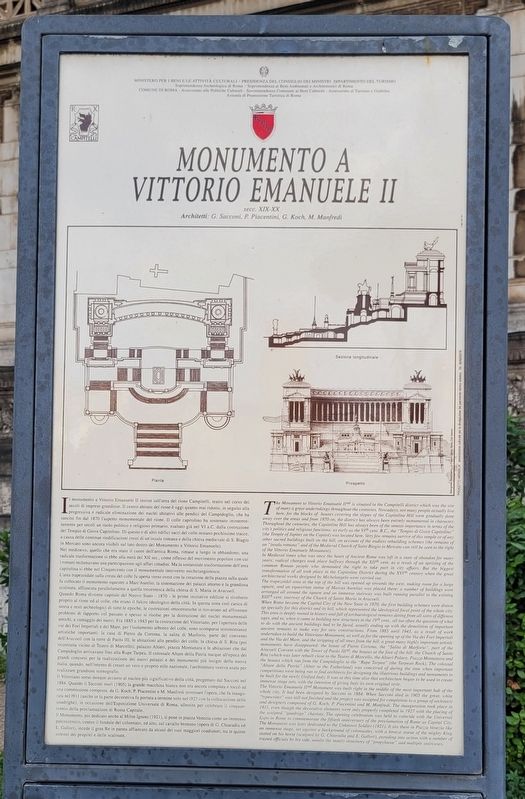
Il monumento a Vittorio Emanuele II insiste sull'area del rione Campitelli, teatro nel corso dei secoli di imprese grandiose. Il centro abitato del rione è oggi quanto mai ridotto, in seguito alla progressiva e radicale eliminazione dei nuclei abitativi alle pendici del Campidoglio, che ha sancito fin dal 1870 l'aspetto monumentale del rione. Il colle capitolino ha sostenuto ininterrottamente per secoli un ruolo politico e religioso primario, esaltato già nel VI a.C. dalla costruzione del Tempio di Giove Capitolino. Di questo e di altri edifici sacri del colle restano pochissime tracce, a causa delle continue riedificazioni (resti di un'insula romana e della chiesa medievale di S. Biagio in Mercato sono ancora visibili sul lato destro del Monumento a Vittorio Emanuele).
Nel medioevo, quello che era stato il cuore dell'antica Roma, rimase a lungo in abbandono, una radicale trasformazione si ebbe alla metà del XII sec, come riflesso del movimento popolare con cui i romani reclamavano una partecipazione agli affari cittadini. Ma la sostanziale trasformazione dell'area capitolina si ebbe nel Cinquecento con il monumentale intervento michelangiolesco.
L'area trapezoidale sulla cresta del colle fu aperta verso ovest con la creazione della piazza sulla quale fu collocato il monumento equestre a Marc Aurelio, la sistemazione dei palazzi attorno e la grandiosa scalinata, affiancata parallelamente a quella trecentesca della chiesa di S. Maria in Aracoeli.
Quando Roma divenne capitale del Nuovo Stato - 1870 - le prime iniziative edilizie si rivolsero proprio al rione ed al colle, che erano il fulcro ideologico della città. In questa zona così carica di storia e resti archeologici di tutte le epoche, le costruzioni ottocentesche
this page online
Il Vittoriano sorse dunque accanto al nucleo più significativo della città, progettato dal Sacconi nel 1884. Quando il Sacconi morì (1905) la grande macchina bianca non era ancora compiuta

Photographed by James Hulse, June 24, 2023
2. The view of the Marker along the east side of the Victor Emmanuel II Monument
Il Monumento, poi dedicato anche al Milite Ignoto (1921), si pone in piazza Venezia come un immenso palcoscenico, contro il fondale del colonnato, ed alto, sul cavallo bronzeo (opera di G. Chiaradia ed E. Gallori), incede il gran Re in parata affiancato da alcuni dei suoi maggiori coadiutori, tra le quinte solenni dei propilei e delle scalinate.
Didascalie
(Foto #1) Pianta
(Foto #2) Sezione longitudinale
(Foto #3) Prospetto
Architects: G. Sacconi, P. Piacentini, G. Koch, M. Manfredi
The Monument to Vittorio Emanuele IInd is situated in the Campitelli district which was the site of many a great undertakings throughout the centuries. Nowadays, not many people actually live here, for the blocks of houses covering the slopes of the Capitoline

Photographed by James Hulse, June 24, 2023
3. The front view of the Victor Emmanuel II Monument
In Medieval times what was once the heart of Ancient Rome was left in a state of abandon for many years; radical changes took place halfway through the XIIth cent, as a result of an uprising of the common Roman people who demanded the right to take part in city affairs. But the biggest transformation of all took place in the Capitoline District during the XVIth century when the great architectural works designed by Michelangelo were carried out.
The trapezoidal area at the top of the hill was opened up towards the west, making room for a large square, and an equestrian statue of Marcus Aurelius was placed there: a number of buildings were arranged all around the square and an immense stairway was built running parallel to the existing XIII cent, stairway of the Church of Santa Maria in Aracoeli.
When Rome became the Capital City of the New State in 1870, the first building schemes were drawn up specially for this district and its hill, which represented the ideological focal point of the whole city. This area is deeply rooted in history and full of archaeological remains dating from all sorts of different ages, and so, when it came to building new structures in the 19th cent. all too often the question of what to do with the ancient buildings had to be faced, actually ending up with the demolition of important ancient remains to make way for new constructions. From 1885 until 1943, as a result of work undertaken to build the Vittoriano Monument, as well as for the opening up of the Via dei Fori Imperiali and the Via del Mare, and the stripping of all trees from the hill, a great many highly important artistic monuments have disappeared: the house of Pietro Cortona, the "Salita di Marforio", part of the Aracoeli Convent with the Tower of Paolo III, the houses at the foot of the hill, the Church of Santa Rita (which was later rebuilt close to the Teatro di Marcello, the Altieri Palace, Piazza Montanara and the houses which ran from the Campidoglio to the "Rupe Torpea" (the Tarpean Rock). The colossal "Altare della Patria" (Altar to the Fatherland) was conceived of during the time when important competitions were being run to find architects for designing the illustrious buildings and monuments to be built for the newly Unified Italy. It was at this time also that architecture began to be used to create immense stage sets, with the intention of giving Italy its own original style.
The Vittorio Emanuele II Monument was built right in the middle of the most important hub of the whole city. It had been designed by Sacconi in 1884. When Sacconi died in 1905 the great, white "typewriter" was still not finished and the project was assigned for completion to a group of architects and designers composed of G. Koch, P. Piacentini and M. Manfredi. The inauguration took place in 1911, even though the decorative elements were only properly completed in 1927 with the placing of the sculpted quadriga chariots. The opening celebration was held to coincide with the Universal Expo in Rome to commemorate the fiftieth anniversary of the proclamation of Rome as Capital City. The Monument was later dedicated to the Unknown Soldier (1921). It sits there in Piazza Venezia like an immense stage, set against a background of colonnades, with a bronze statue of the mighty King seated on his horse (sculpted by G. Chiaradia and E. Gallori), parading into action with a number of trusted officials by his side, amidst the stately structures of "propylaea" and multiple staircases.
Captions
(Photo #1) Plan
(Photo #2) Longitudinal section
(Photo #3) Elevation
Erected by Ministry for Cultural Heritage and Activities Presidency of the Council of Ministers Ministry of Tourism Superintendency for Archaeological Heritage of Rome Superintendency for Environmental and Architectural Heritage of Rome City of Rome Municipality Superintendence for Cultural Heritage Cultural Policies Department Municipal Superintendency for Cultural Heritage Tourism Promotion of Rome.
Topics. This historical marker is listed in this topic list: Architecture. A significant historical year for this entry is 1870.
Location. 41° 53.683′ N, 12° 29.046′ E. Marker is in Roma, Lazio (Latium, Rome), in Città metropolitana di Roma Capitale. It is in Rione X Campitelli. It is at the intersection of Via dei Fori Imperiali and Via di S. Pietro in Carcere, on the left when traveling north on Via dei Fori Imperiali. The marker is located along the east side of the Victor Emmanuel II Monument. Touch for map. Marker is in this post office area: Roma, Lazio 00186, Italy. Touch for directions.

Regionally, it is in Europe, the European Union, the Schengen Area, a coastal Mediterranean country, and the Western World. Historically, it finds itself in what was once the Roman Empire.
Other nearby markers. At least 8 other markers are within walking distance of this marker: Liberazione di Roma dall'occupazione Nazifascismo / Liberation of Rome from Nazifascism (here, next to this marker); A Cinquant'anni dalla Liberazione di Roma / Fifty Years After the Liberation of Rome (a few steps from this marker); Il Vittoriano: Monumento della Celebrazione / The Vittoriano: Monument of Celebration (a few steps from this marker); a different marker also named Il Vittoriano: Monumento della Celebrazione / The Vittoriano: Monument of Celebration (within shouting distance of this marker); Foro di Traiano / Forum of Trajan (about 90 meters away, measured in a direct line); Foro di Traiano (112-113 d.C.) / Forum of Trajan (112-113 A.D.) (about 90 meters away); Strutture Medievali e Moderne (XII-XX Secolo) / Medieval and Modern Structures (12th-20th Century) (about 90 meters away); Museo Nazionale del Palazzo di Venezia / National Museum of Palazzo Venezia (about 90 meters away). Touch for a list and map of all markers in Roma.
Also see . . . Victor Emmanuel II Monument. Wikipedia
The Victor Emmanuel II National Monument (Italian: Monumento Nazionale a Vittorio Emanuele II), also known as the Vittoriano or for synecdoche Altare della Patria ("Altar of the Fatherland"), is a large national monument built between 1885 and 1935 to honour Victor Emmanuel II, the first king of a unified Italy, in Rome, Italy. It occupies a site between the Piazza Venezia and the Capitoline Hill. The monument was realized by Giuseppe Sacconi.(Submitted on March 12, 2025, by James Hulse of Medina, Texas.)
Credits. This page was last revised on March 12, 2025. It was originally submitted on March 11, 2025, by James Hulse of Medina, Texas. This page has been viewed 201 times since then and 59 times this year. Photos: 1, 2, 3. submitted on March 12, 2025, by James Hulse of Medina, Texas.
